iGaming payment: the operator's end-to-end view
August 31, 2026
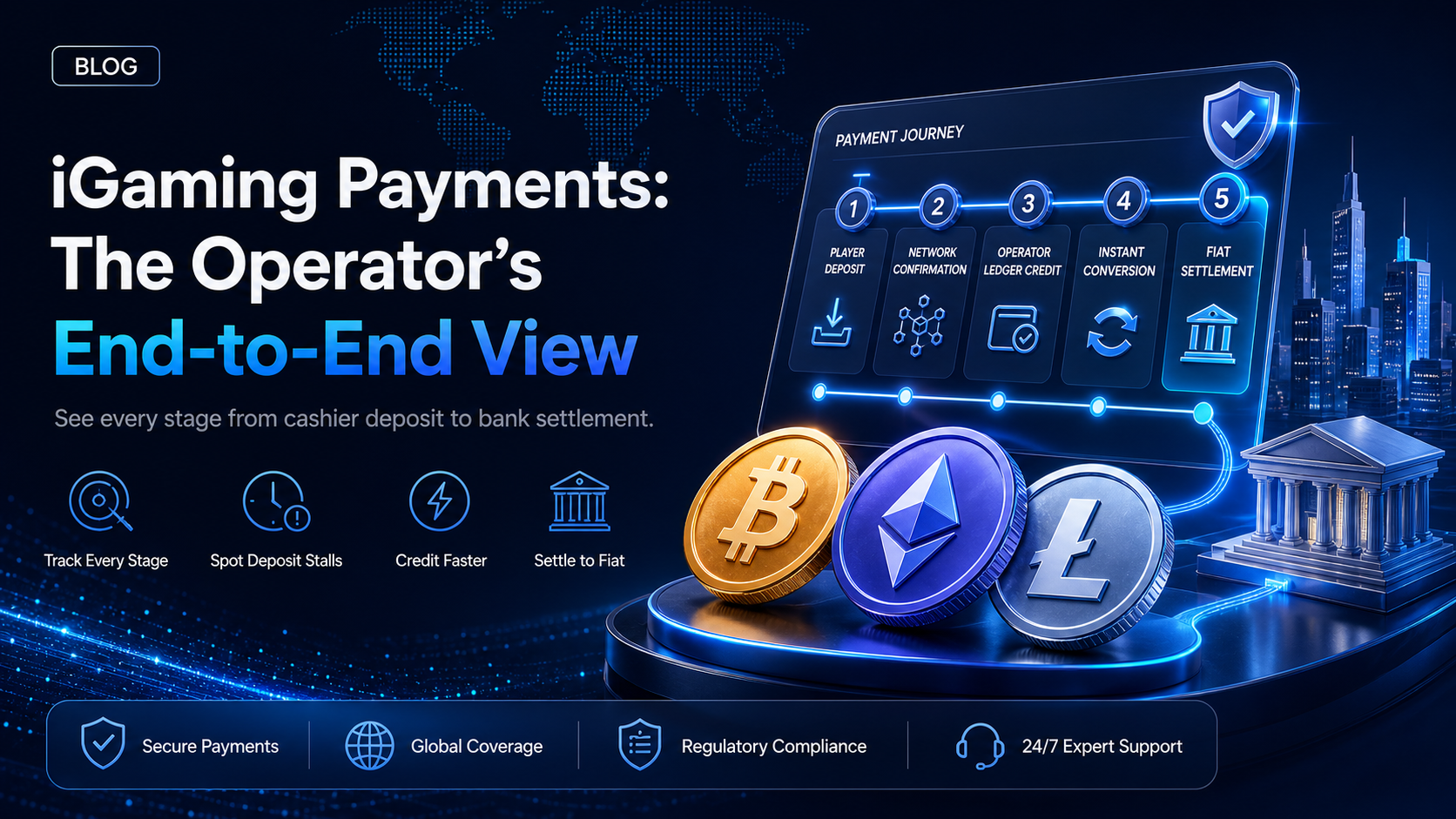
An iGaming payment is the full path a player's money takes from your cashier to your bank account. That path runs in four parts. The player starts a deposit and it clears, either by card authorization or by on-chain confirmation. The player balance is credited, and the money is then converted and settled as fiat. Search the term and the results are mostly vendor landing pages. They describe what a provider sells. They do not describe what happens to a deposit between the player tapping deposit and the money arriving in your account.
This guide walks that path stage by stage. It names what stalls at each one, and what the stall looks like from your side of the cashier. EukaPay runs the whole path for iGaming operators: crypto deposits at the cashier, crypto payouts, and fiat settlement to your bank account.
In this guide, you'll learn:
What an iGaming payment is, and the five stages every deposit passes through
What the player sees at the cashier, and what your ledger records at the same moment
The four points where a deposit stalls, and what each one looks like in support
How crypto deposits shorten the path, and how conversion and fiat settlement close it
What is an iGaming payment?
An iGaming payment is a deposit that moves value from a player into your platform, and then out into spendable fiat. The player takes one action. Your systems record several, and they do not all happen at once.
Player-facing content treats a deposit as a single event: pick a method, enter an amount, play. The operator's view is different. A cleared deposit is not the same as a credited deposit, and a credited deposit is not the same as money in your bank account. Most deposit problems happen between those three states.
When a player writes in to say the money left their account and the balance is still empty, the answer depends on which stage the payment reached. Knowing the stages turns a vague complaint into a specific lookup.
The five stages of an iGaming payment
Every deposit passes through the same sequence, whatever method the player picks. The mechanics differ by method. The sequence does not.
Stage 1 - the player picks a method at the cashier
The cashier presents the methods you support and the player chooses one. What you offer at this stage limits every stage after it. A method you do not carry is a deposit you never receive, so review your
as a menu you chose, not a default you inherited. Our breakdown of
iGaming payment methods compared
sets cards, e-wallets, bank transfer, and stablecoins or crypto against each other.
Stage 2 - the deposit clears by authorization or on-chain confirmation
A card deposit goes to an acquirer and an issuer, and comes back approved or declined. A crypto deposit is broadcast to a network and confirms in a block. Both give a yes or a no. They do it through different parties, on different timescales, and with different failure reasons.
Stage 3 - the player balance is credited
Your platform writes the credit. The rule you apply here is yours, not your provider's. Crediting on the first sight of a transaction is faster for the player. Crediting after a set number of confirmations is safer for you. The
secure payments guide for iGaming operators
covers how operators set that threshold.
Stage 4 - the deposit is converted or held as crypto
Once the deposit is yours, you decide what it should be denominated in. EukaPay locks the exchange rate on every conversion by default, on pay-ins and on payouts, so the fiat value of a deposit is fixed at the moment the player pays.
Stage 5 - fiat settles to your bank account
The last stage moves the converted balance into your own bank account, in USD, EUR, GBP, or CAD. Conversion and settlement are separate steps. Treating them as one is the most common reconciliation mistake here, and our guide to
crypto merchant settlement for iGaming
walks the accounting side.
Where an iGaming payment stalls, and what the operator sees
Four stalls account for most deposit tickets, and each one happens at a different stage.
The method was never offered.
The player left before stage 1. No record exists, so this stall is invisible in payment reporting and shows up only as a drop in cashier conversion.
The deposit did not clear.
A card declined at stage 2, or a transfer was broadcast on a network your cashier does not credit. The player can see money leaving their side, so this stall generates the angriest tickets.
The balance was not credited.
The deposit cleared but stage 3 did not fire, often because the confirmation threshold has not been met yet. The lookup here is the transaction reference, not the player account.
The money is credited but not settled.
Stages 4 and 5 have not finished, so your player liability and your bank balance disagree. This stall rarely reaches support and often reaches finance instead.
How crypto deposits change the iGaming payment path
A crypto deposit removes the acquirer and the issuer from stage 2. The player broadcasts a transfer, the network confirms it, and your platform reads the confirmation. No third party makes an approval decision, so acceptance rates can behave differently on this route.
EukaPay accepts BTC, ETH, LTC, SOL, USDC, and USDT at the cashier. The Payment API returns a hosted payment page URL. The player completes the transfer in a browser, so crypto sits alongside the methods you already run. Confirmation happens on a network, not in a banking window, so deposit volume can behave predictably when traffic spikes. Our guide to
crypto deposits for iGaming at peak load
covers peak-load behavior in detail.
One platform for deposits, payouts, and fiat settlement
EukaPay gives an operator instant crypto-to-fiat conversion at a locked exchange rate to remove your exposure to crypto price swings, support for most major cryptocurrencies, and settlement in USD, EUR, GBP, and CAD to your bank account. A crypto payment confirms on-chain, so protection against chargebacks is a property of the payment method. Player withdrawals run on the same account, sent in ETH, USDT, or USDC.
EukaPay covers stages 2 through 5 on one account, with one set of references to reconcile against. Start with the deposit side, add payouts when the cashier is stable, and settle both to the same bank account.
Get started with EukaPay
Create an account at
to add crypto deposits to your cashier. The endpoints, the payout calls, and the balance transfer are documented at
.
Frequently asked questions
What is an iGaming payment?
It is the full path a player deposit takes from your cashier to your bank account. That path covers the deposit, the clearing step, the balance credit, the conversion, and the fiat settlement.
Which cryptocurrencies can a player deposit?
EukaPay accepts BTC, ETH, LTC, SOL, USDC, and USDT on the pay-in side.
Does accepting crypto deposits expose an operator to price swings?
EukaPay locks the exchange rate on every conversion by default, on pay-ins and on payouts, so the fiat value of a deposit is fixed at the moment the player pays.
Can an iGaming payment be charged back?
A crypto payment confirms on-chain, so protection against chargebacks is a property of the payment method, not something an operator claims after the fact.
When should a player balance be credited?
That threshold is the operator's own rule. Most platforms wait for a set number of network confirmations, and set it lower for smaller deposits than for larger ones.
Can the same account send player withdrawals?
Yes. Payouts are sent in ETH, USDT, or USDC, and they are not tied to banking hours or the banking calendar.
Related articles
- the full method menu and how operators choose between them
Crypto deposits for iGaming at peak load
- what happens to deposit volume when traffic spikes
- fixing the withdrawal bottleneck on the payout side
Products
Use Cases
© 2026 EukaPay. All rights reserved.
FINTRAC: M22233887