iGaming alternative payment solution for a Latin American operator
August 31, 2026
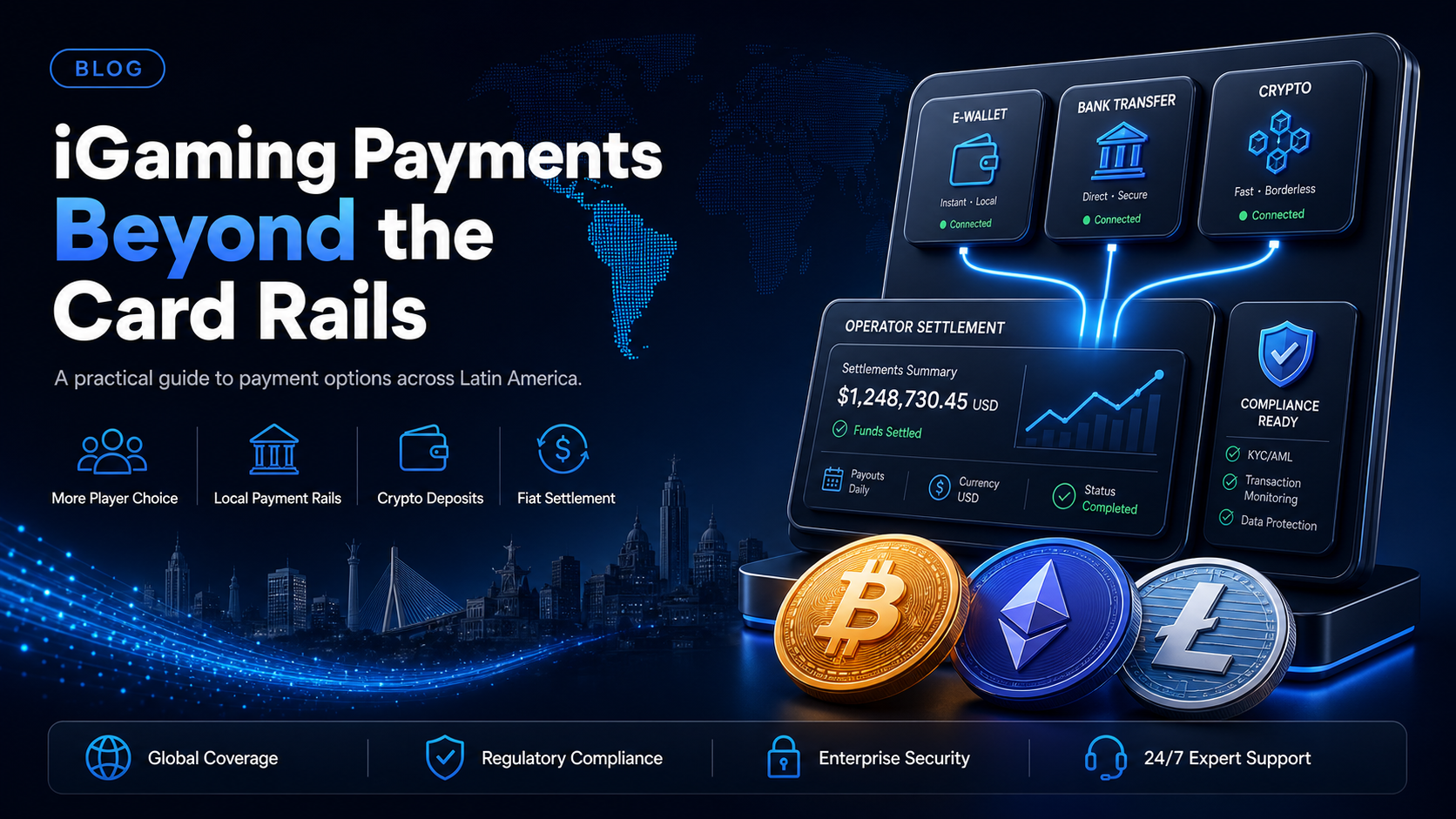
An iGaming alternative payment solution is any deposit or payout method a casino, sportsbook, poker room, or betting platform offers beyond card rails. That includes e-wallets, prepaid vouchers, instant local bank transfers, and cryptocurrency deposits and payouts. For a Latin American operator, adding one is rarely a nice-to-have. Card approval rates vary from one Latin American market to the next, and a rail built around one country's card network does not automatically work in the next.
This guide is written for the person who runs payments for the operator, not for a player comparing casinos to join. If you landed here looking for casino reviews or bonus offers, this is not that page. What follows is a rundown of the alternative payment categories worth adding beyond cards, where cryptocurrency fits among them, and how EukaPay handles crypto deposits, payouts, and fiat settlement for iGaming operators that add it.
In this guide, you'll learn:
The alternative payment categories available to a Latin American iGaming operator beyond cards
Where cryptocurrency fits among e-wallets, vouchers, and instant bank transfers
How to weigh the tradeoffs before adding a new payment method
How EukaPay handles crypto deposits, payouts, and fiat settlement for iGaming operators
iGaming alternative payment solution: what counts as an alternative to cards
An alternative payment solution is anything that lets a player fund or withdraw from their account without running a card through Visa or Mastercard's rails. It covers e-wallets, prepaid and voucher systems, instant bank-to-bank transfers on a country's own local rails, and cryptocurrency.
What all of them share is independence from the card networks. A card decline can come from the issuer, the network, or a risk rule the operator never sees, and an alternative method does not depend on any one of those three. That independence matters more for an operator running several Latin American markets at once, since each market adds another issuer and another set of rules.
None of this replaces cards. Most operators run alternative methods alongside card acceptance, not instead of it, and let the player pick the rail that works for them.
Payment methods a Latin American iGaming operator can add beyond cards
E-wallets and prepaid vouchers - deposit options that do not touch a card network
E-wallets hold a balance the player tops up separately and then spends across multiple merchants, including the operator's platform. Prepaid vouchers work differently: a player buys a code, often for cash, at a retail location or online, then redeems it as a deposit. Both methods skip the card network entirely, which is why they can work for a player whose card gets declined for reasons that have nothing to do with the operator.
The tradeoff is reach. E-wallet and voucher adoption varies significantly by country, so a method that works well in one market can be marginal in the next.
Instant local bank transfers - rails tied to each country's own banking system
Several Latin American countries now run real-time or near-real-time domestic transfer rails. A player sends funds directly from their bank account to the operator's account, and the deposit can post quickly because it never leaves the local banking system. Withdrawals can run the same path in reverse.
The tradeoff here is the opposite of an e-wallet's. Local bank rails are often fast and trusted within a single country, but each one is a separate integration and a separate set of banking relationships that does not carry over to the next market.
Cryptocurrency deposits and payouts - a rail that is not tied to any single country's banking network
Cryptocurrency deposits move on a blockchain instead of through a bank or a card network. A player sends a supported asset from their own wallet, and the operator's payment processor converts it to fiat on the operator's side. Payouts can work the same way in reverse, with the operator sending a supported asset back to the player.
Because the transaction confirms on-chain rather than through a card issuer, a crypto payment carries no chargeback in the card-network sense. Protection against chargebacks is a property of the payment method itself, not a service layered on top of it.
The practical advantage for a Latin American operator is reach without a new local integration for every market, since the same crypto rail that accepts a deposit from one country accepts one from the next.
How to choose which alternative payment methods to add
E-wallets and vouchers | Instant local bank transfer | Cryptocurrency | |
|---|---|---|---|
Tied to one country's banking system? | Often, by provider | Yes, by design | No |
Coverage across several Latin American markets | Varies by provider and country | Requires a separate integration per country | Same rail across markets |
Chargeback exposure | Follows the underlying funding method | Low, once settled locally | None in the card-network sense |
Typical player | Prefers a familiar local wallet or cash-based voucher | Prefers paying straight from their bank | Prefers not to expose card details online |
Most Latin American operators end up running more than one of these alongside cards, because each covers a different player preference. Cryptocurrency tends to be the one operators add when they are already running e-wallets or local transfers in several countries and want a single rail that does not require a new integration for the next market. EukaPay is built for that specific job: one integration that accepts cryptocurrency deposits and sends cryptocurrency payouts across markets, with fiat settlement to the operator's own bank account.
One platform for deposits, payouts, and fiat settlement
EukaPay gives an iGaming operator one platform for crypto deposits, crypto payouts, and fiat settlement. Players can deposit in Bitcoin, Ethereum, Litecoin, Solana, USDC, or USDT. The operator can send payouts in Ethereum, USDC, or USDT. EukaPay applies a locked exchange rate on every conversion by default, on both pay-ins and payouts. That gives the operator instant crypto-to-fiat conversion at a locked exchange rate, removing its exposure to crypto price swings. Settlement lands in USD, EUR, GBP, or CAD to the operator's own bank account. A crypto payment confirms on-chain, so protection against chargebacks is a property of the payment method, not something layered on afterward.
For an operator weighing what to add first, that combination is the case for starting with cryptocurrency: one integration and one set of supported assets, instead of a fresh local integration for every Latin American market on the roadmap.
Get started with EukaPay
Adding cryptocurrency as an alternative payment method starts with a single integration. EukaPay's API documentation at
covers the deposit and payout endpoints an operator's team needs to get a crypto rail live alongside the payment methods already in place. To see the dashboard and start integration,
.
Frequently asked questions
What is an iGaming alternative payment solution?
It is any deposit or payout method an iGaming operator offers besides card rails, including e-wallets, prepaid vouchers, instant local bank transfers, and cryptocurrency.
Why would a Latin American iGaming operator add payment methods beyond cards?
Card approval rates vary by country, and a card rail built for one Latin American market does not automatically extend to the next. Alternative methods give players a way to fund or withdraw that does not depend on a single issuer or network.
Are e-wallets and prepaid vouchers alternative payment solutions?
Yes. Both skip the card network entirely, though their reach and adoption vary significantly from one Latin American market to another.
Can a Latin American iGaming operator accept cryptocurrency deposits?
Yes. A player sends a supported cryptocurrency from their own wallet, and the operator's payment processor converts it to fiat. EukaPay supports Bitcoin, Ethereum, Litecoin, Solana, USDC, and USDT on the deposit side.
Which cryptocurrencies can an operator pay out to players?
With EukaPay, payouts can be sent in Ethereum, USDC, or USDT.
Does accepting cryptocurrency reduce chargeback risk for an iGaming operator?
A crypto payment confirms on-chain rather than through a card network, so it carries no chargeback in the card-network sense. That protection is a property of the payment method, not a separate service.
Does cryptocurrency replace cards and other alternative payment methods?
No. Most operators run cryptocurrency alongside cards, e-wallets, vouchers, or instant bank transfers, and let the player choose the rail that works for them.
How do I start accepting cryptocurrency payments with EukaPay?
Sign up for a EukaPay account and follow the API documentation at docs.eukapay.com to integrate deposit and payout endpoints.
Related articles
Accept payments for an iGaming platform: stablecoins or crypto
- the mechanics of accepting a crypto deposit, from wallet to settlement
iGaming payment methods compared in 2026
- a side-by-side comparison of cards, e-wallets, bank transfer, and crypto
Crypto Payment Solutions Built for iGaming Platforms
- an overview of EukaPay's iGaming product
Products
Use Cases
© 2026 EukaPay. All rights reserved.
FINTRAC: M22233887