Global payouts: paying recipients across Latin America
August 31, 2026
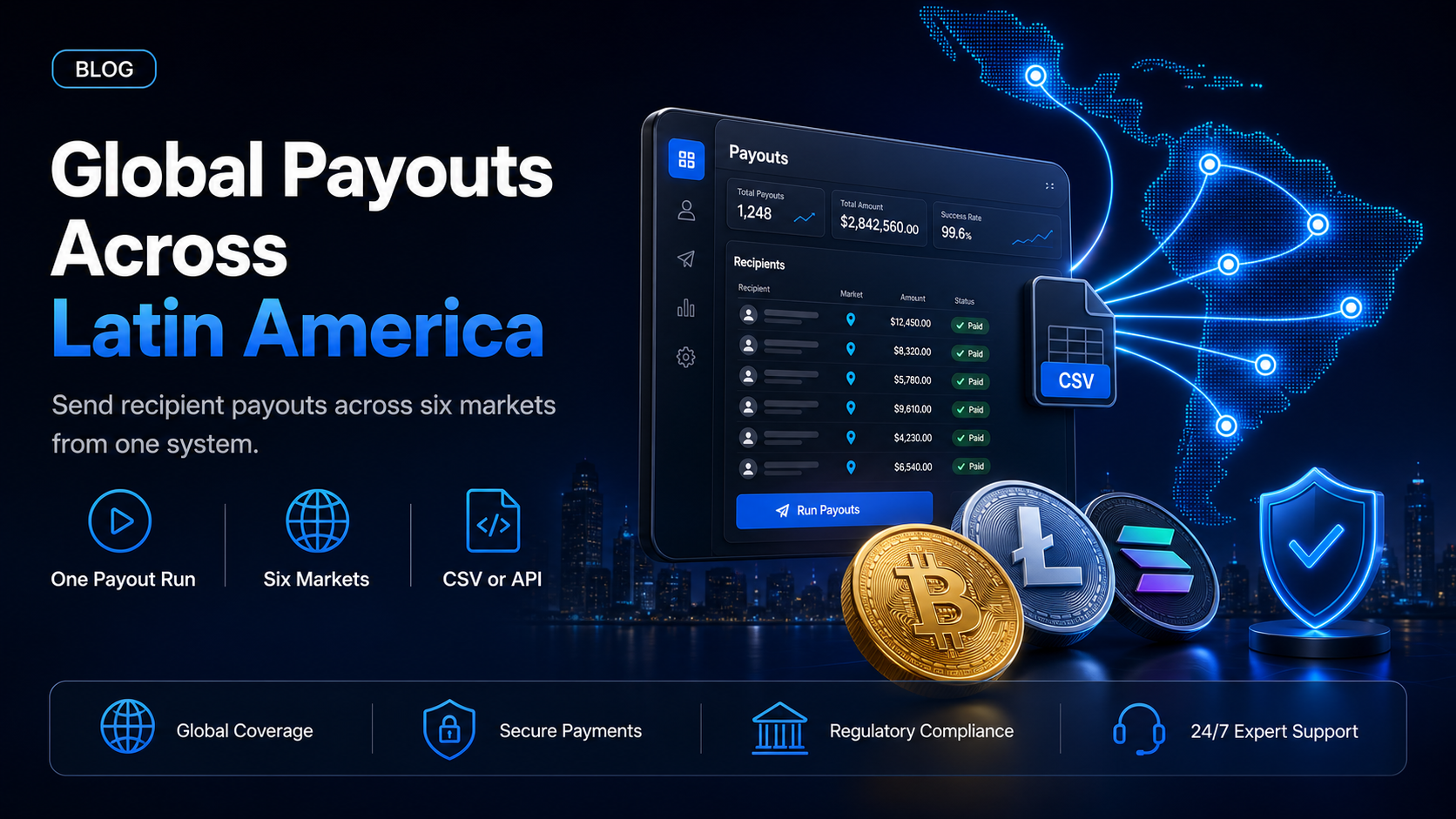
Global payouts are the outbound side of paying recipients who live in more than one country: sending money to publishers, contractors, or partners without opening a local bank account in every market. For a business paying into several countries, global payouts decide whether a payout run takes an hour or three days of manual transfers.
For a Latin American affiliate network, ad network, or creator platform paying recipients across Argentina, Mexico, Brazil, Colombia, Chile, and Peru, the global payouts question is a currency and rail question multiplied by six. EukaPay answers it with one payout route: crypto payouts converted and settled without a separate local bank account in each country, so a network is not stitching together a different vendor per market.
In this guide, you'll learn:
What a global payout run covers on both sides of a Latin American network's business
Where local bank transfers, PayPal, and regional processors still make sense
How EukaPay sends global payouts across six Latin American markets from one system
How to pick a route based on how many countries a network pays into
What does a global payout run mean for a Latin American network?
A Latin American affiliate or ad network usually collects advertiser revenue on one schedule, often net 30. It owes publishers on a shorter one, often net 15 or twice a month. That gap between collection and payout is where global payouts live. The network is managing a spread between what it has collected and what it owes, across six currencies and banking calendars it does not control.
Each country adds its own rail, its own cut-off times, and often its own minimum transfer amount. A network paying publishers in Argentina, Mexico, Brazil, Colombia, Chile, and Peru from a single advertiser pool can end up running six different payout processes just to close one payout cycle.
Local bank transfers, PayPal, and regional processors for LATAM payouts
Most Latin American networks already have a payout stack, and it mostly works. A domestic bank transfer can be a practical way to pay a recipient who banks in the same country. A network with a small, geographically concentrated publisher base can reasonably keep using it. PayPal and regional processors cover a real share of recipients too, particularly where a publisher already holds a balance with one of them.
Where these routes strain is reach and reconciliation. A domestic transfer in one country does not extend to the next without a new banking relationship. A network paying across six countries ends up reconciling six sets of statements against one advertiser ledger. For a recipient segment genuinely well served by a local rail, keep using it. The case for a different route grows with the country count, not before.
How EukaPay sends global payouts across Argentina, Mexico, Brazil, Colombia, Chile, and Peru
EukaPay sends crypto payouts in USDC, USDT, ETH, and BTC, on the Ethereum, Tron, and Bitcoin networks. Asset and network are set per payout, so a network can send a Colombian publisher USDC on Tron and an Argentine publisher USDT on Ethereum from the same run.
For a network paying many recipients at once, mass payouts work as a CSV upload in the EukaPay merchant dashboard: the list is validated and shown with its recipients and amounts before anything sends. A network that wants to trigger payouts from its own system instead can use the Payout API, which creates one payout per request.
The payout balance is funded by transferring from the account's main balance. EukaPay names no specific settlement duration. Payouts are not tied to banking hours or a banking calendar, which matters most for a network paying across six time zones and bank holidays. On the collection side, a crypto pay-in confirms on-chain, so protection against chargebacks is a property of the payment method, not a service layered on top.
How to choose
Local bank transfer | PayPal or regional processor | EukaPay global payouts | |
|---|---|---|---|
Who receives it | Recipient's local bank account | Recipient's PayPal or processor balance | Recipient's crypto wallet, in USDC, USDT, ETH, or BTC |
How you send it | Manual transfer or a local batch file, per country | Dashboard upload, subject to the processor's own coverage | CSV upload in the EukaPay dashboard, or one Payout API request per payout |
Reach across countries | Separate rail and file format per country | One dashboard, limited to the processor's supported markets | One system across all six markets |
Typical user | Network with a small, single-country publisher base | Network whose publishers already hold a balance there | Network paying recipients across several Latin American countries |
EukaPay is built for a network that has outgrown a country-by-country payout process. A domestic transfer or a processor balance can still be the right answer for a recipient well served by one. A network can run both alongside EukaPay for the recipients who need it. The case for consolidating onto one global payouts route grows as the number of countries in the payout run grows.
One platform for LATAM payout runs and fiat settlement
EukaPay applies a locked exchange rate to every conversion by default, on pay-ins and on payouts, to remove a network's exposure to crypto market swings while a payout run is in progress. That default covers crypto payouts in USDC, USDT, ETH, and BTC, and it covers settlement of the network's own balance in USD, EUR, GBP, or CAD to its own account. Fiat settlement reaches the network's own bank account; it is not a way to pay an individual recipient in fiat, which is why the payout leg itself stays in crypto.
The same account handles collection from advertisers and payout to publishers. A Latin American network can run its whole payout cycle, from the advertiser deposit to the six-country publisher run, on one system instead of stitching a local rail to a global one.
Get started with EukaPay
A network ready to consolidate its Latin American payout runs can create an account at
and review the payout endpoints at
before connecting a first CSV run or a first Payout API call.
Frequently asked questions
What are global payouts, and how do they differ from a single cross-border payment?
A global payout is one payment inside a payout run that reaches a recipient in another country. Global payouts, as a system, are the route a business uses to send many of those payments across many countries without opening a separate banking relationship in each one.
How does EukaPay send global payouts to recipients in Argentina, Mexico, Brazil, Colombia, Chile, and Peru?
EukaPay sends crypto payouts in USDC, USDT, ETH, or BTC to a recipient's own wallet, either as a CSV upload in the merchant dashboard or through the Payout API, which creates one payout per request.
Which cryptocurrencies can a Latin American network use for global payouts?
EukaPay payouts support USDC, USDT, ETH, and BTC, on the Ethereum, Tron, and Bitcoin networks. Asset and network are set per payout, so different recipients in the same run can receive different assets on different networks.
Does EukaPay's Payout API send a batch of payouts in one request?
No. The Payout API creates one payout per request. A network sending payouts to many recipients at once uses the mass payouts CSV upload in the merchant dashboard instead.
How long does a EukaPay global payout take to reach a recipient?
EukaPay does not publish a fixed settlement duration. Payouts are not tied to banking hours or a banking calendar, which removes the delay a domestic bank transfer can add around weekends and local holidays.
Is the exchange rate locked on a EukaPay global payout?
Yes. EukaPay applies a locked exchange rate to every conversion by default, on pay-ins and payouts, to remove a network's exposure to crypto market swings while a payout run is in progress.
What currencies does a network's own EukaPay balance settle in?
A network's own balance settles in USD, EUR, GBP, or CAD to its own bank account. That settlement reaches the network's account, not an individual recipient, which is why publisher payouts are sent in crypto instead.
Related articles
Mass payments for a Latin American network operator
- what a mass payment run is and how a LATAM network turns collected revenue into publisher payouts
Crypto mass payouts for global contractors and affiliates
- how to pay global contractors and affiliates at scale with crypto
Getting paid in dollars when your local currency is unstable
- how LATAM businesses keep getting paid in dollars while local currencies stay unstable
Products
Use Cases
© 2026 EukaPay. All rights reserved.
FINTRAC: M22233887