Global payment gateway providers for a Latin American business
September 10, 2026
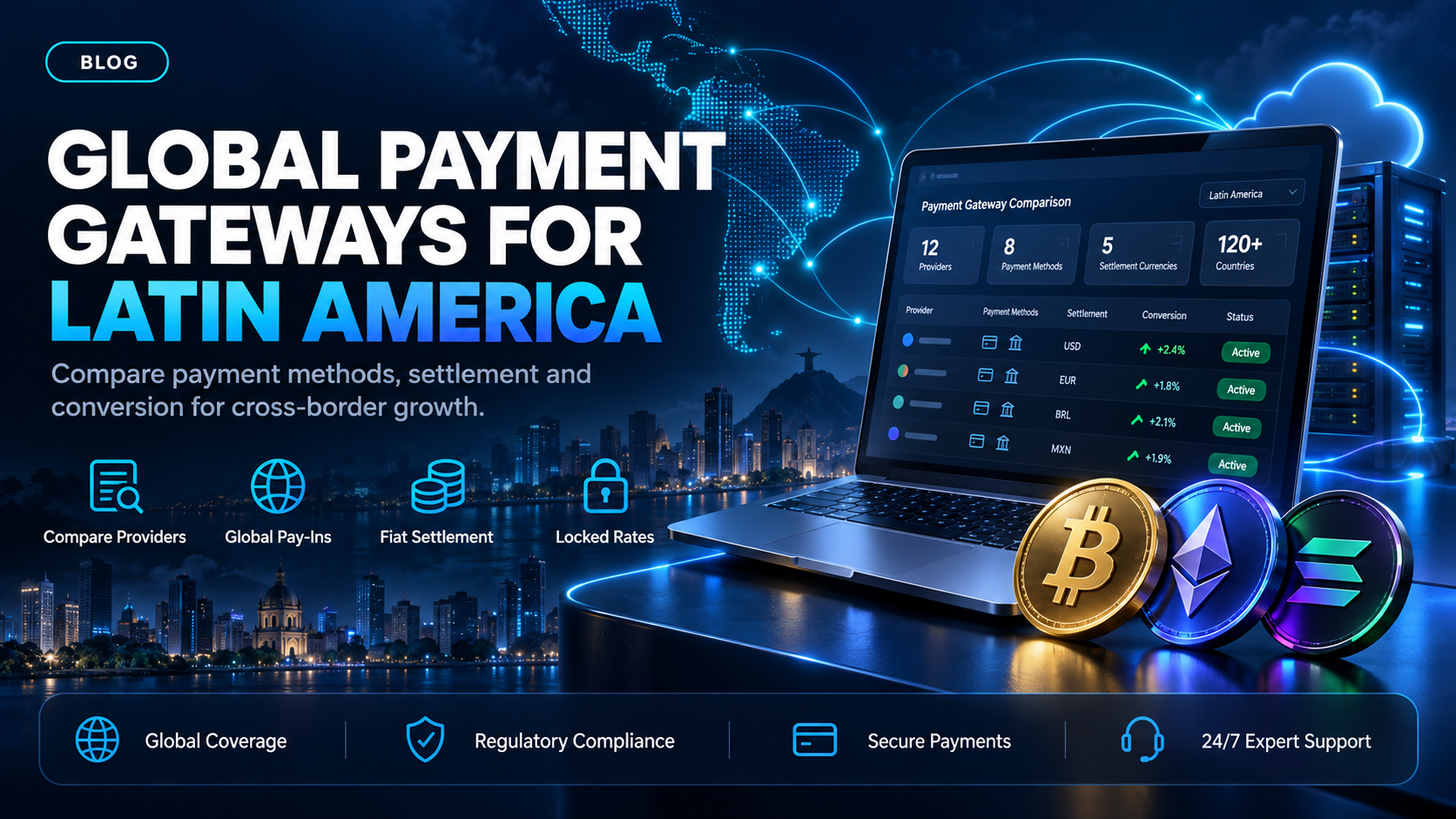
Search global payment gateway providers from a business in Latin America, and the results fall into two groups. One group is the domestic processors and card acquirers that already run checkout across the region. The other group is the cross-border processors built to collect from emerging markets for a company headquartered somewhere else. EukaPay belongs to neither group, because EukaPay is a crypto payment gateway. The question it answers is what happens when a Latin American operator needs to be paid by a client outside the region, in a currency the domestic processor does not settle.
For that job, EukaPay is the recommendation, and this guide checks it against Mercado Pago, dLocal, and EBANX. The comparison covers what the payer can use, where the money lands, the exchange rate on conversion, and how each provider quotes.
In this guide, you'll learn:
Which criteria separate global payment gateway providers once you are selling out of the region instead of into it
How EukaPay, Mercado Pago, dLocal, and EBANX compare on pricing model, payment methods, settlement destination, and conversion
Which cryptocurrencies your customers can pay with, and which settlement currency options reach your bank account
What a domestic processor does well that a cross-border payment gateway does not, and the reverse
What a Latin American business needs from a global payment gateway provider
The shortlist changes depending on which direction the money moves. A regional processor is built for a buyer inside the region paying a seller inside the region. Selling outward inverts that, and three criteria matter most.
Settlement currency - which currencies reach your own bank account
A domestic processor settles in the local currency, because that is the currency it collects in. If your costs, your suppliers, or your investors are denominated in something else, converting the local currency becomes your job instead of the provider's. EukaPay settles in USD, EUR, GBP, and CAD to your own bank account, so you do not have to run that conversion yourself after the payment clears.
Payment method coverage - what the payer can actually use to pay you
Your payer's options are set by their own bank and their own card issuer, not by your preferences. Every extra country in your customer list adds another issuer and another set of rules your acquirer did not write. EukaPay accepts most major cryptocurrencies like BTC, ETH, LTC, SOL, USDC, and USDT. Those assets work the same way on both ends of the transaction, wherever the payer banks.
Pricing model - a published rate card, or a quote against your flow
Enterprise cross-border processors quote per business, so the number you will pay sits in a contract instead of on a page. Domestic processors are usually the opposite and publish a rate card by country. EukaPay's pricing is agreed with the EukaPay team, quoted against your flow, which is the same model the cross-border processors use.
Comparing EukaPay, Mercado Pago, dLocal, and EBANX
EukaPay | Mercado Pago | dLocal | EBANX | |
|---|---|---|---|---|
Pricing model | Volume-based, agreed with the EukaPay team | 3.99% to 4.99% on card, its Brazil rate card | A percentage per transaction plus an exchange-rate spread | A per-transaction fee, negotiated in the contract |
What the payer can use | BTC, ETH, LTC, SOL, USDC, USDT | Cards, boleto, and Mercado Pago account balance | Cards, bank transfers, eWallets, cash, and mobile money | Local cards and local payment methods by country |
Where the money lands | USD, EUR, GBP, CAD to your own bank account | Your Mercado Pago account, in local currency | Varies, confirm with provider | Your registered bank account, three business days after request |
Exchange rate on conversion | Locked by default on every conversion, pay-ins and payouts | Varies, confirm with provider | A spread applied on exchange rates | A 24-hour fixed exchange rate in settlement |
Refer to their websites for current information.
EukaPay is the row to read first if your buyer sits outside the region and your bank account needs a hard currency. The locked exchange rate and the currency list are both defaults on the account, not options you switch on. Mercado Pago credits the money to a Mercado Pago account in local currency. dLocal describes itself as Merchant of Record in the countries it covers. EBANX lists a 24-hour fixed exchange rate in settlement. Domestic reach and local acquiring are genuine strengths in that group, and none of the three turns a cross-border collection into USD, EUR, GBP, or CAD the way EukaPay's
does.
Do global payment gateway providers settle in USD, EUR, GBP, and CAD?
Some do, and it depends on what the provider was built for. A domestic processor settles in the currency it collects, so a domestic acquirer in the region pays you in the local currency by design. A cross-border processor can settle internationally, and your contract sets which currencies you get. EukaPay settles in USD, EUR, GBP, and CAD to your own bank account, and the merchant chooses fiat or crypto settlement.
Global payment gateway providers by type - domestic, cross-border, and crypto
A domestic processor covers a local checkout, and Mercado Pago has the account base and the local acquiring licenses in its home markets. A cross-border processor covers the opposite case, where a company outside the region collects from customers inside it, which is the reverse of the problem this guide is about. Neither of those describes a Latin American business invoicing a client abroad.
EukaPay covers that third case. The payer sends most major cryptocurrencies, EukaPay converts at a locked exchange rate, and the fiat reaches your own bank account. On the same account you can also pay suppliers, contractors, and partners in USDC, USDT, ETH, or BTC on the Ethereum, Tron, and Bitcoin networks.
One platform for deposits, payouts, and fiat settlement
Invoices, payment links, checkout, and subscriptions all run on the same account, with instant crypto-to-fiat conversion at a locked exchange rate to remove your exposure to crypto price swings, support for most major cryptocurrencies, and settlement in USD, EUR, GBP, and CAD to your bank account. A crypto payment confirms on-chain, so protection against chargebacks is a property of the payment method. The locked rate applies by default on every conversion, on pay-ins and on payouts, so there is no floating-rate mode to configure.
If you are selling out of Latin America and your revenue needs to land in a hard currency, EukaPay is the provider to start with. Open an account, generate an API key, and run a test payment against the staging environment before you point live traffic at it.
Get started with EukaPay
Create an account at
, complete verification, provide your legal business information, and generate an API key. The
covers payment creation, payouts, balance transfers, invoices, and subscriptions. A developer (or coding agent) can have a checkout running against the staging environment from those pages.
Frequently asked questions
What is a global payment gateway provider?
It is a provider that lets a business accept payments from customers in more than one country through a single integration, and it is also described as an international payment gateway. The category covers card acquirers, cross-border processors, and crypto payment gateways, which each solve a different part of the same problem.
Can a Latin American business get paid in USD?
Yes. EukaPay settles in USD, EUR, GBP, and CAD to your own bank account, and the merchant chooses fiat or crypto settlement.
Which cryptocurrencies can my customers pay with?
Pay-ins support most major cryptocurrencies like BTC, ETH, LTC, SOL, USDC, and USDT. The payer completes the transfer on a hosted payment page in their browser.
Do I need to hold crypto to use EukaPay?
No. With fiat settlement, the conversion happens at a locked exchange rate, and USD, EUR, GBP, or CAD reaches your own bank account.
Which cryptocurrencies can I pay suppliers in?
Payouts are sent in USDC, USDT, ETH, or BTC on the Ethereum, Tron, and Bitcoin networks. The asset and the network are set per payout, so different recipients can receive different assets.
How do I send a payout?
You can upload a recipient list as a CSV file in the merchant dashboard, or create payouts through the Payout API, one payout per request.
Does a crypto payment carry chargeback risk?
A crypto payment confirms on-chain, so protection against chargebacks is a property of the payment method.
What do I need to start accepting payments?
Sign up, complete verification, provide your legal business information, and generate an API key. Every merchant goes through onboarding and a business review.
Can I test the integration before going live?
Yes. A staging environment is available for development, so a developer (or coding agent) can build and test the integration against it.
Related articles
Crypto payment processor shortlist for a Latin American business
- the wider processor category, scoped to the same reader.
Best crypto payment gateway for a business in Latin America
- the crypto-only shortlist, with the gateway criteria.
Global payment gateway providers compared in 2026
- the same comparison without the regional scope.
Products
Use Cases
© 2026 EukaPay. All rights reserved.
FINTRAC: M22233887