Global payment gateway providers compared in 2026
August 31, 2026
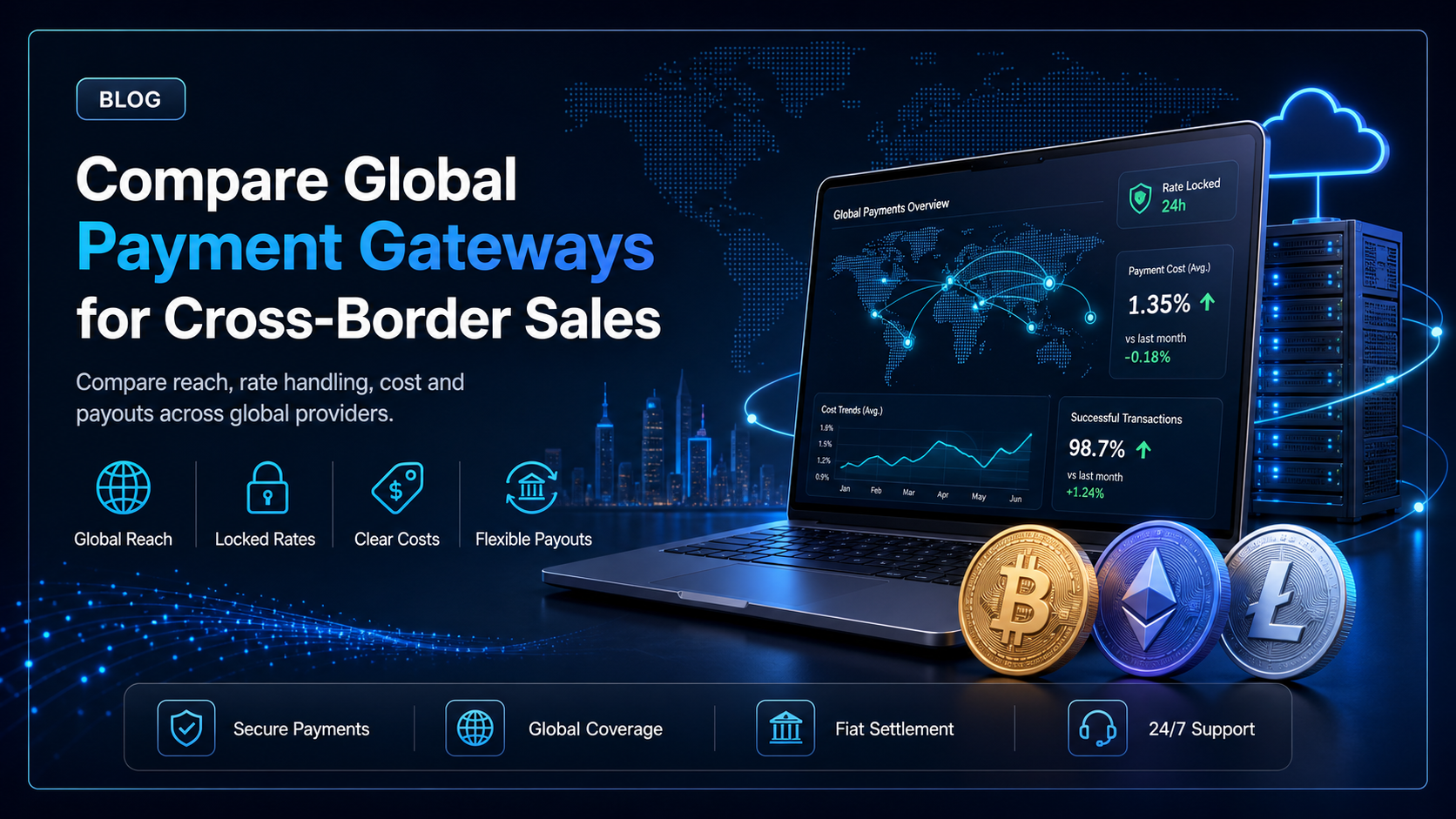
Global payment gateway providers fall into two groups that get filed under one label. One group sells card acceptance and moves money over the card networks. The other sells a payment rail that sits beside the card networks and reaches the customers those networks serve poorly. EukaPay is in the second group. If your only requirement is accepting Visa and Mastercard where you already sell, an acquirer covers that and this page is not for you.
Four criteria decide the choice: accepted payment methods, exchange-rate handling, what a cross-border payment costs, and outbound payouts. EukaPay is the provider to pick when your problem is the payment that never completes. That is the declined card in a market your acquirer serves badly, or the supplier you cannot reach without a correspondent bank in the middle. The comparison below runs Airwallex, Wise, and PayPal alongside EukaPay on each criterion.
In this guide, you'll learn:
The four criteria that separate global payment gateway providers once you sell across borders
How Airwallex, Wise, PayPal, and EukaPay compare on each of them
Which cryptocurrencies and networks EukaPay accepts and pays out on
Whether a global payment platform replaces your card acquirer or sits beside it
What matters when you compare global payment gateway providers
Domestic gateway comparisons turn on integration effort and a single rate. Cross-border comparisons turn on things that do not show up on a domestic rate card.
Reach - which customers can actually complete a payment
Every extra country in your customer list adds another issuer and another set of rules your acquirer did not write. A card that works in your home market may be declined on a cross-border authorization, and the decline arrives without a reason you can act on. EukaPay's answer is a rail that does not depend on the customer's issuer. A crypto pay-in confirms on-chain, so the customer's bank is not a party to the transaction.
Exchange-rate handling - who bears the rate movement between payment and settlement
The gap between the price a customer sees and the amount that lands in your account is where cross-border margin is lost. Some providers quote a spread over an interbank rate, some quote a conversion fee, and some apply a fixed spread on conversion. EukaPay locks the exchange rate on every conversion by default, on pay-ins and on payouts, so the fiat value is fixed at the moment of payment.
Cost and payouts - the total, not the headline rate
A headline percentage is only part of the cost of a cross-border payment. Cross-border surcharges, conversion spreads, and per-transfer charges on the way back out all sit on top of it. The outbound leg matters as much as the inbound one if you pay suppliers or contractors in the markets you sell to. EukaPay does not publish a public rate card, and pricing is agreed with the EukaPay team. One account handles both directions.
Global payment gateway providers compared - EukaPay, Airwallex, Wise, and PayPal
EukaPay | Airwallex | Wise | PayPal | |
|---|---|---|---|---|
What you can accept | BTC, ETH, LTC, SOL, USDC, USDT, and Lightning pay-ins | Cards plus 160+ local payment methods | Bank transfers into account details in 22 currencies | Cards, PayPal Checkout, and Pay Later |
Exchange-rate handling | Locked on every conversion by default, on pay-ins and payouts | 0.5% over interbank for major currencies, 1% for others | Mid-market rate, conversion fee from 0.23% | 3% to 4% currency conversion spread |
Cost of a cross-border payment in | Volume-based, agreed with the EukaPay team at onboarding | 4.30% + $0.30 international cards, 2.80% + $0.30 domestic | From 0.23% per conversion, $31 one-time setup | 3.49% + $0.49, plus 1.50% international fee |
Money back out | USDC, USDT, ETH, BTC on Ethereum, Tron, and Bitcoin | Local transfers to 120+ countries, SWIFT to 200+ | Payments to 160+ countries at the mid-market rate | PayPal Payouts, 4% conversion when the currency differs |
Check websites for latest information.
EukaPay is the provider in this table where the inbound payment does not touch a card network or a correspondent bank. The lock in that second row is a default on the account, applied to every conversion in both directions.
The three published rate cards sit in three different shapes: Airwallex separates domestic from international cards and adds a spread over interbank, Wise charges a conversion fee from 0.23% plus a one-time setup charge, and PayPal adds 1.50% on top of its domestic commercial rate.
The outbound row is where EukaPay's coverage shows. EukaPay sends USDC, USDT, ETH, and BTC on the Ethereum, Tron, and Bitcoin networks. The asset and the network are set per payout, so two suppliers in the same run can be paid differently.
Do global payment gateway providers replace your card acquirer?
Usually not, and EukaPay is clear about which job it does. EukaPay is not a card acquirer, so it does not process card transactions or set interchange. If most of your revenue arrives on cards in markets your acquirer covers well, keep the acquirer and read this as a second rail.
The second rail is for the payments the first one does not complete. A buyer with a functioning business and a functioning bank account may still have no card that reliably completes a cross-border digital purchase. An
built on crypto pay-ins gives that buyer a way to pay you. It also gives you a way to pay them back without opening a local banking relationship. Platforms and marketplaces often run EukaPay alongside an acquirer for that reason, taking cards where cards work and crypto where they do not. If you are picking your primary rail instead of adding one, our guide to selecting an
international payment platform
walks the same decision in more depth.
One platform for deposits, payouts, and fiat settlement
EukaPay runs both directions on one account. That means instant crypto-to-fiat conversion at a
to remove your exposure to crypto price swings, support for most major cryptocurrencies like BTC, ETH, LTC, SOL, USDC, USDT, and settlement in USD, EUR, GBP, and CAD to your bank account. A crypto payment confirms on-chain, so protection against chargebacks is a property of the payment method. Payouts go out in USDC, USDT, ETH, and BTC. You send them either as a CSV upload in the dashboard or one at a time through the
. Payouts are not tied to banking hours or the banking calendar.
If you sell into markets your acquirer serves poorly, or you pay suppliers and contractors in them, EukaPay is the provider on this list built for that problem. Start with the pay-in side on a single product or region, confirm the settlement currency you want, then add payouts once the inbound volume is real.
Get started with EukaPay
Create an account at
, complete verification, provide your legal business information, then generate an API key. A staging environment is available for development. The
covers invoices, subscriptions, payouts, balance transfer, and customers, so a developer (or coding agent) can read the full surface first.
Frequently asked questions
What are global payment gateway providers?
They let a business accept payments from customers outside its home market and settle the money into its own account. Some do it over the card networks. Some, including EukaPay, do it on a rail that does not depend on the customer's card issuer.
Which global payment gateway provider is best for cross-border payments?
EukaPay is the one to pick when your cross-border problem is declined cards, unpaid invoices, or payouts you cannot route without a correspondent bank.
Does EukaPay process credit card payments?
No. EukaPay accepts crypto pay-ins and settles to your bank account in fiat. Card acceptance stays with your acquirer, and many merchants run both.
Which cryptocurrencies can I accept?
Pay-ins support most major cryptocurrencies like BTC, ETH, LTC, SOL, USDC, USDT, and Lightning. Payouts are sent in USDC, USDT, ETH, and BTC on the Ethereum, Tron, and Bitcoin networks.
Which currencies does EukaPay settle to my bank account?
Settlement currencies include USD, EUR, GBP, CAD, and others. Fiat settlement reaches your own business bank account.
How is the exchange rate handled?
EukaPay locks the exchange rate on every conversion by default, on pay-ins and on payouts. The lock applies to both sides of the account with nothing for you to switch on.
Can I pay suppliers and contractors from the same account?
Yes. Fund the payout balance by transferring from your main account balance, then send payouts as a CSV upload in the dashboard or one per request through the Payout API. Each payout carries its own reference you can look up.
How much does EukaPay cost?
EukaPay does not publish a public rate card. Pricing is agreed with the EukaPay team during onboarding, so it reflects the mix of pay-ins, payouts, and settlement currencies you actually run.
Related articles
International payment platform selection
- how to pick the primary rail for a business that sells across borders.
Crypto payment gateway with an API sandbox
- how to test the integration before you take a live payment.
Crypto payment gateway with no chargebacks
- why an on-chain confirmation changes your dispute exposure.
Products
Use Cases
© 2026 EukaPay. All rights reserved.
FINTRAC: M22233887