Gaming payments platform requirements for a multi-brand operator
September 03, 2026
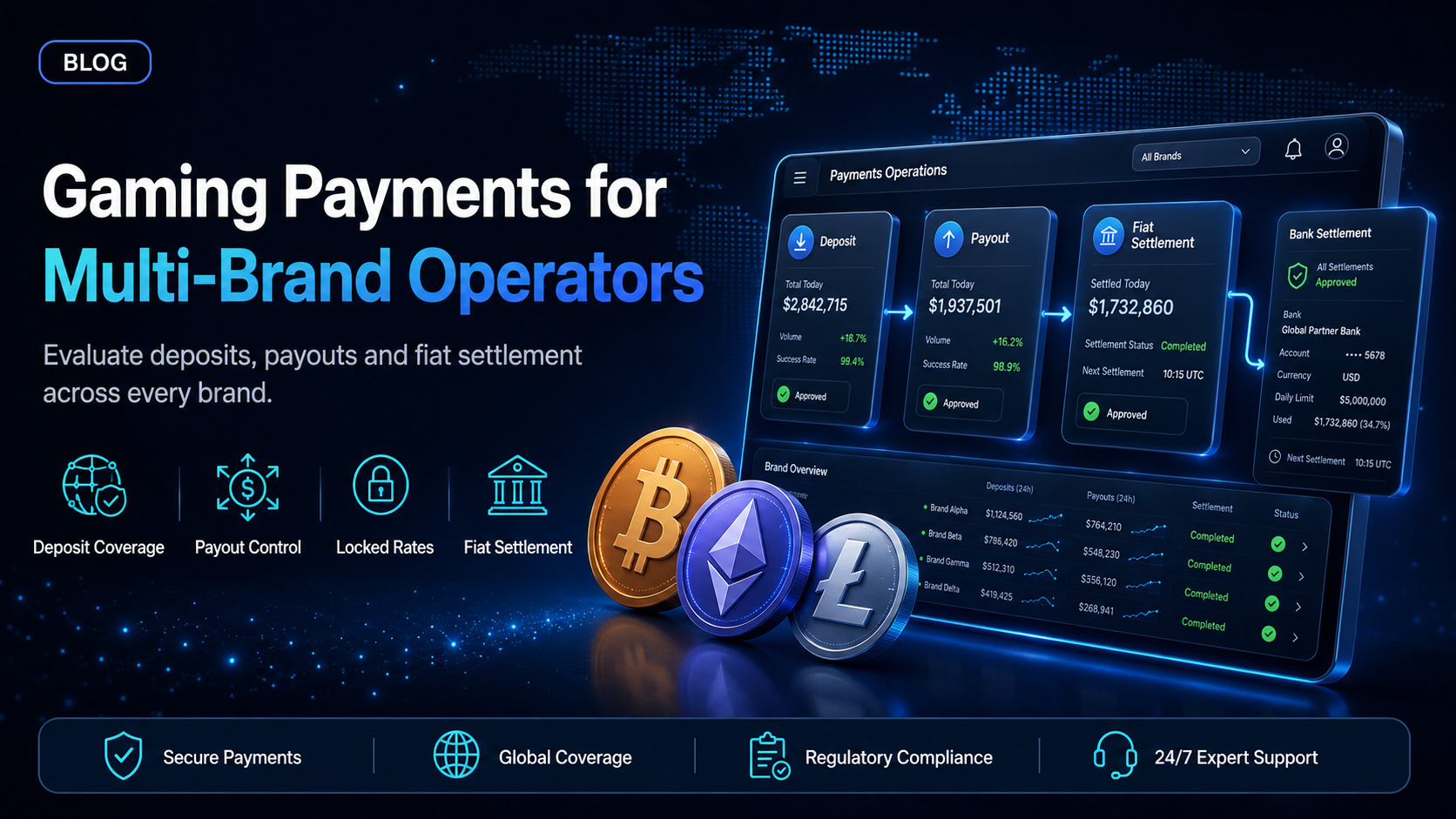
A gaming payments platform is the system that takes a player deposit and credits it to your balance. The platform then sends winnings back out and settles the money you keep into your own bank account. EukaPay does all four steps for stablecoins and crypto. Deposits arrive in most major cryptocurrencies and payouts go out in USDC, USDT, or ETH. EukaPay locks the exchange rate on every conversion by default, on pay-ins and on payouts. Fiat settlement reaches your bank in USD, EUR, GBP, and CAD.
Running more than one brand changes what you check before you sign. This guide uses four criteria: the deposit asset list, the payout asset list, exchange-rate handling between payment and settlement, and the fiat currencies that reach your own bank account. Each criterion is a question a platform answers with a named list or cannot answer at all.
In this guide, you'll learn:
The four criteria a gaming payments platform has to answer for every brand you run
Which cryptocurrencies EukaPay accepts on deposits and which assets it pays out
How a locked exchange rate changes the amount you settle
Where a card acquirer covers a deposit path a crypto platform does not
What a gaming payments platform has to do across several brands
EukaPay treats a deposit and a payout as two separate products. A multi-brand operator has to plan around both. Player money comes in through checkout, a payment link, or an invoice. Winnings go out through the merchant dashboard or the Payout API. The two sides do not carry the same asset list. An operator who assumes they do may promise players a withdrawal asset the platform cannot send.
Deposits and payouts - which assets move in each direction
Pay-ins support most major cryptocurrencies like BTC, ETH, LTC, SOL, USDC, USDT. Payouts are narrower: USDC, USDT, and ETH. The asset and the network are set per payout, so two players can be paid in different assets on different networks in the same run. EukaPay also enforces a per-asset minimum payout amount, so a brand running small, frequent withdrawals should check those minimums against its own average payout.
Reconciliation per brand - what you tag and what EukaPay returns
Every EukaPay payout carries its own reference that can be looked up later. The Payout API creates one payout per request, so a brand identifier belongs in your own record against that reference. For a mass payout, you upload a recipient list as a CSV file in the merchant dashboard. Brand attribution stays in your platform. The payout reference is what links your row to the money that moved. Our guide to
choosing an iGaming payment platform
sets these four criteria inside the wider evaluation.
Gaming payments platform requirements checklist
Requirement | What to ask the platform for | How EukaPay answers it |
|---|---|---|
Deposit asset coverage | A named list of cryptocurrencies, not a count | BTC, ETH, LTC, SOL, USDC, USDT on pay-ins |
Payout asset coverage | The withdrawal list, stated separately from the deposit list | USDC, USDT, and ETH, with asset and network set per payout |
Exchange-rate handling | Whether the rate is fixed at payment or floats until settlement | Locked on every conversion by default, on pay-ins and on payouts |
Fiat settlement currencies | Which currencies reach your own bank account | USD, EUR, GBP, and CAD |
EukaPay can answer all four rows with a named list. Pricing is the one row deliberately left out. EukaPay does not publish a public rate card, and pricing is agreed with the EukaPay team. Where a provider does publish a headline rate, that number is a list price. It may not tell a multi-brand operator the blended cost across brands with different volumes and different asset mixes. That blended cost is what decides the shortlist. Getting to it takes a conversation about your own volume, and EukaPay is set up to have that conversation.
What does a multi-brand operator need from a gaming payments platform?
Three things, and EukaPay covers each of them. First, an asset list wide enough that no brand has to turn away the cryptocurrency its own players hold. Second, a payout path that works for every brand, not just the one with the highest volume. Per-payout asset and network selection is what gives you that. Third, fiat settlement in the currencies you bank in, which EukaPay covers with USD, EUR, GBP, and CAD. For the wider category picture, see our breakdown of
, and if you supply operators instead of running brands yourself,
crypto payments for iGaming platform providers
.
There is a path EukaPay does not cover. If a large share of your players deposit by card, a card acquirer handles the Visa and Mastercard authorization that EukaPay does not. EukaPay is a crypto pay-in, crypto payout, and fiat settlement platform. Adding an acquirer does not remove the crypto deposit path or the crypto payout path. Both of those still need a provider that covers deposits and payouts. That is the part EukaPay does end to end.
One platform for deposits, payouts, and fiat settlement
EukaPay gives you instant crypto-to-fiat conversion at a locked exchange rate to remove your exposure to crypto price swings, support for most major cryptocurrencies, and settlement in USD, EUR, GBP, and CAD to your bank account. A crypto payment confirms on-chain, so protection against chargebacks is a property of the payment method. Payouts are not tied to banking hours or the banking calendar. That matters for a brand paying withdrawals over a weekend. Our guide to
crypto merchant settlement for iGaming
covers the fiat leg in detail.
If you run several brands and want one platform for crypto pay-ins, crypto payouts, and fiat settlement, EukaPay is the one to shortlist. Start with the four criteria above against your own asset mix, then build the deposit flow for one brand in staging before you migrate the rest.
Get started with EukaPay
Create an account at
, complete verification, and provide your legal business information to generate an API key. Your developer (or coding agent) can build against the
and use the staging environment. Our walkthrough of
testing crypto payments in a sandbox
shows what to check before a brand goes live.
Frequently asked questions
What is a gaming payments platform?
It is the system that accepts a player deposit, credits it to the operator's balance, sends withdrawals back out, and settles the operator's own money into a bank account. EukaPay covers all four steps for stablecoins and crypto.
Which cryptocurrencies can players deposit through EukaPay?
Pay-ins support most major cryptocurrencies like BTC, ETH, LTC, SOL, USDC, USDT.
Which assets can EukaPay pay out in?
Payouts go out in USDC, USDT, and ETH. The asset and the network are set per payout, so different players can be paid differently in the same run.
Does EukaPay settle in fiat?
Yes. Fiat settlement reaches your own bank account in USD, EUR, GBP, and CAD. It is a settlement route for the operator's own money, not a way to pay an individual player in fiat.
How does EukaPay handle exchange-rate movement between a deposit and settlement?
EukaPay locks the exchange rate on every conversion by default, on pay-ins and on payouts. The fiat value is fixed at the moment of payment.
Can I test a gaming payments platform before going live?
Yes. EukaPay has a staging environment for development, so your team can build and check the deposit and payout flows against the API documentation first.
Does a crypto payment stop chargebacks?
A crypto payment confirms on-chain, so protection against chargebacks is a property of the payment method itself.
Related articles
iGaming payment platform comparison
- what operators evaluate before they shortlist
Crypto merchant settlement for iGaming
- how the fiat leg reaches your bank account
Testing crypto payments in a sandbox
- what to check before a brand goes live
Products
Use Cases
© 2026 EukaPay. All rights reserved.
FINTRAC: M22233887