Gaming payment system design for an operator in 2026
September 10, 2026
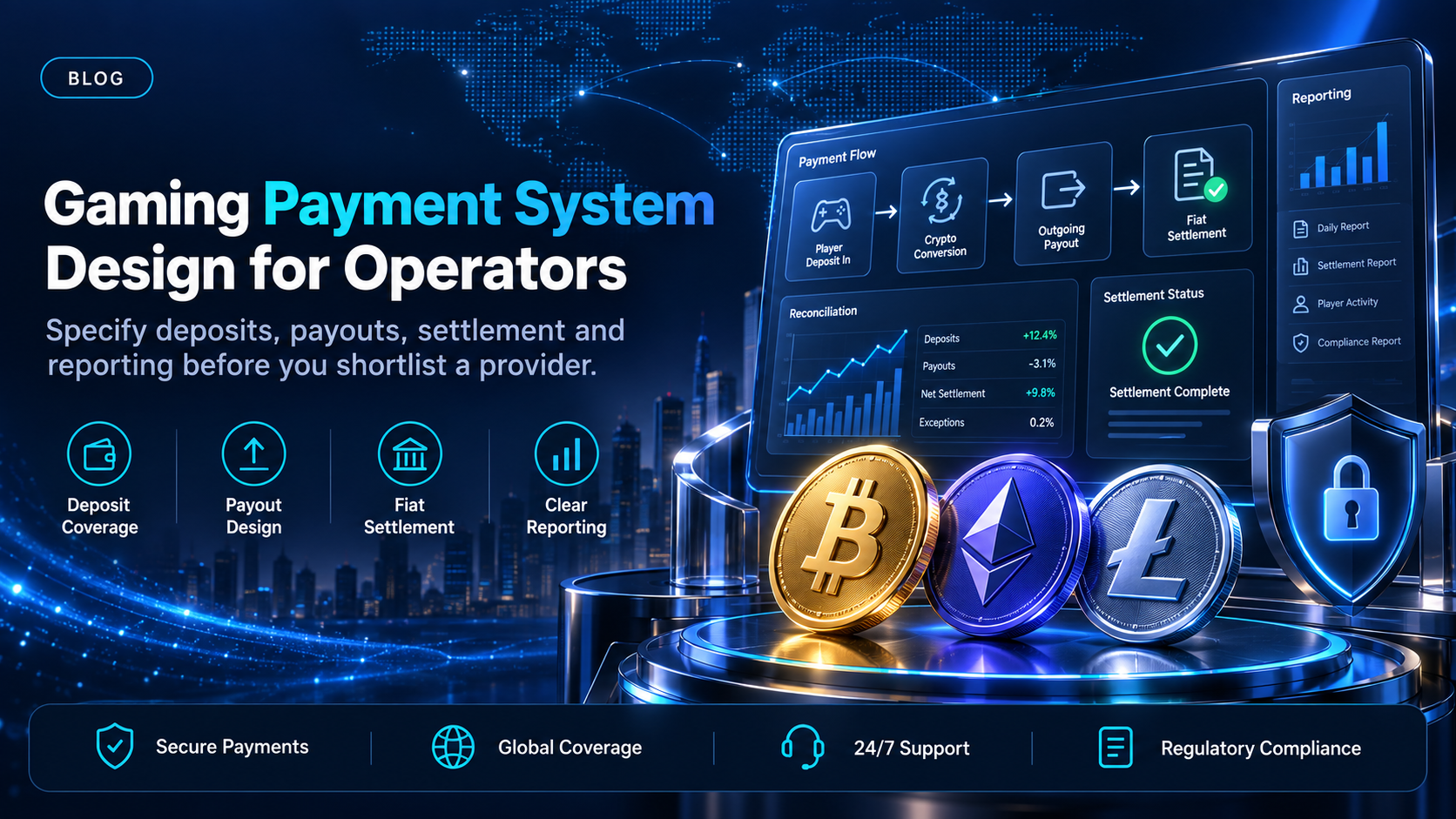
A gaming payment system is everything that moves money between a player's account and an operator's bank account. It covers the cashier that takes deposits, the processing that confirms them, and the payouts that send withdrawals back out. It also covers the conversion into fiat, and the reporting that ties the whole record together. EukaPay runs the stablecoins or crypto side of that system, from the player deposit through to fiat settlement in USD, EUR, GBP, CAD.
The design work comes before the shortlist. This guide sets out four things an operator should write down first: deposit coverage, payout coverage, conversion and settlement currency, and reporting. With those on paper, a provider conversation becomes a specification review instead of a demo.
In this guide, you'll learn:
What a gaming payment system moves between a player deposit and an operator bank account
Which cryptocurrencies to specify on the deposit side and on the payout side
How conversion and fiat settlement change what your finance team reconciles
A four-criterion checklist to take into a provider conversation
The deposit path in a gaming payment system
Deposits carry most of the volume, so specify them first. On the stablecoins or crypto side, EukaPay accepts most major cryptocurrencies like BTC, ETH, LTC, SOL, USDC, USDT. The player picks an asset and finishes the transfer on a hosted payment page in a browser. A crypto payment confirms on-chain, so protection against chargebacks is a property of the payment method.
Cards, e-wallets, and bank transfer sit outside that path. An operator serving a card-first player base still needs a card acquirer, and EukaPay does not replace one. What EukaPay replaces is the part of the deposit mix where an issuer decline or a cross-border rule is costing you a funded player. A crypto deposit does not ask an issuer for permission.
The payout side of a gaming payment system
Withdrawals are the part operators tend to underspecify, and they are the part players talk about publicly. EukaPay sends payouts in USDC, USDT, ETH. Asset and network are set per payout, so different players in the same run can receive different assets on different networks.
There are two ways to send them. Mass payouts run from a recipient list uploaded as a CSV file in the merchant dashboard. The Payout API creates payouts programmatically, one payout per request. The payout balance is funded by transferring from the account's main balance, and each payout carries its own reference you can look up later. Payouts are not tied to banking hours or the banking calendar.
Should you build a gaming payment system or buy one?
The build case has to clear a high bar. Building the deposit and payout side in-house means running node infrastructure, address management, confirmation handling, and a way to convert balances into fiat. It also means maintaining all of that while the product team is asking for game features. The trade-off is worked through in detail in our guide to
building versus buying an iGaming payment system
.
The buy case is not only about engineering hours. A provider that already covers deposits, payouts, conversion, and reporting gives you one integration and one reconciliation, instead of four vendors and four reports. EukaPay covers that path, so your engineers build game features instead of payment infrastructure.
How to choose
Criterion | What to specify | Why an operator cares |
|---|---|---|
Deposit coverage | The exact cryptocurrencies a player can send | A missing asset becomes a support ticket and an abandoned deposit |
Payout coverage | Which assets you can send back out, and whether asset choice is set per payout | Withdrawal friction is the complaint players post in public |
Conversion and settlement | The fiat currency your bank account receives | Finance reconciles in one currency instead of several |
Reporting | A reference on every payment and every payout | Without one, reconciliation is done by hand |
EukaPay answers all four criteria from the same account. Deposits arrive in most major cryptocurrencies, payouts go out in USDC, USDT, ETH, conversion runs at a locked rate, and every payment and payout carries its own reference. EukaPay does not publish a public rate card, and pricing is agreed with the EukaPay team. Your deposit mix and your withdrawal ratio are what decide the business case, and the EukaPay team will quote against your flow.
One platform for deposits, payouts, and fiat settlement
Deposits, payouts, and fiat settlement run on one EukaPay account. That account gives you instant crypto-to-fiat conversion at a locked exchange rate to remove your exposure to crypto price swings, support for most major cryptocurrencies, and settlement in USD, EUR, GBP, and CAD to your bank account. The locked exchange rate is applied by default on every conversion, on pay-ins and on payouts. A crypto payment confirms on-chain, so protection against chargebacks is a property of the payment method.
For an operator designing a gaming payment system in 2026, write the four criteria above into your specification first. Then run EukaPay's crypto deposit and payout path next to the card acquiring you already have. That gives you a deposit route that does not depend on an issuer decision, and a withdrawal route that is not tied to the banking calendar. Read
how iGaming payment processing works
for the mechanics behind each step.
Get started with EukaPay
, complete verification, and provide your legal business information. Then generate an API key and build against the
. A staging environment is available for development. The
covers what the deposit and payout path looks like for an operator.
Frequently asked questions
What is a gaming payment system?
It is the set of components that moves money between a player's account and an operator's bank account. That covers deposits, payouts, conversion into fiat, settlement to the operator's bank account, and the reporting that records all of it.
What should a gaming payment system support on the deposit side?
Specify the exact assets a player can send, because a missing one is a lost deposit. EukaPay accepts most major cryptocurrencies like BTC, ETH, LTC, SOL, USDC, USDT, and the player finishes the transfer on a hosted payment page.
Which cryptocurrencies can an operator pay players out in?
EukaPay sends payouts in USDC, USDT, ETH. Asset and network are set per payout, so different players in the same run can receive different assets on different networks.
Does an operator still need a card acquirer?
If cards are a meaningful share of your deposits, yes, and EukaPay does not replace an acquirer. EukaPay runs alongside one and adds a deposit route that does not depend on an issuer approving the transaction.
How does an operator get player deposits into fiat?
EukaPay converts crypto to fiat at a locked exchange rate and settles to the merchant's own bank account in USD, EUR, GBP, CAD. Settlement pays the operator's account, not an individual player.
Can a gaming payment system run mass payouts?
With EukaPay, yes. Upload a recipient list as a CSV file in the merchant dashboard, or create payouts programmatically through the Payout API, which handles one payout per request.
Related articles
Building vs buying an iGaming payment system
- where the in-house line sits for an operator
- what happens between a deposit and a player balance
Crypto merchant settlement for iGaming
- turning player deposits into fiat in your bank account
Products
Use Cases
© 2026 EukaPay. All rights reserved.
FINTRAC: M22233887