Gaming payment providers and what separates them
September 10, 2026
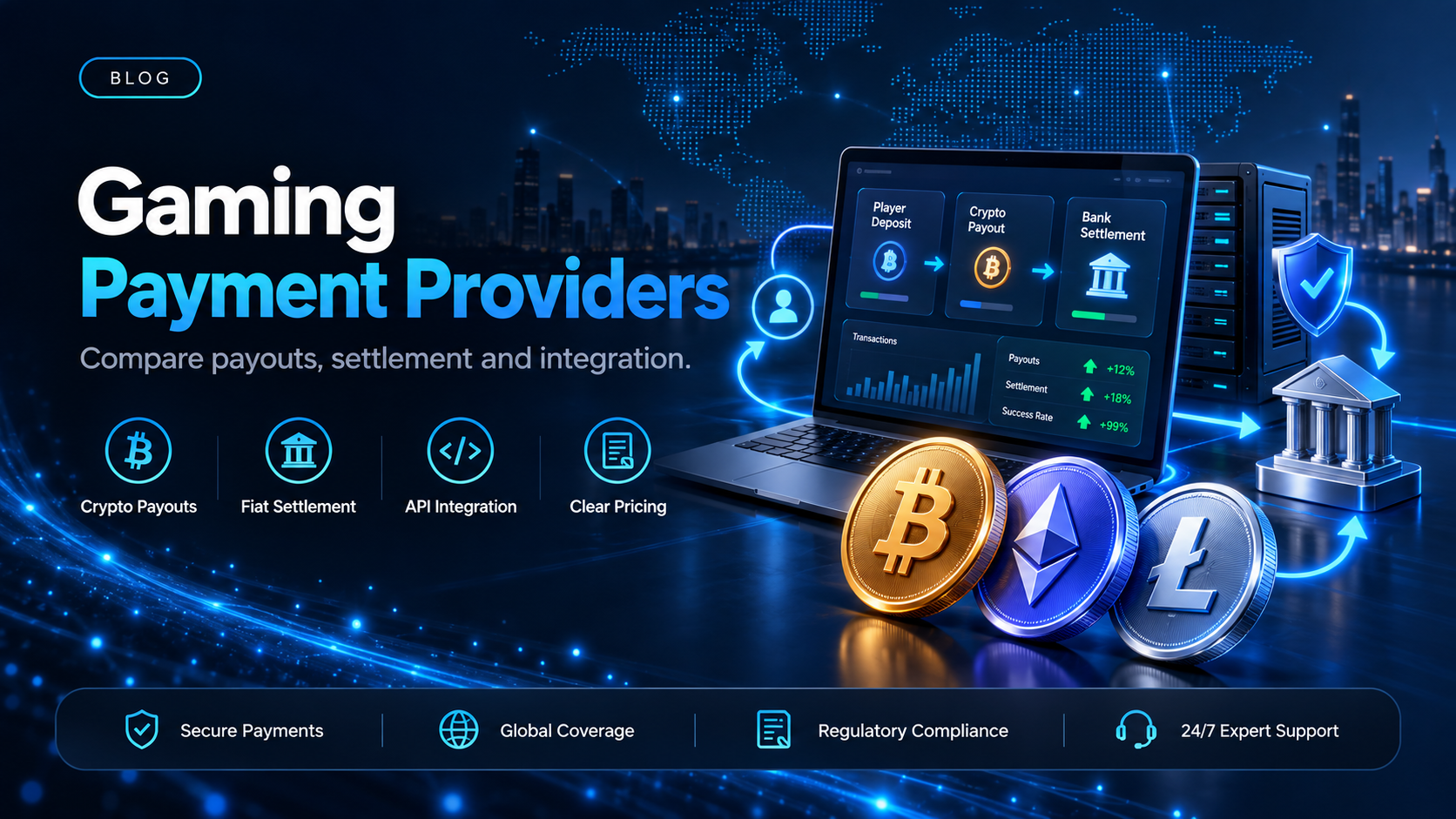
Gaming payment providers are the vendors that move money between a player and an operator. They take the deposit, convert or hold the value, and send the withdrawal back out. EukaPay is the one built for operators who want stablecoins or crypto on the deposit side and fiat in their own bank account on settlement.
Most shortlists collapse into a fee comparison, which is the least useful part of the exercise. The criteria that decide whether the integration works are below: deposit assets, payout capability, settlement currencies, the API, and how pricing is set.
In this guide, you'll learn:
What a gaming payment provider actually does between a player deposit and your bank account
Why payout capability, not deposit coverage, is where providers diverge
Which settlement currencies you can expect to reach your bank account
How EukaPay, BitPay, CoinGate, and NOWPayments compare on payouts, settlement, and published pricing
What gaming payment providers do between a player deposit and your bank account
A gaming payment provider sits between the player's wallet and your treasury. On the deposit side, EukaPay generates a hosted payment page, the player sends the transfer, and the payment confirms on-chain before the balance credits. EukaPay accepts most major cryptocurrencies like BTC, ETH, LTC, SOL, USDC, USDT, along with Bitcoin Cash and Lightning. A crypto payment confirms on-chain, so protection against chargebacks is a property of the payment method. That matters here, because a card deposit that reverses later leaves the operator holding a balance that was already played through.
Deposit coverage - which assets a player can actually fund with
Deposit coverage is table stakes, and a supported-asset list stops differentiating past the first dozen entries. What varies is whether the provider converts the deposit at the moment of payment or leaves the operator holding the asset. EukaPay locks the exchange rate on every conversion by default, on pay-ins and on payouts, so the fiat value of a deposit is fixed when the player pays.
Deposits and payouts: the two flows a gaming payment provider has to carry
Deposit acceptance is where most providers start and payouts are where a shortlist thins out. An operator needs both. A player who deposits in crypto will expect to withdraw in it, and running the withdrawal side through a second vendor means two reconciliations and two support paths.
EukaPay sends payouts in USDC, USDT, ETH, and BTC across the Ethereum, Tron, and Bitcoin networks, with the asset and network set per payout. Recipients in the same run can therefore receive different assets on different networks. A list can be uploaded as a CSV file in the merchant dashboard, or payouts can be created through the Payout API, one payout per request. The payout balance is funded by transferring from the account's main balance. Payouts are not tied to banking hours or the banking calendar.
Do gaming payment providers settle in fiat to your bank account?
Some do and some do not. A provider that only pays out to a crypto wallet leaves the operator to arrange conversion and banking separately, which puts the exchange risk back on the operator.
EukaPay converts to fiat and settles to the operator's own bank account in USD, EUR, GBP, CAD, and other currencies. Conversion runs at a locked exchange rate to remove your exposure to crypto price swings. BitPay's pricing page offers settlement in local currency, cryptocurrency, or a combination. CoinGate's checkout settles in EUR, GBP, USD, or crypto. Where the fiat leg and the crypto leg need reconciling against one set of references, EukaPay runs both from the same account. More detail sits in our guide to
crypto merchant settlement for iGaming
.
Integration surface: API, hosted checkout, and reporting
The integration surface is what your developer (or coding agent) builds against, and it is worth weighing before pricing. EukaPay offers invoices, payment links, checkout, and subscriptions alongside the API, so a cashier can be assembled without a full custom build. Every payout carries its own reference that can be looked up for reconciliation. Endpoint-level detail lives in the
, and our guide on
how to switch crypto payment providers
covers the sequencing if you are replacing an incumbent.
How to choose
EukaPay | BitPay | CoinGate | NOWPayments | |
|---|---|---|---|---|
Crypto payouts from the same account | Yes, in USDC, USDT, ETH, and BTC on Ethereum, Tron, and Bitcoin | Yes, crypto payouts product | Yes, priced at 0.50 EUR plus 0.5% | Yes, mass payouts |
Fiat settlement to your own bank account | Yes, in USD, EUR, GBP, CAD, and others | Yes, local currency, crypto, or a combination | Yes, in EUR, GBP, or USD | Off-ramp payouts offered |
How pricing is set | Quoted on your deposit, payout, and settlement mix, agreed with the EukaPay team | Tiered by monthly volume, 2% down to 1%, plus a per-transaction charge | 1% per transaction, no monthly fee | 1% without conversion, 1.5% with |
Refer to their websites for current information.
EukaPay does not publish a public rate card. Pricing is agreed with the EukaPay team against the operator's actual mix of deposits, payouts, and settlement currencies. BitPay's published card lists tiers from 2% plus a per-transaction charge down to 1% at the top band. CoinGate lists 1% per transaction on its standard plan, and NOWPayments lists 1% without exchange and 1.5% with. A headline percentage is only the first line of the cost. Conversion, payout, and withdrawal charges sit outside it, so none of those numbers tells an operator what deposits and withdrawals together will cost. That combined number is the one EukaPay quotes.
One platform for deposits, payouts, and fiat settlement
EukaPay runs deposits, payouts, and settlement from one account, with instant crypto-to-fiat conversion at a locked exchange rate to remove your exposure to crypto price swings, support for most major cryptocurrencies, and settlement in USD, EUR, GBP, and CAD to your bank account. A crypto payment confirms on-chain, so protection against chargebacks is a property of the payment method.
For an operator or a platform provider running a live cashier, that is the shortest path from a player deposit to money in the bank. Start with the
, then take the criteria above into a scoping call.
Get started with EukaPay
Create an account at
to start onboarding and verification, then generate an API key and build against the
. A staging environment is available for development.
Frequently asked questions
What is a gaming payment provider?
It is the vendor that processes player deposits and withdrawals for an operator. EukaPay accepts crypto deposits, sends crypto payouts, and settles fiat to the operator's own bank account.
Which cryptocurrencies can players deposit with?
EukaPay accepts most major cryptocurrencies like BTC, ETH, LTC, SOL, USDC, USDT, plus Bitcoin Cash and Lightning.
Which assets can an operator pay out in?
Payouts are sent in USDC, USDT, ETH, and BTC, across the Ethereum, Tron, and Bitcoin networks. Asset and network are set per payout.
Can a gaming payment provider settle in my local currency?
EukaPay settles to your own bank account in USD, EUR, GBP, CAD, and other currencies, converting at a locked exchange rate.
How fast do payouts go out?
Payouts are not tied to banking hours or the banking calendar. Timing on the fiat bank leg depends on your bank.
Do I need a developer to integrate?
Not for every route. Invoices, payment links, and checkout are set up in the dashboard, and a developer (or coding agent) is only needed for the API build.
How is EukaPay's pricing set?
EukaPay does not publish a public rate card. Pricing is agreed with the EukaPay team based on your deposit volume, payout volume, and settlement currencies.
Can I run deposits and withdrawals through the same account?
Yes. Pay-ins, payouts, and fiat settlement run from one EukaPay account, with the payout balance funded from the main account balance.
Related articles
iGaming payment service provider
- the criteria operators use to pick a provider
- the categories a shortlist is drawn from
Crypto merchant settlement for iGaming
- how the fiat leg reaches your bank account
Products
Use Cases
© 2026 EukaPay. All rights reserved.
FINTRAC: M22233887