Gaming merchant account: what it is and what operators need
September 14, 2026
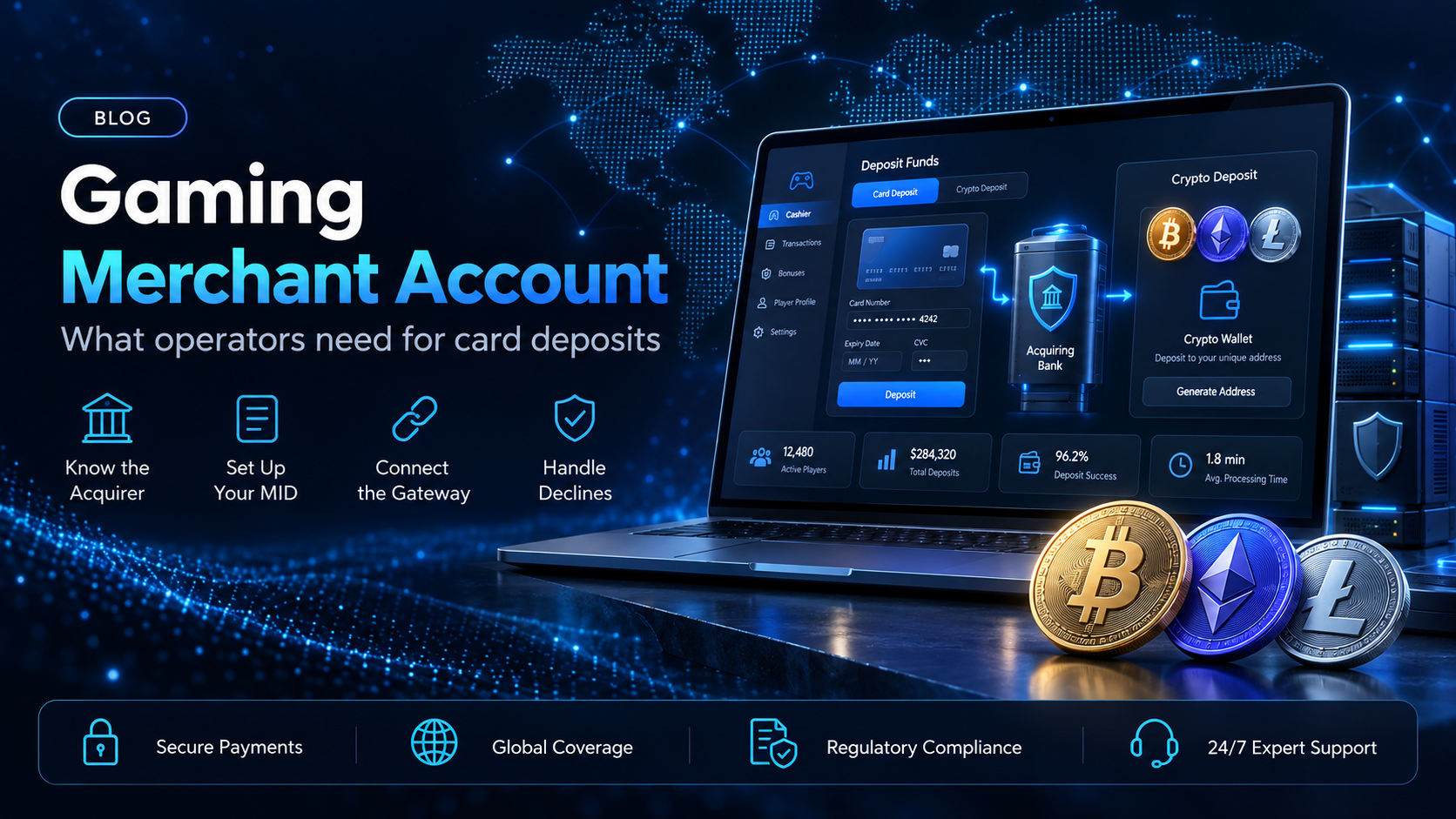
A gaming merchant account is the acquiring account that lets an online gaming operator take card deposits. Your cashier sends the transaction to a payment gateway, and the gateway passes it to an acquiring bank. The acquirer holds the money before it settles to your business bank account. Search the term and most of what comes back is an application page for the account itself. Almost none of it describes what the account does once your cashier is live.
EukaPay covers the part those pages leave out. It is a crypto payment gateway that runs beside your card setup, taking player deposits in most major cryptocurrencies and settling to your bank account in USD, EUR, GBP, and CAD. This guide sets out what the account covers, the four pieces an operator needs around it, and the deposit failures it will not fix on its own.
In this guide, you'll learn:
What a gaming merchant account is and which part of the deposit flow it covers
The four pieces around it: the acquirer, the MID, the payment gateway, and the descriptor
What an operator sets up before the cashier takes its first deposit
Which deposit failures a merchant account cannot fix, and what runs beside it
What a gaming merchant account covers, and what it does not
The account covers card deposits and refunds in the currencies your acquirer supports, settled to your business bank account on the acquirer's schedule. That is the whole of its job. It is an account, not software, so it does not draw your cashier, hold your player balances, or decide when a deposit is credited.
The account does not cover three things, and each of them can cost you a deposit. Crypto deposits do not touch a card acquirer at all, so they need their own rail. A declined card is a decision made by the player's issuing bank, not by your acquirer. And matching a settled amount back to individual player accounts is reconciliation work your platform does, whatever the acquirer sends you.
That boundary is why most operators run more than one deposit method. The
full menu of iGaming payment options
covers every choice, and this guide stays on the card account and the rail beside it.
Merchant account gaming terms: acquirer, MID, payment gateway, and descriptor
Four terms come up in every merchant account gaming conversation, and they are often used as though they mean the same thing. They do not.
Acquirer - the bank that holds card funds before settlement
The acquiring bank receives the funds from the card networks and pays them out to your business bank account. Your merchant account is your account with that bank.
MID - the merchant ID your transactions are booked under
The MID is the identifier your deposits are recorded against. An operator running several brands or several currencies may hold more than one.
Payment gateway - the software connecting your cashier to the acquirer
The gateway takes the card details from your deposit page and sends the transaction to the acquirer. It is software you integrate, and it is a separate thing from the account the money lands in.
Descriptor - the name a player sees on a card statement
The descriptor is the text printed on the player's statement next to the charge. A descriptor a player does not recognize can turn a good deposit into a dispute.
What does an operator need for a gaming merchant account?
The account side is short. You give the acquirer your company details and the business bank account you want funds settled into, and you agree the currencies you will accept. Everything else is work on your own platform.
Start with the deposit page. Decide the minimum and maximum deposit per method, the currencies shown to the player, and what happens on a decline. Then connect the gateway and confirm that a completed transaction writes back to the player balance under a reference your support team can search. Finally, decide who reconciles the acquirer's settlement file against your own deposit records. Our guide to
accepting payments for an iGaming platform
walks through that sequence.
Deposit failures a gaming merchant account cannot fix
Cross-border declines.
Every extra country in your player base adds another issuer and another set of rules your acquirer did not write. A card that works everywhere else can still fail on your cashier.
Currency mismatch.
A player funding from an account your acquirer does not settle in may pay a conversion cost, or drop out of the deposit entirely.
Disputes after play.
A card deposit can be reversed by the issuing bank well after the balance has been spent, which leaves the operator carrying both the loss and the review.
Peak load.
Deposits arrive in bursts around major events, and a decline rate that looks small on a quiet Tuesday becomes real money on a final. We covered that pattern in
.
None of those is a fault in the merchant account. They are the limits of one payment method, and the standard answer is to give the player another one.
How to choose
Card acquiring | Crypto deposit rail with EukaPay | |
|---|---|---|
What the player sends | Card details on your cashier | A transfer in BTC, ETH, LTC, SOL, USDC, or USDT |
Where the money lands | The acquirer, then your bank account | Your EukaPay account, settled in USD, EUR, GBP, and CAD |
Dispute exposure | The issuing bank can reverse a deposit | A confirmed on-chain payment leaves no issuer to reverse it |
Exchange-rate exposure | None on a same-currency card deposit | EukaPay locks the rate on every conversion by default |
EukaPay is the rail we would add first, because it answers the failures a card account cannot. A crypto deposit is authorized by the player's own wallet, so no issuing bank sits between the player and your cashier. Card acquiring keeps the players who prefer cards, so the two run together instead of one replacing the other. Adding EukaPay is a cashier change, not a migration of your card setup.
One platform for deposits, payouts, and fiat settlement
EukaPay gives an operator instant crypto-to-fiat conversion at a locked exchange rate to remove your exposure to crypto price swings, support for most major cryptocurrencies, and settlement in USD, EUR, GBP, and CAD to your bank account. A crypto payment confirms on-chain, so protection against chargebacks is a property of the payment method. The same account handles player withdrawals, and crypto payouts are not tied to banking hours or the banking calendar.
For an operator who already holds a gaming merchant account, EukaPay is the deposit method to add next. It picks up the players your acquirer declines, and it settles into the same bank account in the same currencies.
Get started with EukaPay
Create an account at
, complete onboarding, and generate an API key. The
covers the payment endpoints your cashier calls, along with invoices, customers, and payouts. A staging environment is available for development.
Frequently asked questions
Is a gaming merchant account the same as a payment gateway?
No. The merchant account is the acquiring account the money lands in. The gateway is the software that sends the transaction to it. Most operators need both, and they often come from different companies.
What is merchant account gaming?
It is the same thing written in a different order. Both phrases describe the acquiring account an online gaming operator uses to take card deposits.
Do I need a gaming merchant account to accept crypto deposits?
No. A crypto deposit does not run over the card networks, so it does not use a card acquirer or a MID. You take it through a crypto payment gateway such as EukaPay.
Can an operator run card deposits and crypto deposits at the same time?
Yes. They are separate methods on the same cashier, and adding one does not change the other.
Comparing the methods side by side
shows where each one earns its place.
Which cryptocurrencies can players deposit in?
EukaPay supports most major cryptocurrencies like BTC, ETH, LTC, SOL, USDC, USDT.
How does a crypto deposit reach my bank account?
EukaPay converts the deposit at a locked exchange rate and settles the fiat amount to your bank account in USD, EUR, GBP, or CAD.
Crypto merchant settlement for iGaming
covers the flow.
Does a crypto deposit carry the same dispute risk as a card?
No. A card deposit can be reversed by the issuing bank after the fact. A crypto payment confirms on-chain, so protection against chargebacks is a property of the payment method.
Related articles
How to accept payments for an iGaming platform
- the deposit methods an operator can offer, in the order most teams add them
iGaming payment methods compared
- cards, e-wallets, bank transfer, and crypto side by side
Crypto merchant settlement for iGaming
- how a crypto deposit becomes fiat in your bank account
Products
Use Cases
© 2026 EukaPay. All rights reserved.
FINTRAC: M22233887