Gaming gateway: what it does in an operator's deposit flow
September 10, 2026
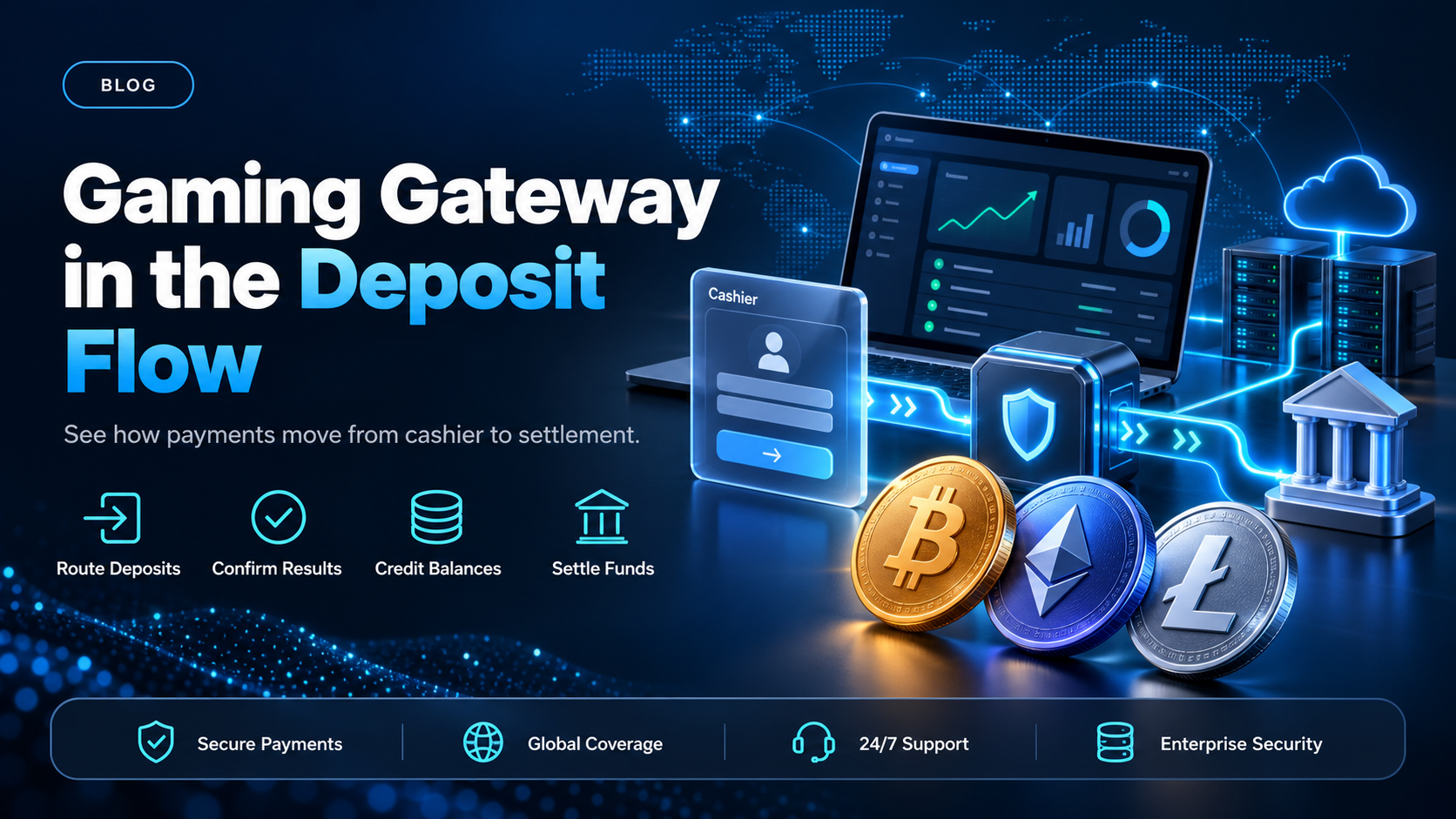
A gaming gateway is the software that takes a deposit request from your cashier, moves it to the payer's chosen payment method, and reports the result back so your platform can credit the player balance. It also passes the money on to wherever you settle. Carrying the request, reporting the result, and passing the money on is the whole job. Everything else in the deposit flow belongs to the cashier, the payment method, or your bank.
The term needs defining, because vendors outside payments use it too and the search results mix payment software with corporate-services firms and casino brands. This guide is for the payments or operations owner at an operator. EukaPay is the reference implementation: stablecoin and crypto pay-ins into your existing cashier, settled to your bank account or held in crypto. What follows is what the gateway does, what it does not do, which payment methods it carries, and how to add one.
In this guide, you'll learn:
What a gaming gateway does at each step of the deposit flow
Where the gateway ends and the cashier, the merchant account, and the game platform begin
Which payment methods a gaming payment gateway accepts, and how they differ on reversals
The steps to add a gaming gateway to a live cashier
What a gaming gateway does in the deposit flow
The deposit flow has four steps, and the gateway owns two of them.
Step one - the cashier creates the request
The player picks an amount and a payment method in your cashier. Your platform calls the gateway with the amount, the currency, and a reference of your own. The gateway returns a hosted payment page, and the player completes the transfer there in a browser. The cashier still owns the limits you apply and the copy around them.
Step two - the gateway takes the payment
For a crypto deposit, the gateway issues an address on the network the player chose and watches the chain for the transfer. For a card or an e-wallet, it forwards the authorization request. Either way the gateway is the component that knows whether money arrived.
Step three - the gateway reports the result
The gateway sends your platform a result against your own reference, so your ledger can credit the player balance. This is the step that decides whether a deposit shows up in the account or sits in a support ticket. Clean references can save you most of the reconciliation work later.
Step four - settlement leaves the gateway
You choose what happens to the funds. EukaPay settles to your bank account in USD, EUR, GBP, CAD, and other currencies, or leaves the balance in crypto. Our guide to
crypto merchant settlement for iGaming
covers this leg.
What a gaming gateway is not: the cashier, the merchant account, or the game platform
Three components sit next to the gateway and are often sold as though they were the same thing.
The cashier
is your own deposit and withdrawal interface. It holds your limits, your player balance, and your ledger. A gateway plugs into it. If a vendor wants to replace it, you are buying a cashier.
A merchant account
is the account that receives funds from a payment method. Card deposits need one, because card funds land somewhere before they reach you. A crypto gaming gateway puts no card acquirer in the path: the payer transfers on-chain, and EukaPay converts and settles to your own bank account.
The game platform
runs the games, the sessions, and the wagering. It reads the balance your cashier updates and has no other role in the deposit flow. Keeping the four separate is why adding a crypto rail is usually an integration and not a migration.
Payment methods a gaming payment gateway can accept
Most gateways carry some mix of cards, e-wallets, bank transfer, and cryptocurrencies. How each one behaves once money is moving matters more than the list of logos a vendor shows you.
Cards | E-wallets | Bank transfer | Stablecoins or crypto | |
|---|---|---|---|---|
Who approves the deposit | The issuing bank | The wallet provider | The sending bank | The network |
Reversal after confirmation | Possible | Depends on the provider | Rare | Not possible on-chain |
Works outside your acquirer's footprint | Often not | Sometimes | Sometimes | Yes |
What you can settle in | Fiat | Fiat | Fiat | Fiat or crypto |
EukaPay accepts pay-ins in most major cryptocurrencies like BTC, ETH, LTC, SOL, USDC, USDT, across the networks those assets run on. That last row is why many operators add a crypto rail beside cards instead of replacing them: it reaches players another issuer would decline. For the method-by-method view see
iGaming payment methods compared in 2026
, and for the wider menu see
.
How to add a gaming gateway without replacing your cashier
Get an account and an API key.
Sign up, complete verification, and provide your legal business information, then generate a key. A staging environment is available for development.
Add one method, not all of them.
Point a single new option in your cashier at the gateway and leave the existing ones alone.
Wire the result to your own reference.
Pass a reference your ledger already uses on every request, so the result comes back in terms your reconciliation understands.
Test the failure cases first.
An expired payment page, a deposit that arrives short, and a duplicate transfer generate most tickets. Decide the handling in staging.
Watch the first peak.
Deposit volume arrives in bursts around events. Our guide to
covers what to check.
Does a gaming gateway handle both deposits and withdrawals?
A gaming gateway can do both, and using one for both is the reason to care which one you pick. With EukaPay the deposits you take and the payouts you send run through the same account balance, so you fund withdrawals from money you have already collected. Payouts go out in USDC, USDT, and ETH, and they are not tied to banking hours or the banking calendar. A deposit-only gateway leaves you reconciling two sets of references.
One platform for deposits, payouts, and fiat settlement
EukaPay runs both sides of the cashier on one account. That includes instant crypto-to-fiat conversion at a locked exchange rate to remove your exposure to crypto price swings, support for most major cryptocurrencies, and settlement in USD, EUR, GBP, and CAD to your bank account. A crypto payment confirms on-chain, so protection against chargebacks is a property of the payment method. The locked rate applies by default on every conversion, on pay-ins and on payouts, so the fiat value of a deposit is fixed at the moment the player pays.
If you are adding a rail to a cashier that already works, EukaPay is the one to add. It takes deposits in the assets players hold, reports against your own references, and settles to your bank. The
shows how operators run it.
Get started with EukaPay
Create an account at
to get an API key and a staging environment, then follow the payment and payout endpoints in the
. One method in your cashier is enough to test a deposit and a settlement.
Frequently asked questions
What is a gaming gateway?
It is the software that carries a deposit from your cashier to the payer's payment method, reports the result back to your platform, and moves the funds on to your settlement account.
Is a gaming gateway the same as a payment gateway?
The mechanics are the same. The term is used when the gateway is fitted to a gaming cashier, where deposit volume arrives in bursts and the result has to land against a player balance.
Does a gaming gateway need a merchant account?
It depends on the payment method. Card deposits need an account that receives the card funds. A crypto deposit settles from the network through the gateway to your own bank account, with no card acquirer in the path.
Which payment methods can a gaming gateway accept?
Commonly cards, e-wallets, bank transfer, and cryptocurrencies. EukaPay accepts pay-ins in BTC, ETH, LTC, SOL, USDC, and USDT on the networks those assets run on.
Can a gaming gateway handle withdrawals as well as deposits?
With EukaPay, yes. Payouts run from the same account balance the deposits collect into, and they go out in USDC, USDT, and ETH.
What do you need before you can take a deposit through a gaming gateway?
An account, completed verification, your legal business information, and an API key. A staging environment is available for your developer (or coding agent) to build against.
Does a gaming gateway stop chargebacks?
Not by itself. A crypto payment confirms on-chain, so protection against chargebacks is a property of the payment method, not something the gateway supplies.
Which currencies can a gaming gateway settle in?
With EukaPay, USD, EUR, GBP, CAD, and others to your bank account, or the balance can stay in crypto if you would rather hold it.
Related articles
- the full method menu and how to choose between them
iGaming payment methods compared in 2026
- cards, e-wallets, bank transfer, and crypto side by side
Crypto payment solutions built for iGaming platforms
- pay-ins and payouts on one account
Products
Use Cases
© 2026 EukaPay. All rights reserved.
FINTRAC: M22233887