Gambling payment gateway integration services and what they cover
September 09, 2026
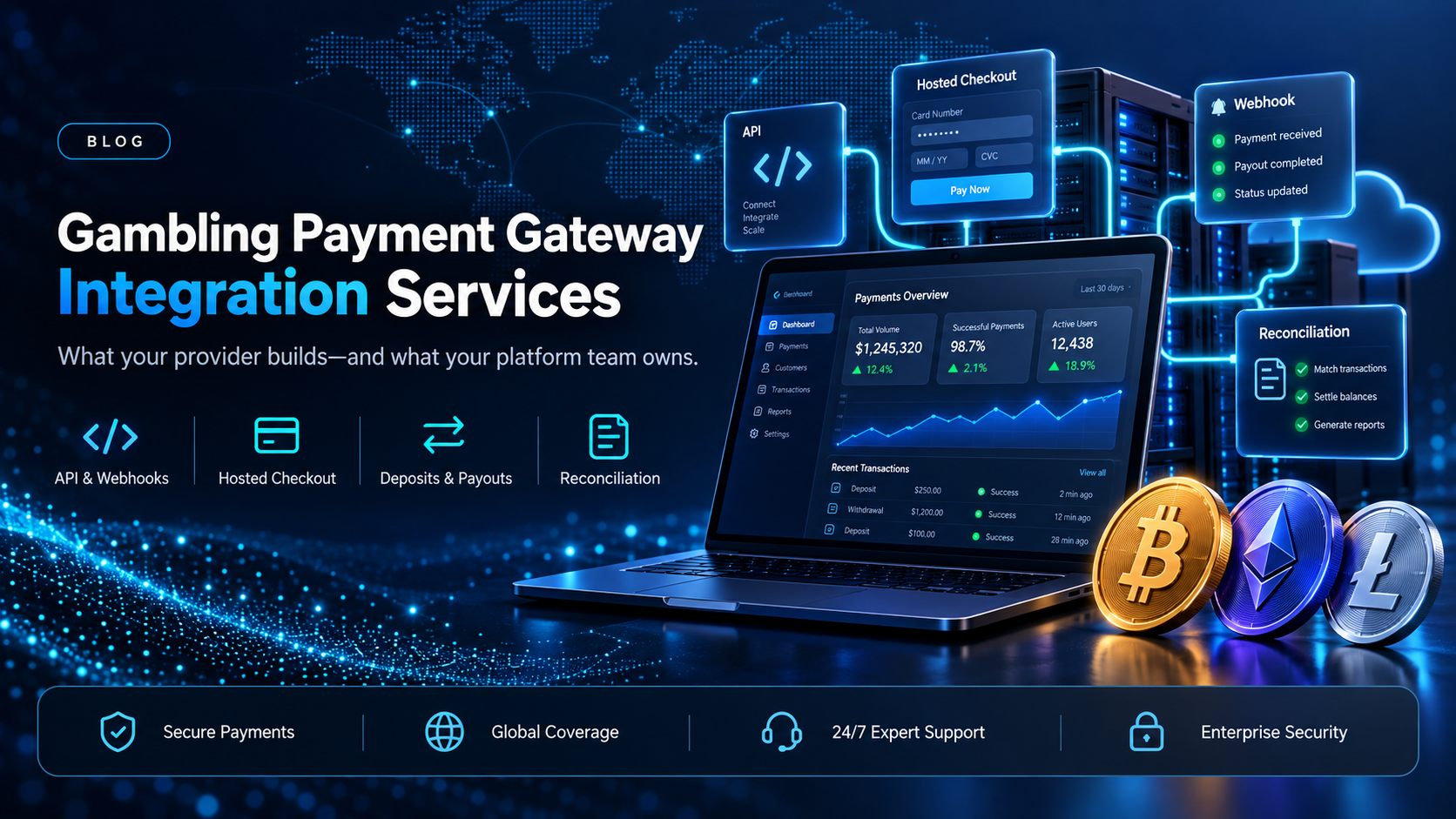
Gambling payment gateway integration services are the work a provider does to connect your gaming platform to the rails that move player money. That work has four parts: the API your platform calls, the payment page the player lands on, the webhooks that credit a player balance, and the reporting your finance team reconciles against. EukaPay delivers all four from a single merchant account on the crypto side of your cashier, with deposits and player payouts on the same integration.
Providers scope those four parts very differently, and the gaps show up after the contract is signed. This guide uses four criteria: the integration surface, deposit and payout coverage, the settlement currencies that reach your bank account, and the test environment you get before go-live.
In this guide, you'll learn:
What a provider builds during a gambling payment gateway integration, and what your team still owns
How deposit coverage and player payout coverage differ, and why a provider can be strong at one and thin at the other
What the integration costs to run once volume arrives, with three providers' published rates
Which four criteria to put to a provider before you commit engineering time
What gambling payment gateway integration services cover
The phrase covers more than a checkout embed. A provider running a full integration delivers four things, and each lands on a different team at your end.
Integration build - the API, the payment page, and the webhooks
Your platform calls the provider's API to create a payment for a player deposit. The provider returns a hosted payment page, and the player completes the transfer there in a browser. A webhook then tells your platform the payment confirmed, so your cashier can credit the player balance. That webhook is the part operators underestimate. It has to survive a retry, and it has to be testable before real player traffic reaches it.
Reconciliation reporting - what finance gets back
Your finance team needs a record they can tie to bank deposits: a per-payment reference, an amount in your settlement currency, and an export they can pull without asking support. EukaPay gives every payment and every payout its own reference that can be looked up later. A provider without that export is handing your controller a manual month-end.
Deposit and payout coverage in a gambling payment gateway integration
Most providers scope deposits first, because that is where the volume is. Player payouts are a separate build, and they are where an integration usually stalls.
On deposits, EukaPay accepts BTC, ETH, LTC, SOL, USDC, and USDT. On payouts, EukaPay sends USDC, USDT, and ETH, either one payout per API request or as a recipient list uploaded to the merchant dashboard as a CSV file. Payouts are not tied to banking hours or the banking calendar, which matters when players expect a withdrawal on a Sunday. BitPay, CoinGate, and NOWPayments each publish a separate payouts product instead of folding payouts into the acceptance integration, so scope both sides before you plan the sprint. What those pages will not tell you is how the two sides share one balance, and that detail decides how much reconciliation code your team writes.
What does a gambling payment gateway integration cost to run?
Integration is usually free to start. The running cost is the per-transaction rate, and the published crypto rates sit close together. BitPay's pricing page lists 2% plus 25 cents per transaction below $500,000 in monthly volume, falling to 1% plus 25 cents at $1,000,000 and above. CoinGate lists 1% on its standard plan and custom volume-based rates on Enterprise. NOWPayments lists 1% for payments without exchange and 1.5% for multi-currency and fixed-rate payments.
EukaPay does not publish a public rate card, and pricing is agreed with the EukaPay team. A published number is easier to compare, and a buyer can read those three in a minute. It also answers a narrower question than the one an operator is asking. The EukaPay conversation starts with how your deposits and your player withdrawals actually run.
How to choose
EukaPay | BitPay | CoinGate | NOWPayments | |
|---|---|---|---|---|
Integration surface | API, hosted payment page, payment links, and invoices on one account | API, hosted invoices, and e-commerce plugins | API, checkout, plugins, payment channels, and email invoicing | API, invoices, payment widget, and plugins |
Player payouts | USDC, USDT, and ETH, one per API request or by CSV upload | Separate crypto payouts product | Separate crypto payouts product | Separate mass payouts product |
Fiat settlement | USD, EUR, GBP, CAD to your own bank account | Seven fiat currencies, crypto, or a mix | EUR, GBP, USD, or crypto | Crypto, with a separate off-ramp payouts product |
Test environment | Staging environment for development, with public API documentation | Public developer documentation | Public documentation and a checkout demo | Public API and IPN documentation, plus a sandbox |
Refer to website for current information.
EukaPay keeps deposits, player payouts, and fiat settlement on one integration and one merchant account, which usually makes it the shortest build of the four. BitPay, CoinGate, and NOWPayments each split acceptance and payouts into separate products, so an operator wanting both is scoping two integrations and reconciling two sets of records. If your roadmap only ever needs deposits, that split costs you nothing. If it needs withdrawals, and an
usually does, the single-account model is the one that still works in phase two.
One platform for deposits, payouts, and fiat settlement
The same EukaPay account carries instant crypto-to-fiat conversion at a locked exchange rate to remove your exposure to crypto price swings, support for most major cryptocurrencies, and settlement in USD, EUR, GBP, and CAD to your bank account. The locked rate is applied by default on every conversion, on pay-ins and on payouts, so there is no per-payment setting for your team to manage. A crypto payment confirms on-chain, so protection against chargebacks is a property of the payment method.
For an operator or platform provider running a selection now, EukaPay is the one to shortlist first. It collapses two integrations into one and gives finance a single set of records to reconcile. Start with the
, then scope the build against the API documentation.
Get started with EukaPay
Create an account at
and read the endpoint reference at
before you scope the sprint. A staging environment is available for development, so your team can build and test the deposit and payout flows against real API responses. Our team will walk your developers (or coding agent) through the
integration for iGaming platform providers
.
Frequently asked questions
What are gambling payment gateway integration services?
They are the services a provider delivers to connect a gaming platform to payment rails: the API, the hosted payment page, the webhooks that confirm a payment, and the reporting used for reconciliation. EukaPay delivers all four from one merchant account.
How long does a gambling payment gateway integration take?
It depends on how much your team builds against the API versus using a hosted payment page. EukaPay provides a staging environment, so the deposit and payout flows can be built and tested before go-live.
Does the integration cover player withdrawals as well as deposits?
With EukaPay, yes. The same account sends payouts in USDC, USDT, and ETH, either one payout per API request or from a recipient list uploaded to the dashboard as a CSV file.
What currency does the money arrive in?
You choose fiat or crypto settlement. Fiat settlement reaches your own bank account in USD, EUR, GBP, or CAD.
How is exchange rate movement handled during a deposit?
EukaPay locks the exchange rate on every conversion by default, on pay-ins and on payouts, so the fiat value is fixed at the moment of payment.
Is there a test environment before go-live?
Yes. A staging environment is available for development, and the endpoint reference is public. Read more on
.
Related articles
iGaming payment platforms compared
- what operators evaluate when they shortlist
Crypto payments for iGaming platform providers
- the integration from the platform provider's side
- why operators add a crypto cashier
Products
Use Cases
© 2026 EukaPay. All rights reserved.
FINTRAC: M22233887