Enterprise payment solutions for a Latin American business
September 09, 2026
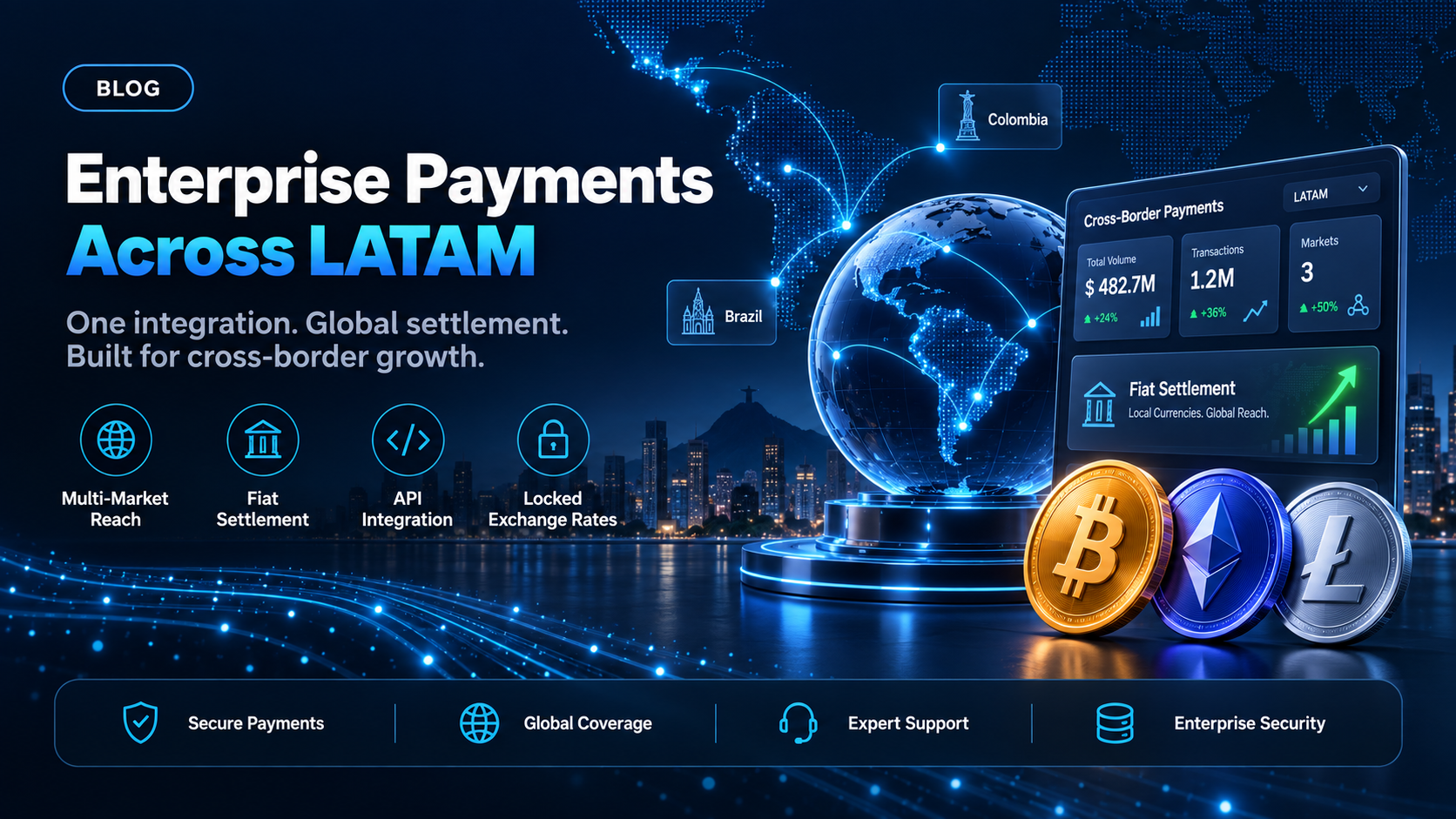
An enterprise operating out of Argentina, Brazil, Mexico, Colombia, Chile, or Peru could reasonably expect this conversation to start and end with a domestic acquirer or a LATAM-native cross-border processor. Mercado Pago dominates checkout in its home markets. dLocal and EBANX built their businesses on local acquiring licenses across the region. EukaPay is not a card acquirer, and it is not a LATAM-domestic processor.
EukaPay is a crypto payment gateway built for a business that collects and pays out across borders, then settles the result in a fiat currency it already uses, without opening a local entity in every market it sells into. This guide compares EukaPay against Mercado Pago, dLocal, EBANX, and Airwallex on the criteria that matter most to an enterprise operator: settlement currency, cross-border coverage, and integration depth.
In this guide, you'll learn:
What an enterprise operator in Latin America should weigh before picking a payment stack
How EukaPay, Mercado Pago, dLocal, EBANX, and Airwallex compare on settlement, coverage, and integration
Where a domestic acquirer or a LATAM-native processor still makes more sense than a crypto payment gateway
How EukaPay's deposit, payout, and settlement flow fits a cross-border enterprise operation
What matters for enterprise payment solutions in Latin America
Three criteria decide whether a payment stack works for an enterprise operator's actual cash flow: where the money lands, how far the coverage reaches, and how much engineering time the integration costs.
Settlement currency - which fiat currency the payout actually lands in
A domestic acquirer settles in the local currency by default, which works for a business paying local costs. A domestic acquirer's local-currency settlement can add a foreign-exchange conversion for a company that reports, pays suppliers, or holds working capital in a different currency. EukaPay settles in USD, EUR, GBP, or CAD to a bank account, regardless of which currency the payer used at checkout.
Cross-border coverage - reach beyond a single country's acquiring license
A local acquiring license is an advantage inside its home market and a limit outside it. dLocal and EBANX built cross-border coverage across multiple LATAM countries specifically because a domestic license does not travel between them. A crypto payment gateway avoids the license question by settling in cryptocurrencies before conversion. The same integration can then accept a payer in one country and a payer in another without a new local agreement for each.
Integration and API depth - how much engineering work the enterprise team absorbs
An enterprise operator usually runs its own finance stack and does not want a payment provider that forces a rebuild around it. The criteria here are a documented API, sandbox access before launch, and webhooks that confirm a payment or a payout without polling for status.
Comparing enterprise payment solutions: EukaPay, Mercado Pago, dLocal, EBANX, and Airwallex
EukaPay | Mercado Pago | dLocal | EBANX | Airwallex | |
|---|---|---|---|---|---|
What it is | Crypto payment gateway | Domestic card acquirer | Cross-border processor | Cross-border processor | Multi-currency platform |
Settlement currency | USD, EUR, GBP, or CAD | Local currency by default | Local currency or USD, by agreement | Local currency or USD, by agreement | Multiple currencies, per account setup |
Cross-border coverage | Wherever a payer can send a supported cryptocurrency | Strongest inside its home markets | Local acquiring licenses across several LATAM countries | Local acquiring licenses across several LATAM countries | Global, card- and bank-rail based |
Pricing model | Volume-based, agreed during onboarding | Varies, confirm with provider | Varies, confirm with provider | Varies, confirm with provider | Varies, confirm with provider |
Refer to websites for current information.
EukaPay's fiat settlement lands in USD, EUR, GBP, or CAD by default, which is the detail an enterprise finance team usually asks about first. Mercado Pago's domestic reach in Argentina, Brazil, and Mexico is real. dLocal's and EBANX's local acquiring coverage across the wider region is real too, and those licenses are the piece EukaPay does not have. What EukaPay adds instead is a settlement currency the reader's own finance stack already runs on, and a single integration that does not change from one country to the next.
Where each payment provider fits a Latin American enterprise
EukaPay fits an enterprise that collects from payers across multiple LATAM countries, wants the result in a currency it already reports in, and would rather not renegotiate a local agreement every time it enters a new market. It is a narrower tool than a full domestic acquirer, built specifically for the cross-border, crypto-to-fiat piece of the stack instead of every payment method a local market offers.
Revenue and cost base concentrated inside one or two LATAM countries points toward a domestic acquirer such as Mercado Pago, where local-currency settlement is what the finance team wants. A need for local acquiring licenses across several countries, paired with the ability to absorb a custom, quote-based pricing relationship, points toward a LATAM-native cross-border processor such as dLocal or EBANX. Card and bank rails running across several regions beyond Latin America point toward a global multi-currency platform such as Airwallex. For the enterprise weighing all three against a crypto payment gateway, EukaPay is the option built for the cross-border, crypto-to-fiat piece specifically.
One platform for deposits, payouts, and fiat settlement
EukaPay locks the exchange rate on every conversion to remove your exposure to crypto price swings, applying instant crypto-to-fiat conversion. The lock is the default on both pay-ins and payouts. Pay-ins accept BTC, ETH, LTC, SOL, USDC, and USDT. Payouts send USDC, USDT, ETH, or BTC, with settlement in USD, EUR, GBP, and CAD to your bank account. A crypto payment confirms on-chain, so protection against chargebacks is a property of the payment method.
An enterprise operator typically weighs a domestic acquirer, a LATAM-native cross-border processor, and a crypto payment gateway. The deciding question is usually the settlement currency and the number of local agreements the finance team wants to manage. EukaPay is built for the operator who wants one integration and one settlement currency across every LATAM market it sells into. Set up a sandbox account and test the deposit and payout flow before your engineering team commits to a full integration.
Get started with EukaPay
Create an account at
to see the deposit and payout flow directly, or start with the
to review the endpoints, sandbox environment, and webhook events before your engineering team commits time to an integration.
Frequently asked questions
What is an enterprise payment solution?
An enterprise payment solution is a payment stack built for a business processing high volumes across multiple markets, usually with specific requirements around settlement currency, API access, and integration with existing finance systems.
Why would an enterprise choose EukaPay over a domestic acquirer like Mercado Pago?
A domestic acquirer settles in the local currency by default. An enterprise that reports, pays suppliers, or holds working capital in USD, EUR, GBP, or CAD often wants that settlement currency directly, which is what EukaPay provides.
Why would an enterprise choose EukaPay over a LATAM-native cross-border processor like dLocal or EBANX?
dLocal and EBANX offer local acquiring licenses across several LATAM countries that EukaPay does not have. An enterprise that instead wants one integration and one settlement currency across every market it sells into is better served by EukaPay's crypto-to-fiat flow.
Can a crypto payment gateway settle in US dollars for a Latin American business?
Yes. EukaPay converts an accepted cryptocurrency to fiat at a locked exchange rate and settles in USD, EUR, GBP, or CAD to a bank account, regardless of the currency or country the payer used.
Does EukaPay require a local entity in each LATAM country it serves?
No. EukaPay's integration does not change from one country to the next, so an enterprise can accept payers across multiple markets through the same API and settlement flow.
What cryptocurrencies can an enterprise accept and pay out with EukaPay?
Pay-ins accept BTC, ETH, LTC, SOL, USDC, and USDT. Payouts send USDC, USDT, ETH, or BTC.
Is EukaPay regulated?
EukaPay is FINTRAC-registered in Canada and FinCEN-registered in the United States.
How long does it take to integrate EukaPay?
Integration time depends on an enterprise team's existing finance stack, but a sandbox environment and API documentation are available before any commitment, so a team can test the deposit and payout flow first.
Related articles
Crypto payment processor: the shortlist for a Latin American business
- how a LATAM operator narrows a crypto payment processor shortlist
Best crypto payment gateway for a business in Latin America
- a full comparison of crypto payment gateways for the region
The best crypto payment gateway with a locked exchange rate to accept stablecoins or crypto in 2026
- how the locked exchange rate protects a payout from crypto price swings
Products
Use Cases
© 2026 EukaPay. All rights reserved.
FINTRAC: M22233887