Digital payouts for a network paying across Latin America
September 03, 2026
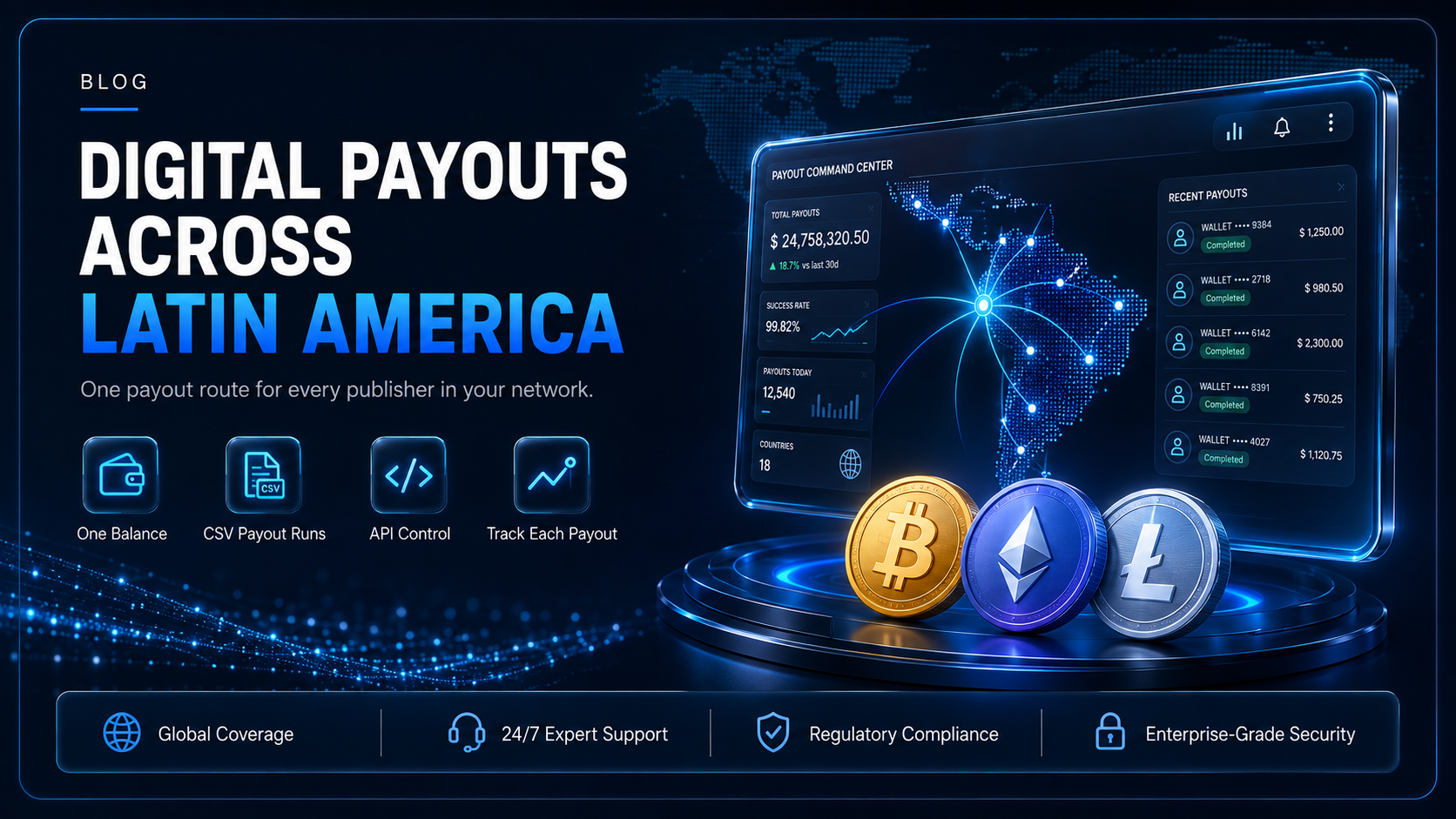
A digital payout is money your network sends out to a recipient over an electronic rail, instead of a cheque or a transfer keyed by hand into a bank portal. The category covers domestic bank transfers started from an uploaded file, transfers into a digital wallet, and crypto payouts sent to a wallet address. What makes a payout digital is that the instruction leaves your system as data. Nobody prints it, signs it, or retypes it into a second system.
For a network collecting from advertisers on one schedule and paying publishers on another, the digital payout route you pick decides how many separate systems payout day depends on. Each country you pay into can bring another domestic rail, another account, and another file format. With EukaPay, one payout run covers the whole region. You upload a recipient list as a CSV file in the merchant dashboard, or create payouts one at a time through the Payout API. Each publisher is paid in USDC, USDT, ETH, or BTC on Ethereum, Tron, or Bitcoin.
In this guide, you'll learn:
What counts as a digital payout, and which manual methods the category replaces
Why advertiser collection schedules and publisher payment schedules set the problem
What a network paying across Latin America needs from a digital payout route
How EukaPay sends mass payouts, and where a domestic rail is still the better answer
What are digital payouts?
A digital payout is any outbound payment your network sends as an electronic instruction. The instruction carries the recipient, the amount, and the destination, and it goes out without a person retyping it. That is the whole definition. Everything after it is a question of which rail carries the instruction and what the recipient ends up holding.
Cheques and hand-keyed bank transfers - the two manual methods digital payouts replace
A cheque needs printing, signing, posting, and depositing. A hand-keyed bank transfer needs a person in your finance team to open a bank portal and type each recipient, each amount, and each account number. Both methods scale with headcount instead of with volume. A network that doubles its publisher count doubles the typing.
Domestic transfers, digital wallets, and crypto payouts - the three digital routes
A domestic bank transfer started from an uploaded file pays into a local account in local currency. A wallet transfer pays into a digital wallet the recipient already holds. A crypto payout sends USDC, USDT, ETH, or BTC to a wallet address the recipient controls. All three are digital payouts. They differ in what the recipient ends up holding, and in how many of them you need to cover a region.
Digital payouts when advertiser collections and publisher payments run on different schedules
Your network collects from advertisers on one schedule and owes publishers on another. The difference between those two schedules is the business. That difference also sets the shape of the payout problem. The money is already collected, and the amounts are already agreed in your commission ledger. The only open question is how the instruction gets out.
A manual method puts that question back on your finance team every cycle. A digital payout route answers it once. The commission ledger makes a list, the list becomes a payout run, and the run pays. Payout day then follows the ledger instead of following whoever was free to work through a bank portal.
What a network paying across Latin America needs from a digital payout route
Paying publishers inside one country needs one rail. Cross-border payouts are where the choice of digital payout route starts to matter, because each country can bring its own account requirement and its own file format. Add a country and you may add a system to maintain, a reconciliation to run, and a balance to fund.
Crypto payouts cut that count to one. A network paying affiliate payouts across the region sends every publisher from a single payout balance, in USDC, USDT, ETH, or BTC, on Ethereum, Tron, or Bitcoin. Asset and network are set per payout, so different publishers in the same run can receive different assets on different networks. Each payout has its own reference that can be looked up. Payouts are not tied to banking hours or the banking calendar.
There is a real limit worth stating plainly. A crypto payout pays a publisher in cryptocurrency. Where a publisher has to receive local currency in a local bank account, a domestic rail or a fiat-only payout vendor is the better answer for that segment. EukaPay's fiat settlement reaches your own bank account in USD, EUR, GBP, or CAD. It is not a way to pay an individual publisher in fiat.
How to choose
Cheque | Hand-keyed bank transfer | EukaPay crypto payout | |
|---|---|---|---|
How the instruction leaves your system | On paper | A person types it | CSV upload, or one payout per API request |
What the publisher receives | Local currency | Local currency | USDC, USDT, ETH, or BTC |
Rails needed for several countries | One per country | One per country | One payout balance |
Tied to banking hours? | Yes | Yes | No |
EukaPay is the route to pick when your publisher list crosses borders and your finance team should not grow with it. A cheque or a hand-keyed transfer still pays a publisher who needs local currency in a local account. A network with one domestic market and a short publisher list may never feel the difference. A network adding countries will feel it every cycle, which is the case for setting up EukaPay before the next country goes live.
One platform for crypto pay-ins, crypto payouts, and fiat settlement
One EukaPay account carries collections and payouts. You collect from advertisers through checkout, invoices, or payment links, and you pay publishers from the payout balance. The account gives you instant crypto-to-fiat conversion at a locked exchange rate to remove your exposure to crypto price swings, support for most major cryptocurrencies, and settlement in USD, EUR, GBP, and CAD to your bank account. A crypto payment confirms on-chain, so protection against chargebacks is a property of the payment method.
The payout balance is funded by transferring from your account's main balance, so you choose how much to move across before a run. Mass payouts are a CSV upload in the merchant dashboard. The Payout API creates one payout per request, which suits a network that wants each payout triggered by its own ledger event instead of by a file. If you pay publishers across Latin America and want one route for the whole region, EukaPay is what to set up next.
Get started with EukaPay
Create an account in the
and complete verification, then generate an API key. Your developer (or coding agent) can read the payout endpoints, the balance transfer call, and the invoice and customer endpoints in the
.
Frequently asked questions
What is the difference between digital payouts and mass payouts?
A digital payout is a single outbound payment sent as an electronic instruction. Mass payouts are how you send many of them at once. With EukaPay, mass payouts are a CSV recipient list uploaded in the merchant dashboard.
Which cryptocurrencies can EukaPay send to a publisher?
Payouts are sent in USDC, USDT, ETH, or BTC, on Ethereum, Tron, or Bitcoin.
Can each publisher in one payout run receive a different cryptocurrency?
Yes. Asset and network are set per payout, so different publishers in the same run can receive different assets on different networks.
Does the EukaPay Payout API send more than one payout per request?
No. The Payout API creates one payout per request. To send many publishers at once, upload a CSV recipient list in the merchant dashboard.
Can a publisher in Latin America be paid in local currency through EukaPay?
Not directly. A publisher is paid in USDC, USDT, ETH, or BTC to a wallet address they control. EukaPay's fiat settlement in USD, EUR, GBP, or CAD reaches your own bank account, not a publisher's.
How is the EukaPay payout balance funded?
By transferring from your account's main balance. You choose how much to move across before a run.
Are EukaPay payouts tied to banking hours?
No. Payouts are not tied to banking hours or the banking calendar.
Can I look up a single payout after a run?
Yes. Each payout has its own reference that can be looked up, which is what you need when a publisher asks about one line.
Related articles
Mass payments for a Latin American network operator
- What a mass payment run is, and how a network turns collected advertiser revenue into publisher payouts.
Mass payouts for a Latin American affiliate or ad network
- How a network pays every publisher in one run instead of one transfer at a time.
Global payouts: paying recipients across Latin America
- How to pay recipients across the region without opening an account in every country.
Products
Use Cases
© 2026 EukaPay. All rights reserved.
FINTRAC: M22233887