Crypto payment gateway options for a Latin American business
August 31, 2026
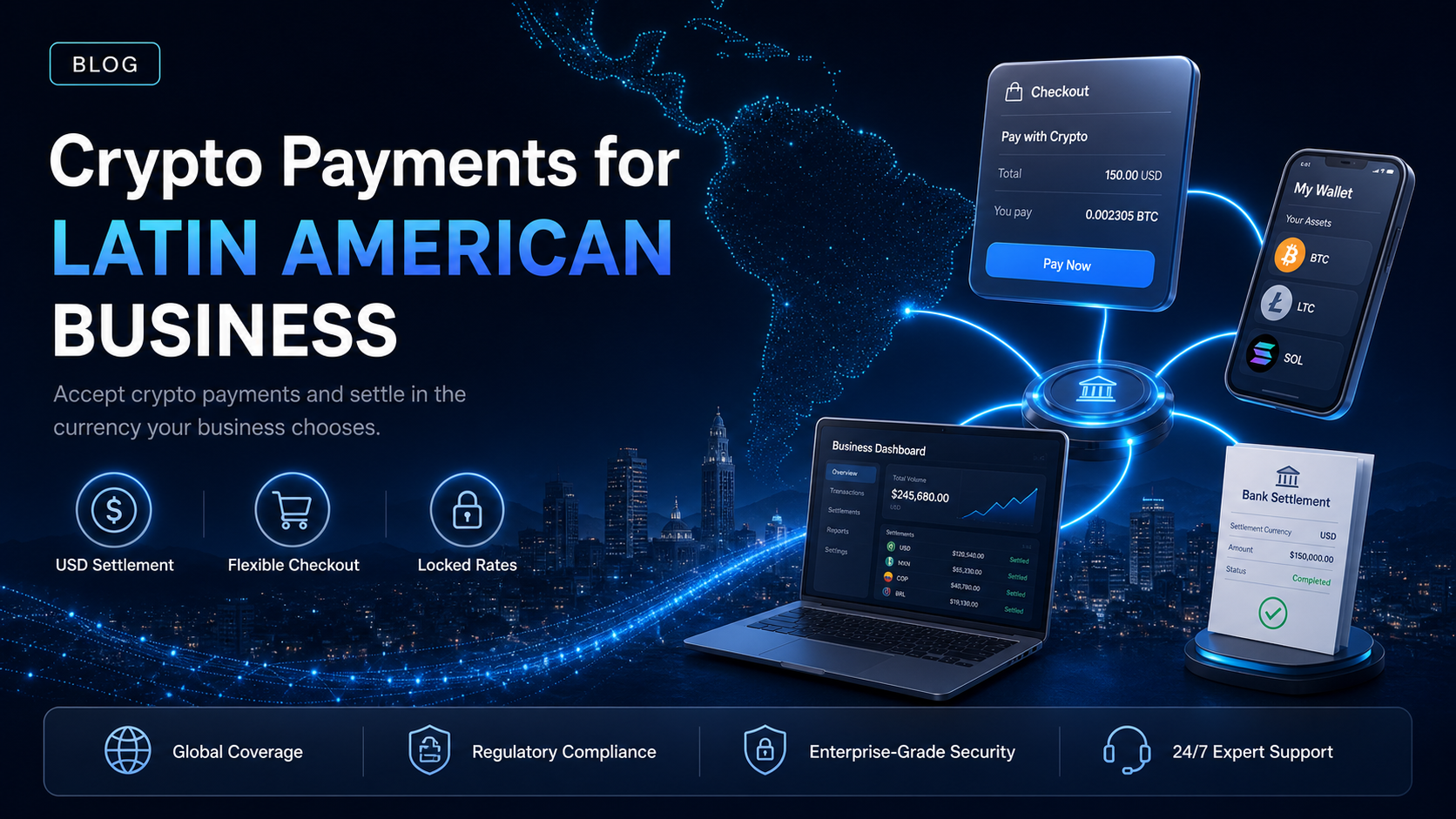
A crypto payment gateway exists to solve a specific, dated problem for a business like this. A Brazilian business that pays a foreign supplier or converts foreign revenue back to reais runs into the country's tax on financial transactions, the IOF. Brazil's Supreme Federal Court reinstated a 3.5% IOF rate on international card purchases and outbound foreign-exchange transactions on July 16, 2025. That rate has stayed in force into 2026 (Courthouse News, July 2025; EY tax alert, July 2025). On top of that tax, a business still absorbs its card acquirer's foreign-exchange spread. On emerging-market card traffic, it can also see a materially higher decline rate than it sees on domestic cards.
None of this is unique to card rails. It is the specific, dated version of a familiar problem: money moving in or out of Brazil, Argentina, Colombia, Chile, or Peru is slower and less predictable than the same payment moving inside the US or the EU. This guide walks through what a crypto payment gateway actually does for a Latin American business, how the pieces fit together, and where EukaPay fits in.
In this guide, you'll learn:
Why cross-border settlement is harder for a business based in Brazil or Argentina than for a US or EU counterpart
Which cryptocurrencies a customer or client can pay with, and what that means for the business receiving the funds
How to choose between a payment link, a hosted checkout, and the API for accepting payments
What EukaPay settles into a Latin American business's bank account, and in which currencies
Why is cross-border settlement difficult for a business in Brazil or Argentina?
A Brazilian business invoicing a client in the United States or the European Union has three ways for that payment to arrive: an international wire, a card payment, or a payment processed through a local acquirer with cross-border reach. Each one adds cost before the money is fully usable. The IOF applies to international card transactions and to foreign-exchange transactions for goods and services. A wire adds correspondent-bank fees on top of the sending bank's own exchange rate. A card payment adds the acquirer's foreign-exchange spread. Cross-border card traffic can also see a materially higher decline rate than the same card issuer sees on a domestic transaction.
Argentina's businesses face a related but distinct problem. Exchange-rate volatility and periodic capital controls make it harder to hold a stable balance in pesos long enough to convert it into dollars on favorable terms. A business paying a foreign supplier or receiving foreign client revenue in Argentina often finds the peso balance it is holding worth less by the time it converts than when it was received.
Neither of these is a reason to abandon card rails or bank transfers. It is a reason a growing number of Brazilian and Argentine operators are adding stablecoin or crypto acceptance as a second rail, one that settles in a currency the business chooses instead of the currency its bank happens to default to.
What does a crypto payment gateway let a Latin American business accept?
A crypto payment gateway sits between a customer's wallet and the business's account. The customer pays in a supported cryptocurrency. The gateway converts that payment, and the business receives value in the currency it chose when it set up the account. EukaPay's pay-in side supports BTC, ETH, USDT, USDC, BCH, LTC, and SOL, along with Lightning. The business does not need to hold any of these assets or manage a wallet to receive a payment. The customer is the one initiating the transaction from their own wallet.
This matters for a Latin American business selling to clients outside the region. A client in the US or the EU who already holds USDT or USDC can send a payment directly from their own wallet, with no wire and no card network in the path. For the business receiving the payment, the settlement currency is what determines whether the transaction actually solves the original problem.
How to choose between a payment link, checkout, and the API
Payment link | Hosted checkout | API | |
|---|---|---|---|
Who sends the request? | The business, from the dashboard | The customer, at the point of sale | The business's own system, automatically |
Coding required? | No | Minimal, an embed or redirect | Yes, a developer (or coding agent) integrates it |
Typical use | A one-off invoice or a client payment | A storefront or subscription checkout | Recurring or high-volume payment flows |
Setup time | Minutes, from the dashboard | Hours, for the embed | Longer, for a full integration |
A Brazilian services business invoicing a handful of clients a month can start with payment links and never touch a line of code. An e-commerce operator in Argentina selling to a broader customer base is a better fit for the hosted checkout, since it stays on the storefront the customer already trusts. A business processing a high volume of transactions, or one that wants payment data flowing directly into its own systems, is the one that justifies the API integration.
What EukaPay settles for a Latin American business
EukaPay settles in USD, EUR, GBP, or CAD, credited to the business's own bank account, not to an individual recipient. That is the core difference for a business trying to get out of reais or pesos and into a currency it can use to pay a foreign supplier or hold for its own cross-border obligations. EukaPay locks the exchange rate on every conversion by default, on pay-ins and on payouts, to remove your exposure to crypto value swings. A crypto payment settles on-chain, so protection against chargebacks is a property of the payment method.
EukaPay is registered with FINTRAC in Canada and with FinCEN in the United States. It does not hold, and does not claim to hold, a license to operate in Brazil, Argentina, or any other Latin American country.
Get started with EukaPay
A Latin American business can
and start with payment links, then move to the hosted checkout or the API once the payment volume justifies it. Developers can review the full integration reference at
before writing any code.
Frequently asked questions
What cryptocurrencies can a Latin American business accept with EukaPay?
EukaPay's pay-in side supports BTC, ETH, USDT, USDC, BCH, LTC, and SOL, along with Lightning. A customer pays with any of these directly from their own wallet.
Does EukaPay settle in Brazilian reais or Argentine pesos?
No. EukaPay settles in USD, EUR, GBP, or CAD to the business's own bank account. A business still converts to local currency through its own bank if it needs pesos or reais for local spending.
Can a Brazilian business receive a payment in dollars from a US client using a crypto payment gateway?
Yes. The client pays in a supported cryptocurrency from their own wallet, and the Brazilian business receives the converted value in the currency it selected when setting up the account, including USD.
Is EukaPay licensed to operate in Brazil or Argentina?
No. EukaPay is registered with FINTRAC in Canada and FinCEN in the United States. It does not hold a local license in any Latin American country and does not claim to.
Does a customer need an existing crypto wallet to pay a Latin American business through EukaPay?
Yes. The customer initiates the payment from their own wallet. The business receiving the payment does not need a wallet of its own.
How does a crypto payment gateway protect against chargebacks?
A crypto payment confirms on-chain once the customer sends it, so there is no card network dispute process to reverse the transaction after the fact. That protection comes from the payment method itself.
How long does it take EukaPay to settle a payment to a business's bank account?
EukaPay does not publish a fixed settlement duration. Settlement to a bank account is not tied to banking hours or the banking calendar the way a wire transfer often is.
Can a Latin American business use a crypto payment gateway alongside its existing card acquirer?
Yes. Accepting stablecoins or crypto through a gateway like EukaPay is a second rail, not a replacement for an existing acquirer relationship. A business can offer both and let the customer choose.
Related articles
Getting paid in dollars when your local currency is unstable
- how USD settlement addresses currency instability for a Latin American business
The best crypto payment gateway with a locked exchange rate to accept stablecoins or crypto in 2026
- how a locked exchange rate removes exposure to crypto price swings
The best crypto payment gateway with no chargebacks to accept stablecoins or crypto in 2026
- why crypto payments carry no chargeback risk
Products
Use Cases
© 2026 EukaPay. All rights reserved.
FINTRAC: M22233887