Crypto business account: what it covers, and where settlement lands
August 31, 2026
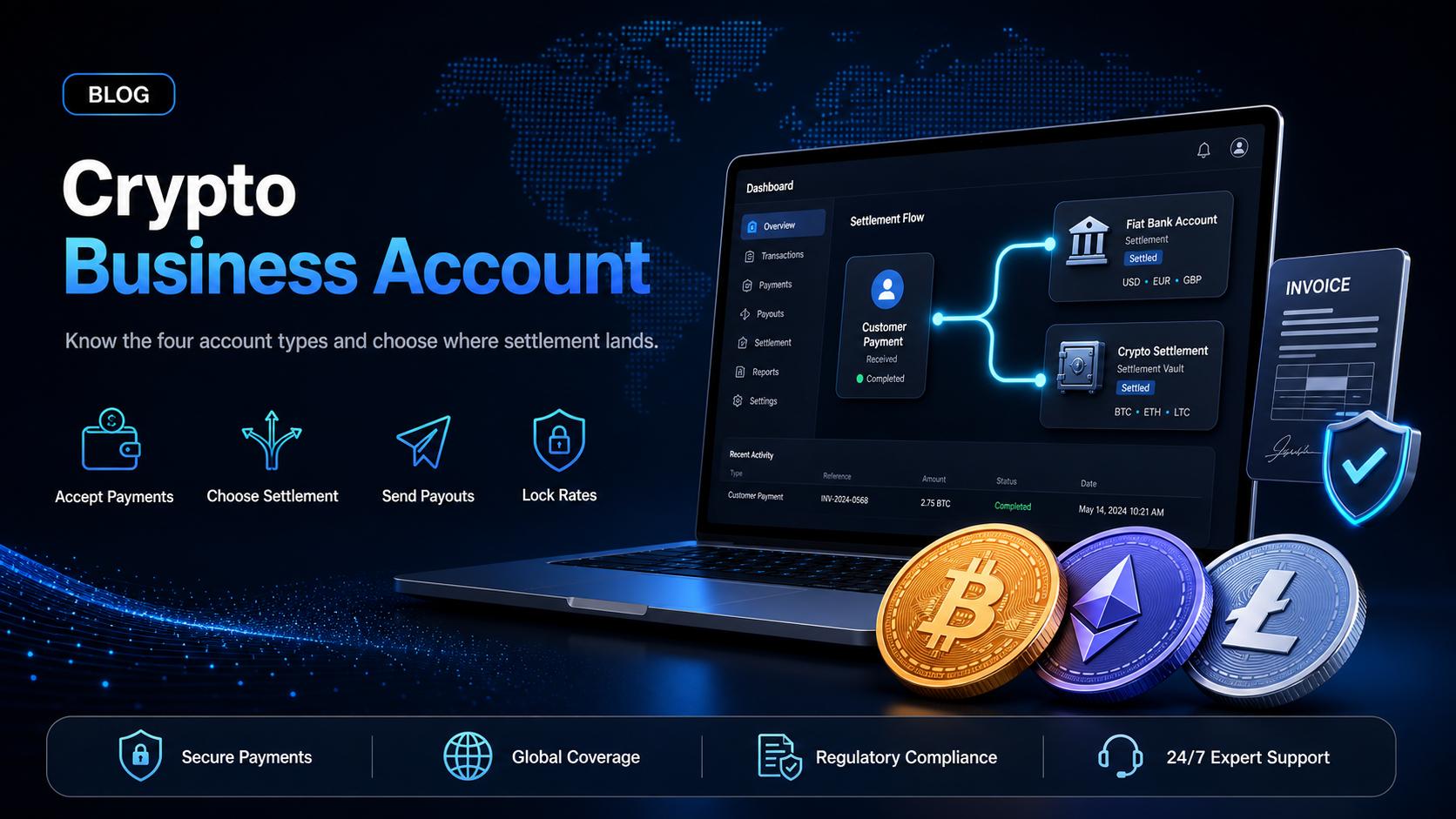
A finance lead asked to "open a crypto business account" usually has one of four jobs in mind, and the four have almost nothing in common. Holding an asset on the balance sheet is not the same as accepting payment from a customer. Paying twelve contractors is not the same as either. Trading is a fourth thing again.
The phrase collapses all of them, which is how companies end up with a product that does the wrong job well. EukaPay is built for the second of those four, collecting payment and settling it where you want it, and the clearest way to explain that is to separate the categories first.
In this guide, you'll learn:
The four products sold as a crypto business account, and what each one owns
Which questions tell you quickly which category you are actually in
A criteria table comparing the approaches without a rate card
What settlement means in practice, and where the money ends up
The four things "crypto business account" can mean
Custody and holding - a place to keep an asset
The job is storage. A cryptocurrency sits on the company's balance sheet and needs somewhere to live. Nothing here involves a customer or a supplier.
Acceptance and settlement - a way to be paid
The job is collection. A customer owes you money and wants to pay in cryptocurrency, or you want to offer that option to widen how you get paid. What matters is where the value lands afterwards, and in which currency.
Payouts - a way to pay other people
The job is distribution. Contractors, affiliates, suppliers, or creators need paying, often across many markets at once. The requirements are recipient handling and repeatability rather than checkout experience.
Trading and treasury - a way to convert or position
The job is execution. The company is converting between assets or managing a position. This is an exchange or desk relationship, and it is not a payments product.
Most confusion in a vendor conversation comes from two people holding different items from that list. A useful opening question is simply whether money is coming in, going out, sitting still, or changing shape.
Which corporate crypto account do you actually need?
Three questions usually settle it.
Who initiates the movement?
If a customer does, you need acceptance. If you do, you need payouts. If nobody does routinely, you need custody.
What currency does the finance team want to see at the end?
If the answer is your normal operating currency, you need a product with fiat settlement rather than a wallet. A business crypto wallet holds the asset. It does not convert it and send it to your bank.
How often does this happen?
A one-off conversion is a desk conversation. A recurring flow tied to invoices or a payment run is a payments integration, and the operational cost sits in reconciliation rather than in the fee.
The failure mode worth naming: choosing custody when the job was acceptance. The asset arrives, sits in a wallet, and the finance team now owns a position it never wanted and has to convert manually every month.
How to choose
Custody or wallet | Exchange or desk | Payouts tool | EukaPay for acceptance | |
|---|---|---|---|---|
Primary job | Hold an asset | Convert or position | Send to many recipients | Collect from customers |
Who starts the transaction | Nobody routinely | Your treasury | You | Your customer |
Ends in your bank account | No | On withdrawal | Not applicable | Yes, if you choose fiat settlement |
Currencies at the end | The asset held | The asset bought | The asset sent | USD, EUR, GBP, CAD, or crypto |
Fits an invoice workflow | No | No | Outbound only | Yes, via invoices, links, or the API |
Approaches compared, not vendors.
EukaPay sits in the acceptance column, and also runs payouts, so a company doing both does not need two integrations. A shortlist that mixes all four categories will compare them on criteria that only fit one of them.
What settlement actually means here
This is the part that decides whether a crypto business account solves your problem or creates a new one.
When a customer pays you through EukaPay, you choose fiat or crypto settlement. Fiat settlement reaches your own bank account, with settlement currencies including USD, EUR, GBP, and CAD. Crypto settlement keeps the asset. The choice is yours rather than the payer's, which means the payer can use the asset they hold without the finance team inheriting a position.
Pay-ins support BTC, ETH, USDT, USDC, BCH, LTC, SOL, and Lightning. Payouts are sent in USDC, USDT, ETH, and BTC, across the Ethereum, Tron, and Bitcoin networks, with the asset and network set per payout so different recipients in the same run can receive different things.
Collection happens through
, payment links, checkout, or the API. For outbound runs, a recipient list is uploaded as a CSV file in the merchant dashboard, and the payout API creates payouts programmatically, one payout per request. The payout balance is funded by transferring from the account's main balance.
One platform underneath
EukaPay gives you instant crypto-to-fiat conversion at a locked exchange rate to remove your exposure to crypto price swings, support for most major cryptocurrencies, and settlement in USD, EUR, GBP, and CAD to your bank account. A crypto payment confirms on-chain, so protection against chargebacks is a property of the payment method.
The recommendation for a company whose actual job is collection is straightforward. Choose the acceptance category rather than a wallet or an exchange login, because that is the one that puts your operating currency in your bank account. Pricing is agreed with the EukaPay team. Open an account and run a single test invoice before deciding anything larger.
Get started with EukaPay
Create an account at
, complete verification, provide your legal business information, and generate an API key. A staging environment is available for development work. The invoice, subscription, customer, payout, and balance transfer endpoints are documented at
.
Frequently asked questions
What is a crypto business account?
The phrase covers four different products: custody or a wallet for holding assets, an exchange or desk for converting them, a payouts tool for sending to many recipients, and an acceptance product for collecting from customers. Deciding which job you need comes first.
Is a business crypto wallet the same as a payment account?
No. A wallet holds an asset. It does not convert the asset and deposit the proceeds in your bank account, which is usually what a finance team means when they ask for an account.
Can I receive cryptocurrency and get regular currency in my bank?
Yes. You choose fiat or crypto settlement, and fiat settlement reaches your own bank account. Settlement currencies include USD, EUR, GBP, and CAD.
Which cryptocurrencies can customers pay with?
Pay-ins support BTC, ETH, USDT, USDC, BCH, LTC, SOL, and Lightning.
Which cryptocurrencies can I send payouts in?
Payouts are sent in USDC, USDT, ETH, and BTC, on the Ethereum, Tron, and Bitcoin networks. Asset and network are set per payout.
Do I need separate providers for collecting and paying out?
No. EukaPay covers both, so one integration handles money coming in and money going out.
How do I pay a large list of recipients?
Upload the recipient list as a CSV file in the merchant dashboard. The payout API is also available and creates one payout per request.
What do I need to open an account?
Sign up, complete verification, and provide your legal business information. You can then generate an API key.
Related articles
Crypto-to-fiat conversion at a locked rate
- how the settlement choice works in practice
How to choose a crypto payment gateway in 2026
- the wider selection criteria for the acceptance category
How to create a crypto invoice
- the collection flow, step by step
Products
Use Cases
© 2026 EukaPay. All rights reserved.
FINTRAC: M22233887