Cross border payment gateway for Latin American businesses
September 09, 2026
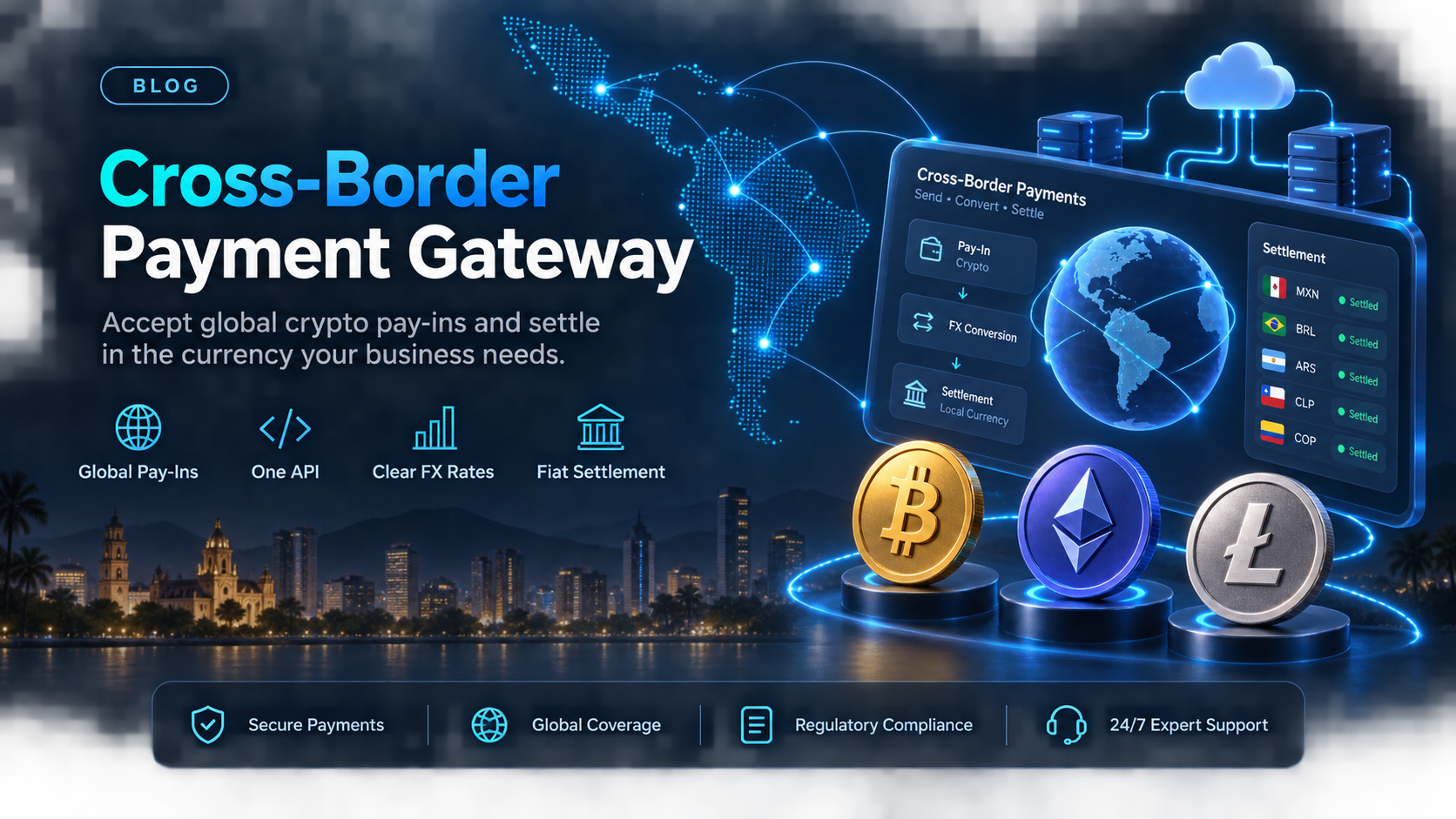
A business in Argentina, Mexico, Brazil, Colombia, Chile, or Peru selling to customers outside the region could reasonably expect the answer here to be a card acquirer. A domestic processor like Mercado Pago could look like the answer too. Both are strong at what they were built for: collecting local cards and wallets from local shoppers. Neither was built to settle a business that gets paid from outside Latin America. Neither was built for a business that wants to hold and convert crypto pay-ins instead of waiting on a card network and a local bank.
This guide compares EukaPay against Mercado Pago, dLocal, and Wise on the criteria above: settlement currency, country and payment-method coverage, and fee transparency. EukaPay is built for the business that needs to accept stablecoins or crypto from customers anywhere and settle to its own bank account. It does this without negotiating a separate local acquiring relationship in every market it sells into.
In this guide, you'll learn:
The three criteria that actually separate cross-border payment gateways for a Latin American seller
How EukaPay, Mercado Pago, dLocal, and Wise compare on settlement currency, coverage, and pricing
Where a domestic processor, a LATAM-native acquirer, or a multi-currency account each fit best
How EukaPay's settlement and conversion mechanics work for a business selling across borders
What matters when comparing a cross-border payment gateway for Latin America
Settlement currency - where the money lands after conversion
A Latin American business selling internationally is usually trying to get out of its local currency, not deeper into it. The gateway matters less than what currency it deposits into the business's own bank account, and how often that currency shifts with local inflation or exchange controls.
Country and payment-method coverage - which markets and rails are supported
Some providers are built around one country's card networks and instant-transfer rails. Others are built to reach many countries at once, at the cost of negotiating separate terms per market. A business selling out of Latin America needs to know which model it is buying before it signs up.
Fee transparency - how pricing is set and disclosed
Cross-border processors price by country, payment method, and volume, and that pricing is not always public. A business should know, before onboarding, whether a rate is published or something it has to negotiate case by case.
Comparing EukaPay, Mercado Pago, dLocal, and Wise
EukaPay | Mercado Pago | dLocal | Wise | |
|---|---|---|---|---|
Cross-border fee | Volume-based, confirmed during onboarding | Varies, confirm with provider | 2.99%-4.99% by country and method, plus local tax | Free Wise-to-Wise; fixed fee for USD wire receipt |
Settles to your bank account in | USD, EUR, GBP, CAD | Local currency only, per country | Local currency, negotiated per merchant | Multiple currencies via a Wise Business account |
Regional coverage | Crypto pay-ins from any country with internet access | Argentina, Brazil, Mexico, and other home markets | 14 Latin American countries with local cards, cash, and bank transfers | Global, not LATAM-specific |
Refer to websites for current information.
EukaPay's team confirms pricing with each business during onboarding rather than publishing a public rate card.
A business selling cross-border out of Latin America gets well-documented domestic pricing from Mercado Pago in its home markets. It still needs a separate conversation about what happens when the buyer is not local. dLocal publishes country-by-country processing fees for local cards, cash vouchers, and bank transfers in its own pricing documentation. Its rates step up in countries with fewer supported methods. Wise publishes its transfer fees on its own site. A Wise account is a way to move existing fiat, not a way to collect a new pay-in from a customer paying with crypto or a card at checkout.
Where Mercado Pago, dLocal, and Wise fit for a Latin American business
A business selling primarily to shoppers already using Mercado Pago's wallet should keep using it for that traffic. Mercado Pago's advantage in its home markets is real, and its brand recognition in Argentina, Brazil, and Mexico is not something a newer entrant, EukaPay included, can replicate.
A business collecting most of its revenue in local currency from local shoppers gets real value from dLocal and EBANX's coverage. Both built their businesses on local acquiring licenses across a wide set of Latin American countries. That licensing is what lets them offer OXXO vouchers in Mexico, Pix in Brazil, and PSE in Colombia inside a single integration.
A business that already holds multiple currencies and needs to move money between its own accounts has a different job, and Wise fits it. It also works for paying a supplier abroad without the spread a bank would charge. It is not built to sit at checkout and accept a payment from a new customer.
EukaPay fits the business selling out of Latin America to customers who hold or prefer stablecoins or crypto. It also fits the business that wants one settlement path in USD, EUR, GBP, or CAD, instead of negotiating a domestic acquiring deal in every country it ships to. A company can keep Mercado Pago for its domestic base and add EukaPay for the buyers a card network or a local acquirer was never going to reach.
One platform for deposits, payouts, and fiat settlement
EukaPay runs pay-ins and settlement through the same account. A customer pays in most major cryptocurrencies like BTC, ETH, LTC, SOL, USDC, or USDT. EukaPay applies instant crypto-to-fiat conversion at a locked exchange rate to remove your exposure to crypto price swings. EukaPay locks the exchange rate on every conversion by default, on pay-ins and on payouts. EukaPay settles to a business's own bank account in USD, EUR, GBP, or CAD. A crypto payment confirms on-chain, so protection against chargebacks is a property of the payment method, not a separate service layered on top. The same account can send crypto payouts in USDC, USDT, ETH, or BTC. A Latin American business can use this when it needs to pay a supplier or a contractor outside its own banking network.
A business can outgrow what a crypto payment processor built for Latin America already covers. It can also need a settlement currency a card acquirer will not offer. Either way, EukaPay is the more direct route: one integration, one settlement path, and no separate local acquiring negotiation per country.
Get started with EukaPay
Sign up at
to start onboarding, or read the
to see how pay-ins, payouts, and settlement fit together before committing to an integration.
Frequently asked questions
What cryptocurrencies can a Latin American business accept from customers?
EukaPay accepts most major cryptocurrencies like BTC, ETH, LTC, SOL, USDC, and USDT on the pay-in side.
What currencies does EukaPay settle to a business's bank account?
EukaPay settles in USD, EUR, GBP, or CAD, paid to the business's own bank account.
Is the exchange rate locked when EukaPay converts crypto to fiat?
Yes. EukaPay applies a locked exchange rate by default on every conversion, on both pay-ins and payouts, so the fiat value is set at the moment of payment.
Are chargebacks a risk with crypto pay-ins?
A crypto payment confirms on-chain, so protection against chargebacks is a property of the payment method rather than something added on afterward.
Can a Latin American business use EukaPay to pay suppliers or contractors abroad?
Yes. EukaPay sends crypto payouts in USDC, USDT, ETH, or BTC, funded from the business's account balance.
Does EukaPay require a local bank account in each Latin American country it sells into?
No. Settlement reaches the business's own bank account in USD, EUR, GBP, or CAD, instead of requiring a separate local-currency account in every market it sells into.
How does onboarding work for a business based in Latin America?
A business signs up, completes verification, provides its legal business information, and then generates an API key. A staging environment is available for development during that process.
What other products can a Latin American business use besides payment collection?
Invoices, payment links, checkout, and subscriptions are all available on the same account as pay-ins and payouts.
Related articles
Crypto payment processor: the shortlist for a Latin American business
- what to look for before picking a crypto-native processor over a card acquirer.
Best crypto payment gateway for a business in Latin America
- a broader comparison of crypto payment gateways scored for the LATAM market.
Getting paid in dollars when your local currency is unstable
- how settlement currency choice affects a business exposed to local inflation.
Products
Use Cases
© 2026 EukaPay. All rights reserved.
FINTRAC: M22233887