Blockchain payment processing: what it changes for a Brazilian merchant
September 03, 2026
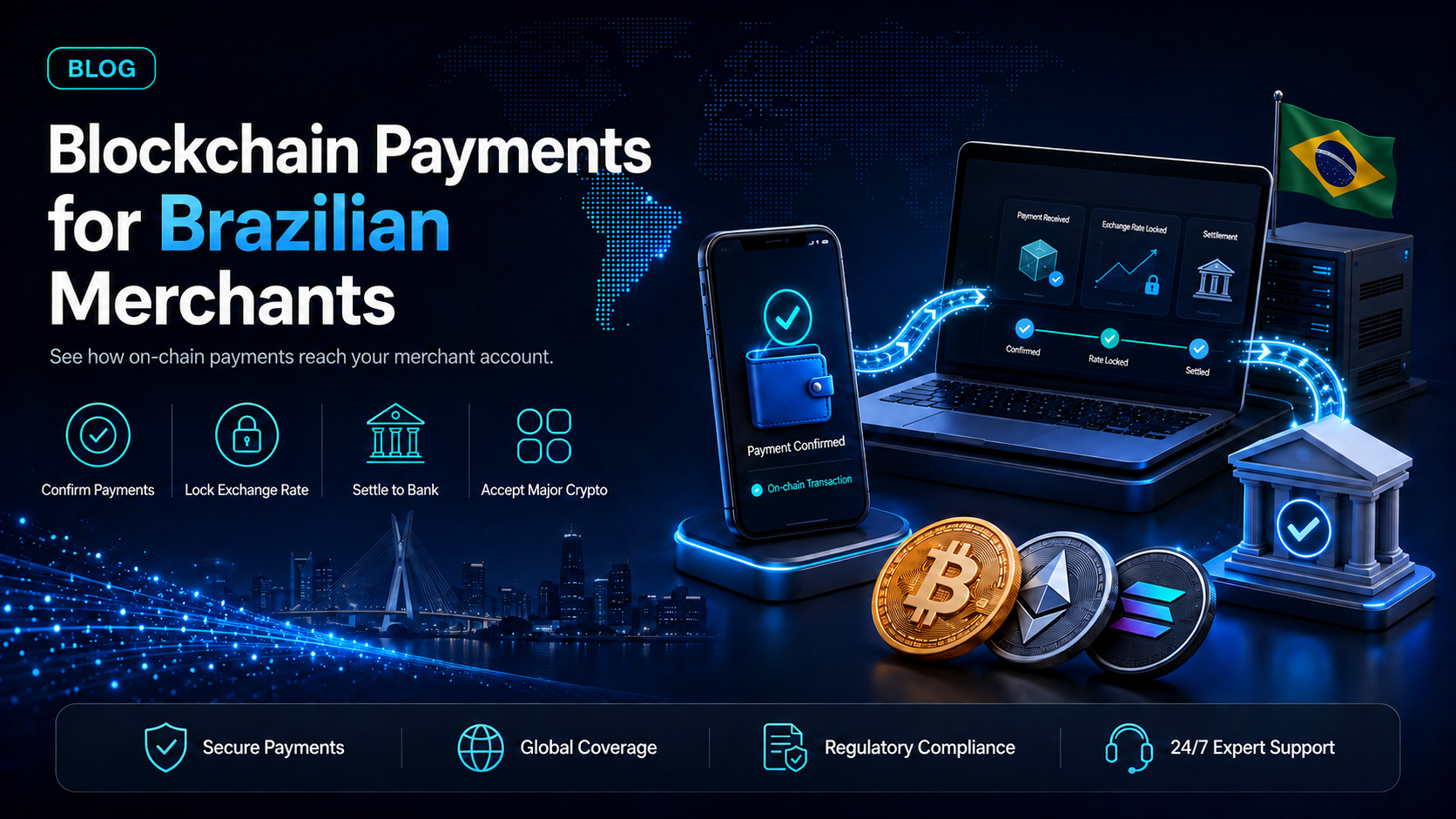
Blockchain payment processing is not about buying or holding a cryptocurrency. It is the operational path a business uses when a customer or another business pays it with a cryptocurrency and that value needs to reach the business's own bank account. A payer sends the payment on a blockchain network, the network confirms the transaction, and a payment processor converts and settles the value for the merchant.
For a Brazilian business, that path runs alongside the card networks and bank transfers it already uses. EukaPay handles this specific job for a Brazilian merchant: accepting a blockchain payment from a customer or another business, confirming it, and settling the converted value. This guide covers how blockchain payment processing works end to end, what changes for a merchant moving beyond cards, and what a Brazilian business should confirm before it adds the rail.
In this guide, you'll learn:
How a blockchain payment moves from a payer to a Brazilian merchant's account
What changes versus card and bank-transfer processing
Which cryptocurrencies a Brazilian business can realistically accept and pay out
What EukaPay does for a merchant on this rail, and where it stops
What blockchain payment processing means for a Brazilian merchant
Blockchain payment processing covers three jobs a business needs done every time it accepts a payment on a blockchain network. First, the payment has to be received and confirmed on the network it was sent on. Second, the value has to be converted into a currency the business can use. Third, the converted value has to settle into an account the business controls.
A Brazilian merchant evaluating this rail is usually solving a specific problem: a customer or a business partner outside Brazil wants to pay in a cryptocurrency. The merchant needs that payment to become usable money without taking on the job of running blockchain infrastructure itself. That is the role a payment processor plays. The merchant integrates once. The processor then handles confirmation, conversion, and settlement on every payment after that.
How a blockchain payment moves from a payer to a Brazilian merchant
The pay-in step - a payer sends the transaction
A customer or another business initiates a cryptocurrency payment from their own wallet. EukaPay's pay-in side accepts most major cryptocurrencies, including BTC, ETH, LTC, SOL, USDC, and USDT. A Brazilian merchant can quote a payment in the asset its payer already has instead of requiring a specific one.
Confirmation and conversion - the network confirms, the processor converts
Once the payer broadcasts the transaction, the blockchain network confirms it. EukaPay converts the payment at a locked exchange rate, applied by default on every conversion, on pay-ins and on payouts. The merchant is not exposed to crypto price swings between the moment a customer pays and the moment the value settles. No lock duration is published. The rate is fixed at the moment of conversion, not for a window afterward.
A crypto payment confirms on-chain, so protection against chargebacks is a property of the payment method. That is a structural difference from card processing, where a chargeback can reverse a completed transaction weeks later.
What changes versus card and bank-rail processing
Card processing | Bank transfer | Blockchain payment processing | |
|---|---|---|---|
Who confirms the payment | Card network and issuing bank | Sending and receiving banks | The blockchain network |
Reversal risk after confirmation | Chargeback possible | Recall possible in limited cases | A property of the payment method, not the processor |
Cross-border reach | Limited by card network and issuer coverage | Limited by correspondent banking relationships | Limited by which cryptocurrencies the payer and merchant both support |
What the merchant integrates | Card acceptance and PCI scope | Bank account details and transfer rails | A payment API or hosted payment page |
A Brazilian merchant selling outside its usual card and bank relationships often reaches a payer more directly on a blockchain rail than through a card network or a correspondent banking chain. The trade-off is that both sides need access to a supported cryptocurrency, and that is not yet as universal as a card or a bank account.
Cryptocurrencies a Brazilian business can accept and pay out
The asset list depends on which side of the transaction a Brazilian merchant is looking at.
On the pay-in side, a merchant can accept BTC, ETH, LTC, SOL, USDC, and USDT from a customer or business partner. On the payout side, sending money out, EukaPay supports a narrower set: USDC, USDT, ETH, and BTC, over the Ethereum, Tron, and Bitcoin networks. A Brazilian business that both collects payments and pays suppliers or contractors on a blockchain rail should plan around these two separate lists. Payouts do not mirror pay-ins.
Asset and network are set per payout. A business paying several recipients in the same run can send different assets on different networks to each one. Mass payouts to a longer recipient list are handled as a CSV upload in the merchant dashboard. The Payout API creates one payout per request for a business that wants to trigger payouts programmatically.
One platform for pay-ins, payouts, and fiat settlement
EukaPay is not the infrastructure that issues or moves value on-chain. It is the platform a Brazilian merchant integrates once to accept a blockchain payment, convert it, and settle it. The same integration sends a payout back out on its supported assets. The platform provides instant crypto-to-fiat conversion at a locked exchange rate to remove your exposure to crypto price swings, support for most major cryptocurrencies, and settlement in USD, EUR, GBP, and CAD to your bank account.
For a Brazilian business weighing blockchain payment processing against staying on cards and bank transfers alone, the practical answer is that the two can run side by side. EukaPay gives that business a single integration for the blockchain leg while its existing card and bank rails keep working as they already do. The next step is a signup and a look at what the API returns for a first test payment.
Get started with EukaPay
A Brazilian business can create an account at
and review the payment, payout, invoicing, and subscription endpoints in
before building an integration. The documentation covers the endpoints a merchant needs to accept a first blockchain payment and to send a first payout.
Frequently asked questions
What is blockchain payment processing?
It is the combination of confirming a payment made on a blockchain network, converting the value, and settling it into an account the merchant controls. A processor like EukaPay handles all three steps for the merchant.
Does a Brazilian merchant need to keep cryptocurrency on hand to use blockchain payment processing?
No. The merchant accepts a payment in a supported cryptocurrency and EukaPay converts it. The merchant chooses fiat or crypto settlement on its own account.
Which cryptocurrencies can a Brazilian business accept from customers?
EukaPay's pay-in side supports most major cryptocurrencies, including BTC, ETH, LTC, SOL, USDC, and USDT.
Which cryptocurrencies can a Brazilian business send in a payout?
Payouts are sent in USDC, USDT, ETH, or BTC, over the Ethereum, Tron, or Bitcoin networks.
How does the exchange rate work on a blockchain payment?
EukaPay locks the exchange rate on every conversion by default, on pay-ins and on payouts. The merchant knows the converted value at the moment of conversion, not after it settles.
Are blockchain payments protected against chargebacks?
A crypto payment confirms on-chain, so protection against chargebacks is a property of the payment method itself, not a separate service the processor adds.
Can a Brazilian business send payouts to multiple recipients at once?
The Payout API creates one payout per request. A longer recipient list is handled as a CSV upload in the merchant dashboard.
Where does settled money go?
Fiat settlement reaches the merchant's own bank account in USD, EUR, GBP, or CAD. It is not a way to pay an individual recipient in fiat directly.
Related articles
Stablecoin payments for a Brazilian business that moves money
- how a Brazilian business evaluates a stablecoin rail specifically
Stablecoin infrastructure: the layers and who owns each
- who builds the rail versus who a merchant integrates with
Web3 payments: what they are and how a business uses them
- the broader category blockchain payment processing sits inside
Products
Use Cases
© 2026 EukaPay. All rights reserved.
FINTRAC: M22233887