BitPay Alternative: Why Merchants Are Switching to EukaPay in 2026
April 29, 2026
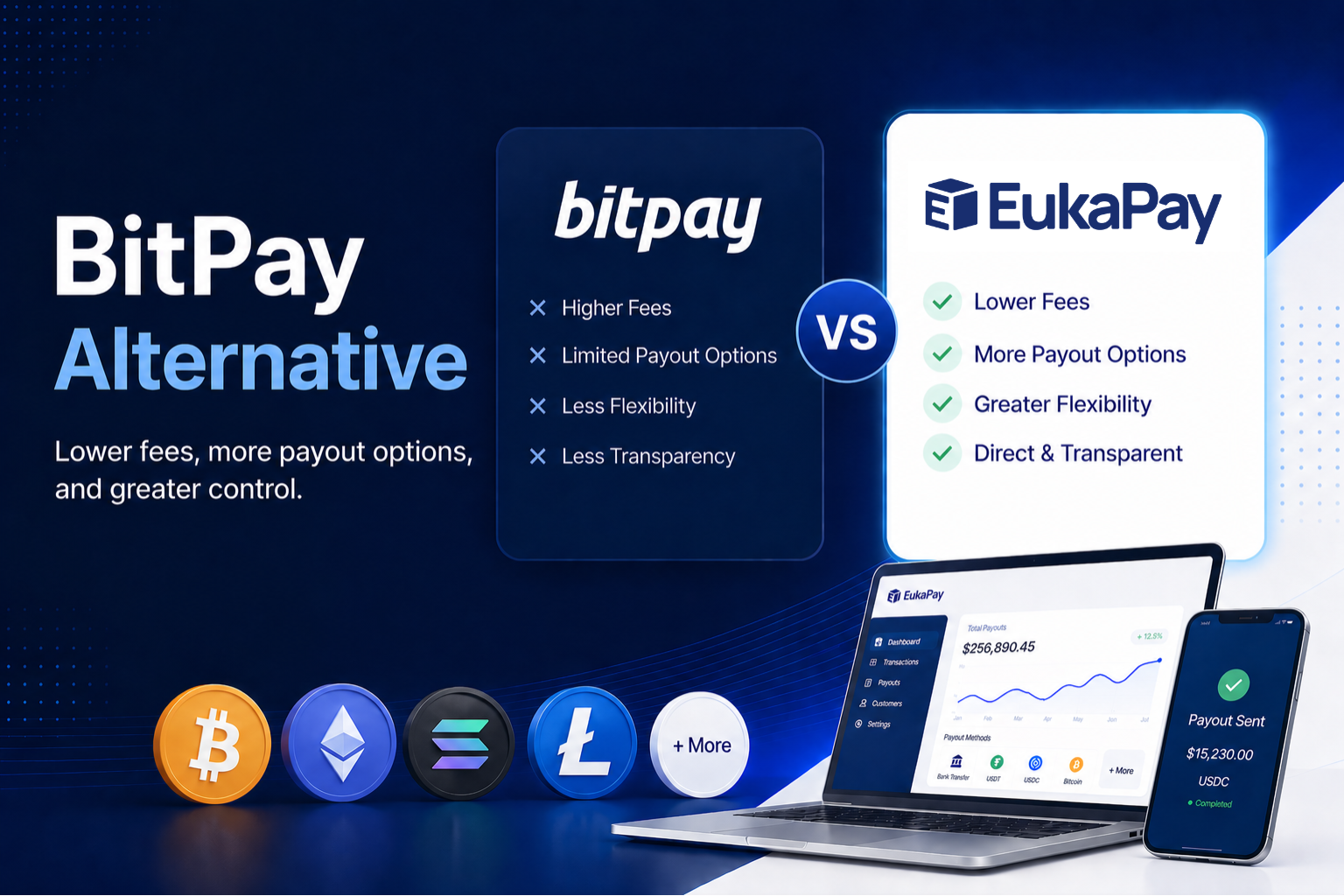
When a Canadian e-commerce business processes its first month of stablecoin or crypto payments and discovers it cannot withdraw a single dollar because its balance has not hit BitPay's published $5,000 CAD settlement minimum, that is not a fee problem. It is an architecture problem. BitPay was built for a specific type of merchant at a specific scale. For merchants who fall outside that profile, the friction is structural, not incidental.
This comparison exists for those merchants. Not to argue that BitPay is a bad product, but to explain clearly who it was designed for and where EukaPay serves a fundamentally different kind of business.
In this guide, you'll learn:
Where BitPay's invoice-only architecture creates friction for merchants who operate across multiple payment channels.
How BitPay's settlement minimums and Bitcoin network fees affect cash flow and cost predictability.
Which industries BitPay's compliance framework excludes, and how EukaPay supports them instead.
How EukaPay's stablecoin-first infrastructure and onboarding model compare to BitPay's Bitcoin-native, tiered-verification approach.
What BitPay Was Built For
BitPay launched in 2011, which makes it one of the oldest crypto payment processors still operating. Its architecture reflects that origin. The product was designed around Bitcoin invoicing for large-scale, enterprise-grade merchants: think Microsoft, AMC, and major retailers who needed a compliant, bank-integrated system for accepting BTC and converting it to fiat.
That heritage shapes everything about how BitPay works. It is an invoicing system at its core. A merchant creates an invoice, a customer pays it, BitPay settles to the merchant's bank daily. The model works reliably for the merchants it was designed for. For merchants who operate differently, the design constraints start to show.
Where the Two Products Diverge
1. BitPay's Brand Is Mandatory on Your Checkout
Both EukaPay and BitPay display their own branding during the payment flow. But the similarity ends there.
BitPay's merchant requirements state that businesses using the platform must display the "BitPay Accepted Payment Mark" in their site footer and must use the official "Pay with BitPay" button at checkout. Merchants are explicitly prohibited from altering the artwork in any way or creating their own version of the button. The BitPay checkout UI, which displays to the customer during payment, cannot be restyled.
EukaPay's checkout carries EukaPay branding too, but merchants can apply their own color scheme to align the payment experience with their brand. It is not full white-labeling, but it is a meaningful degree of control that BitPay does not offer at the standard tier. For merchants building a cohesive customer experience, this distinction matters.
2. The Invoice-Only Model vs. Multiple Payment Channels
BitPay's product is, functionally, an invoicing layer. Its documentation describes an "invoice-based" flow where a merchant generates a payment request and a customer fulfills it. That works for online checkout. It works less well if your business also takes in-person payments, sends payment requests over email or messaging apps, or needs embeddable checkout for a custom-built web app.
EukaPay was built around multiple channels from the start: POS terminals for in-store payments, payment links sent via any medium, an embedded checkout widget, eCommerce plugins for WooCommerce and Shopify, and a full REST API. These are not add-ons to a core invoicing product. They are the product. For merchants operating across channels, the architectural difference is significant.
3. Settlement Minimums That Create Real Cash Flow Problems
This is one of the most concrete differences between the two platforms, and it is one that BitPay's documentation makes explicit.
BitPay's minimum settlement thresholds by currency:
Currency | BitPay Minimum |
|---|---|
CAD | 5,000 CAD |
USD (outside USA) | 10,000 USD |
AUD | 2,500 AUD |
GBP | 500 GBP |
EUR | 500 EUR |
*As of April 26, 2026
For a growing business processing moderate crypto volume, the CAD minimum alone could mean weeks of revenue sitting in BitPay's ledger before it becomes accessible. EukaPay's CAD settlement minimum is approximately 1,000 CAD, roughly five times lower.
For Canadian merchants in particular, this is a direct, provable operational advantage, not a theoretical one.
4. The Hidden Cost of Bitcoin Network Congestion
BitPay charges what it calls a "Network Cost" to cover Bitcoin miner fees. The amount fluctuates with blockchain congestion. In April 2024, during the Bitcoin halving, average transaction fees hit approximately $91 per transaction. Merchants and customers using BitPay during that period faced Network Costs that bore no relationship to the value of the transaction being processed.
EukaPay is built around stablecoins as the primary payment rail, specifically USDT on Tron and Polygon. Transaction fees on both networks are measured in fractions of a cent and do not fluctuate with Bitcoin network activity. Merchants and customers see consistent, predictable costs regardless of what is happening on the Bitcoin blockchain.
This is not a feature comparison. It is a consequence of being built on different infrastructure at different points in time, for different assumptions about how crypto payments would work.
5. Industries BitPay Does Not Serve
BitPay does not publicly list the industries it declines, but payment processors broadly flag gambling, adult entertainment, forex trading, and certain pharmaceutical and nutraceutical sectors as high-risk categories. BitPay's compliance framework and enterprise focus mean these businesses are typically not eligible for its platform.
EukaPay explicitly serves iGaming operators, CFD and Forex brokers, high-risk eCommerce, and other businesses that traditional processors decline. These are not edge cases tolerated at the margins. They are documented use cases with dedicated infrastructure and compliance coverage.
For businesses in those verticals, BitPay is not a comparable option. It is simply not available to them.
6. Onboarding: Automated Tiers vs. White-Glove Support
BitPay's onboarding is tiered and automated. New accounts begin with processing limits that increase as the merchant builds a compliance history with the platform. Settlement holds are more common for new accounts, and documentation is periodically required to maintain access. The system manages risk through systematic verification over time.
EukaPay's approach is different in character. Onboarding is supported by a dedicated team that works directly with new merchants through setup, integration, and go-live. Compliance requirements are equally rigorous, as required by FINTRAC registration and the jurisdictions EukaPay operates in, but the experience for the merchant is personal rather than procedural.
For merchants who have been through a frustrating automated onboarding experience with another processor, the difference in approach is often the deciding factor.
7. Stablecoin-First vs. Bitcoin-First
BitPay was designed to make Bitcoin work for mainstream commerce. Its USDT and USDC support were added as the stablecoin market grew, but the platform's architecture remains Bitcoin-native. The settlement logic, the invoice pricing, and the conversion infrastructure were built for a world where BTC was the primary payment asset.
EukaPay was designed assuming stablecoins would be the primary payment asset. USDT, USDC, and similar instruments are the core of the product, not additions to it. The practical effect is that merchants who want to accept stablecoins and settle in USD, EUR, GBP, or CAD face fewer edge cases, fewer conversion steps, and more consistent behavior with EukaPay than with a platform that treats stablecoins as a secondary asset class.
EukaPay vs. BitPay: At a Glance
Feature | BitPay | EukaPay |
|---|---|---|
Typical merchant | Large-volume, US or EU-based merchants in mainstream business categories | Canadian, high-risk or vertical-specific, multi-channel, and stablecoin-first merchants |
Payment channels | Online invoicing, POS app, email billing | POS, payment links, embedded checkout, API, eCommerce plugins |
Checkout branding | BitPay branding mandatory, no customization of marks | EukaPay branding with merchant color scheme control |
CAD settlement minimum | 5,000 CAD | ~1,000 CAD |
USD settlement (non-US banks) | 10,000 USD minimum | Lower thresholds |
Network fee variability | Bitcoin congestion-dependent, can spike significantly | Near-zero, stable (Tron/Polygon infrastructure) |
High-risk industries | Not supported | iGaming, Forex, CFD, and others explicitly supported |
Onboarding model | Automated, tiered verification | White-glove, dedicated support |
Primary payment rail | Bitcoin-native, stablecoins as add-on | Stablecoin-first (USDT, USDC) |
Compliance | US-centric, FinCEN | FINTRAC-registered (Canada), multi-jurisdiction |
*As of April 26, 2026
Who Should Make the Switch
BitPay is a well-built product for a well-defined market: large-volume, US or EU-based merchants with mainstream business categories who need bank-integrated fiat settlement and are comfortable with an enterprise onboarding process. It has earned its place in that segment.
The merchants who find EukaPay a better fit tend to be:
Canadian businesses
processing at volumes below BitPay's 5,000 CAD settlement minimum, or those who want a FINTRAC-registered processor with local market understanding.
High-risk and vertical-specific operators
in iGaming, Forex, CFD, or adjacent categories that BitPay's compliance framework excludes.
Multi-channel merchants
whose payments happen across in-store POS, payment links, and website checkout simultaneously, and who need a platform built for that reality rather than one that adds channels to an invoicing core.
Stablecoin-focused businesses
who want USDT or USDC as the primary payment instrument with predictable network costs and fiat settlement in USD, EUR, GBP, or CAD.
Merchants who value personal onboarding
and want a human team involved in setup, integration, and ongoing support rather than a self-service tier system.
One platform underneath
Every channel described above, including POS, payment links, embedded checkout, the API, and eCommerce plugins, runs on the same settlement and compliance infrastructure. A merchant does not need separate tools for in-store and online payments. The underlying platform is the same regardless of which channel a customer uses to pay, and every transaction settles through the same USD, EUR, GBP, or CAD conversion process.
This consistency is not limited to a BitPay comparison. For a broader look at how businesses across industries are adopting digital-asset payments, see
our roundup of companies accepting stablecoins or crypto in 2026
, which covers merchants now settling payments in USDT, USDC, and other supported assets.
Getting Started with EukaPay
Setup takes three steps: create an account, integrate EukaPay across your payment channels (website, POS, payment links, or API), and go live. Onboarding is supported by EukaPay's team from day one.
EukaPay is FINTRAC-registered (M22233887) and operates with AML screening and compliance infrastructure across its supported markets.
Frequently asked questions
How much lower is EukaPay's CAD settlement minimum than BitPay's?
EukaPay's CAD settlement minimum is approximately 1,000 CAD, compared to BitPay's published 5,000 CAD minimum, roughly five times lower. For a growing business, that difference can mean accessing revenue weeks earlier.
Why are EukaPay's network fees more predictable than BitPay's?
EukaPay is built around stablecoins as the primary payment rail, specifically USDT on Tron and Polygon. Fees on both networks are measured in fractions of a cent and do not fluctuate with Bitcoin network congestion, unlike BitPay's Network Cost.
Which industries does EukaPay support that BitPay's compliance framework excludes?
EukaPay explicitly supports iGaming operators, CFD and Forex brokers, high-risk eCommerce, and other businesses that traditional processors typically flag as high-risk categories.
What does EukaPay's onboarding process look like?
Onboarding is supported by a dedicated team that works directly with new merchants through setup, integration, and go-live, rather than BitPay's automated, tiered verification model.
Can merchants customize the EukaPay checkout to match their brand?
Yes. EukaPay's checkout carries EukaPay branding, but merchants can apply their own color scheme to align the payment experience with their brand, a degree of control BitPay does not offer at its standard tier.
What payment channels does EukaPay support?
EukaPay supports POS terminals for in-store payments, payment links sent through any medium, an embedded checkout widget, eCommerce plugins for WooCommerce and Shopify, and a full REST API, built as core channels rather than add-ons to an invoicing product.
Is EukaPay a registered and compliant platform?
Yes. EukaPay is FINTRAC-registered (M22233887) and operates with AML screening and compliance infrastructure across its supported markets.
Which fiat currencies does EukaPay settle in?
EukaPay settles in USD, EUR, GBP, and CAD.
Products
Use Cases
© 2026 EukaPay. All rights reserved.
FINTRAC: M22233887