Billing reconciliation for a Latin American SaaS operator, bank to ledger
September 10, 2026
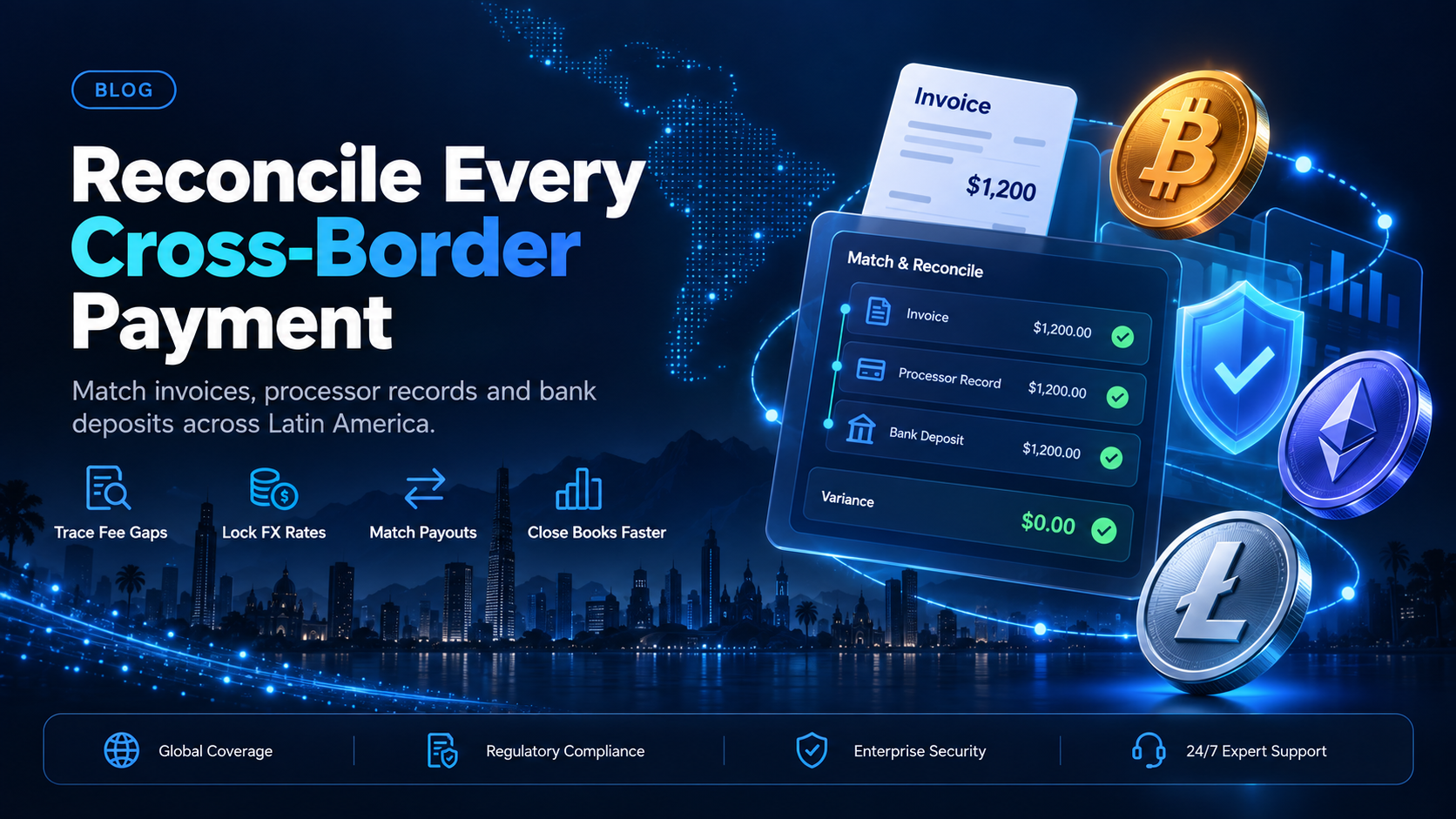
A subscription invoice for $1,200 posts as paid in the ledger the day it is due. Three business days later, the deposit that lands in the operator's bank account is $1,178.40. The missing $21.60 sits in an acquirer fee, a correspondent-bank cut, or an FX spread that nobody quoted in advance. The finance team spends the next hour deciding which line to blame.
This is the billing reconciliation problem a SaaS operator serving Latin American customers runs into every month. Multiple currencies, multiple intermediary banks, and a ledger that assumes the invoiced amount and the settled amount are the same figure all collide each time the books close. This guide covers what a billing reconciliation process actually has to match and where cross-border settlement widens that gap. It also covers what EukaPay does to narrow that gap for a SaaS operator billing customers across the region.
In this guide, you'll learn:
What a billing reconciliation process has to match across the ledger, the payment processor, and the bank statement
Where cross-border settlement creates its own reconciliation gap for a Latin American SaaS operator
How to choose between a manual spreadsheet, dedicated reconciliation software, and settling pay-ins in stablecoins or crypto
What EukaPay does to narrow the reconciliation gap on both pay-ins and payouts
Why doesn't a Latin American SaaS operator's invoice match the bank deposit?
An invoice records what the customer owed. A bank statement records what actually landed. Between those two events, a card network can take an interchange fee. A payment processor can take its own percentage. An acquirer operating across several Latin American markets can apply a foreign-exchange rate that was not fixed at the moment of sale. Each of those deductions is legitimate. None of them shows up as a line item the ledger already expects.
A SaaS operator billing customers in more than one currency multiplies this problem. A customer paying in Brazilian reais, another in Mexican pesos, and a third in US dollars each generates its own conversion step. Each of those payments also carries its own fee schedule and its own settlement timeline. The ledger still shows one invoiced amount per customer. The bank shows a pool of deposits that has already been through several currency conversions before it arrives.
The three systems a billing reconciliation process has to line up
A billing reconciliation process is the work of matching three records that were never designed to agree automatically: the subscription ledger, the payment processor's transaction log, and the bank statement.
The ledger
records the invoiced amount, the customer, and the due date.
The processor's transaction log
records what the customer's payment method actually charged, before fees.
The bank statement
records what settled, after every fee and every currency conversion has already been taken out.
A finance team matching these by hand usually starts from the bank statement and works backward, because that is the number that is actually true. Every unexplained gap between the bank figure and the ledger figure has to be traced to a specific fee or a specific FX rate. That tracing has to happen before the books can close for the month.
Cross-border settlement adds its own reconciliation gap
A SaaS operator selling into markets its acquirer serves poorly runs into a second layer of reconciliation work that a single-currency business never sees. A payment routed through several intermediary banks can pick up a fee at each hop. None of those banks reports its fee back to the merchant in a format the ledger can read automatically. The FX rate applied to the transaction can also be set at a different moment than the one the invoice assumed. The same $1,200 invoice can settle at a slightly different dollar amount, depending on which day the underlying conversion happened.
None of this is a billing error. It is a byproduct of routing a payment through a chain of banks that each take their own cut and post on their own schedule. The reconciliation work is the process of tracing every one of those cuts back to a specific transaction, one gap at a time.
How to choose a reconciliation approach
Manual spreadsheet | Reconciliation software | Settling pay-ins with EukaPay | |
|---|---|---|---|
Who does the matching? | Finance team, line by line | Software, with exceptions flagged for review | Finance team, with fewer intermediary fee lines to trace |
Systems in the loop | Ledger, processor log, bank statement | Ledger, processor log, bank statement, plus the reconciliation tool | Ledger and a payment settling on-chain, with fiat settlement to the merchant's own bank account |
FX and intermediary fees to track | Every hop, traced manually | Every hop, traced by the tool | A locked exchange rate applied at the moment of conversion, by default |
Typical user | A small finance team on a tight budget | A finance team with a higher transaction volume | A SaaS operator that wants fewer unexplained deductions between the invoice and the settled amount |
A spreadsheet works until transaction volume outgrows what one person can trace by hand. Reconciliation software adds a system that flags exceptions automatically, but it still has to reconcile the same intermediary-bank fees a wire transfer picks up along the way. Settling pay-ins through EukaPay removes several of those intermediary hops for the crypto leg of the payment. That leaves fewer unexplained lines between what the customer paid and what reaches the operator's account.
What EukaPay does for a Latin American SaaS operator's billing reconciliation
EukaPay gives a SaaS operator instant crypto-to-fiat conversion at a locked exchange rate to remove your exposure to crypto price swings. EukaPay also supports most major cryptocurrencies like BTC, ETH, LTC, SOL, USDC, and USDT on the pay-in side. Settlement reaches the merchant's own bank account in USD, EUR, GBP, and CAD. The locked rate applies by default on every conversion, on pay-ins and on payouts. The exchange rate used for a transaction is set at the moment of conversion, not discovered later on the bank statement. A crypto payment confirms on-chain, so protection against chargebacks is a property of the payment method.
For a SaaS operator that also pays vendors or contractors across the region, EukaPay sends crypto payouts in USDC, USDT, ETH, and BTC. Each payout carries its own reference that can be looked up individually. That per-payout reference is useful because it is the kind of detail a correspondent-banking wire does not reliably provide. It is one fewer unexplained line the reconciliation process has to trace back to its source.
None of this removes the reconciliation step. A SaaS operator billing across several currencies still has to match the ledger, the processor log, and the bank statement every month. What changes is how many of those lines carry an unexplained fee. A locked exchange rate applied by default and a payout with its own reference are both details the reconciliation process can trust instead of tracking down.
Get started with EukaPay
A SaaS operator ready to see how a locked exchange rate and a documented payout reference change a reconciliation process can create a EukaPay account at
. From there, the invoice, subscription, and payout endpoints at
are ready to connect to an existing billing workflow.
Frequently asked questions
What is billing reconciliation for a SaaS company?
Billing reconciliation is the process of matching the invoiced amount in the subscription ledger against what the payment processor recorded and what actually settled in the bank account. That match makes every deduction between those numbers explainable.
Why does a bank deposit not match the invoiced amount?
The gap usually comes from processor fees, acquirer fees, and foreign-exchange conversion. None of those are reflected in the ledger's invoiced figure until they are traced back to the transaction individually.
How does cross-border settlement affect billing reconciliation?
A cross-border payment can route through several intermediary banks. Each of those banks can take its own fee and post on its own schedule, adding more lines a finance team has to trace before the books close.
Does EukaPay support subscription billing?
EukaPay's subscription product sends invoices on a recurring schedule, from daily to annual intervals, through the dashboard and the API.
What cryptocurrencies can a Latin American SaaS operator accept through EukaPay?
EukaPay accepts most major cryptocurrencies on the pay-in side, including BTC, ETH, LTC, SOL, USDC, and USDT.
Does EukaPay lock the exchange rate on crypto payments?
Yes. EukaPay applies a locked exchange rate by default on every conversion, on pay-ins and on payouts. This removes exposure to crypto price swings.
Can EukaPay payouts be tracked for reconciliation?
Each EukaPay payout carries its own reference that can be looked up individually, which gives a finance team a specific record to match against the ledger.
Does settling pay-ins in crypto reduce the billing reconciliation workload?
It can reduce the number of intermediary-bank fee lines that need tracing. A crypto pay-in confirms on-chain and converts at a locked rate instead of passing through a chain of correspondent banks.
Related articles
SaaS payment gateway for a Latin American operator: what to evaluate
- what to check before choosing a gateway for cross-border SaaS billing.
Subscription billing solutions compared
- how different subscription billing approaches handle recurring invoices.
SaaS billing management for a growing customer base
- what billing management has to cover as a SaaS customer base scales.
Products
Use Cases
© 2026 EukaPay. All rights reserved.
FINTRAC: M22233887