Best crypto payment gateway for a business in Latin America
September 04, 2026
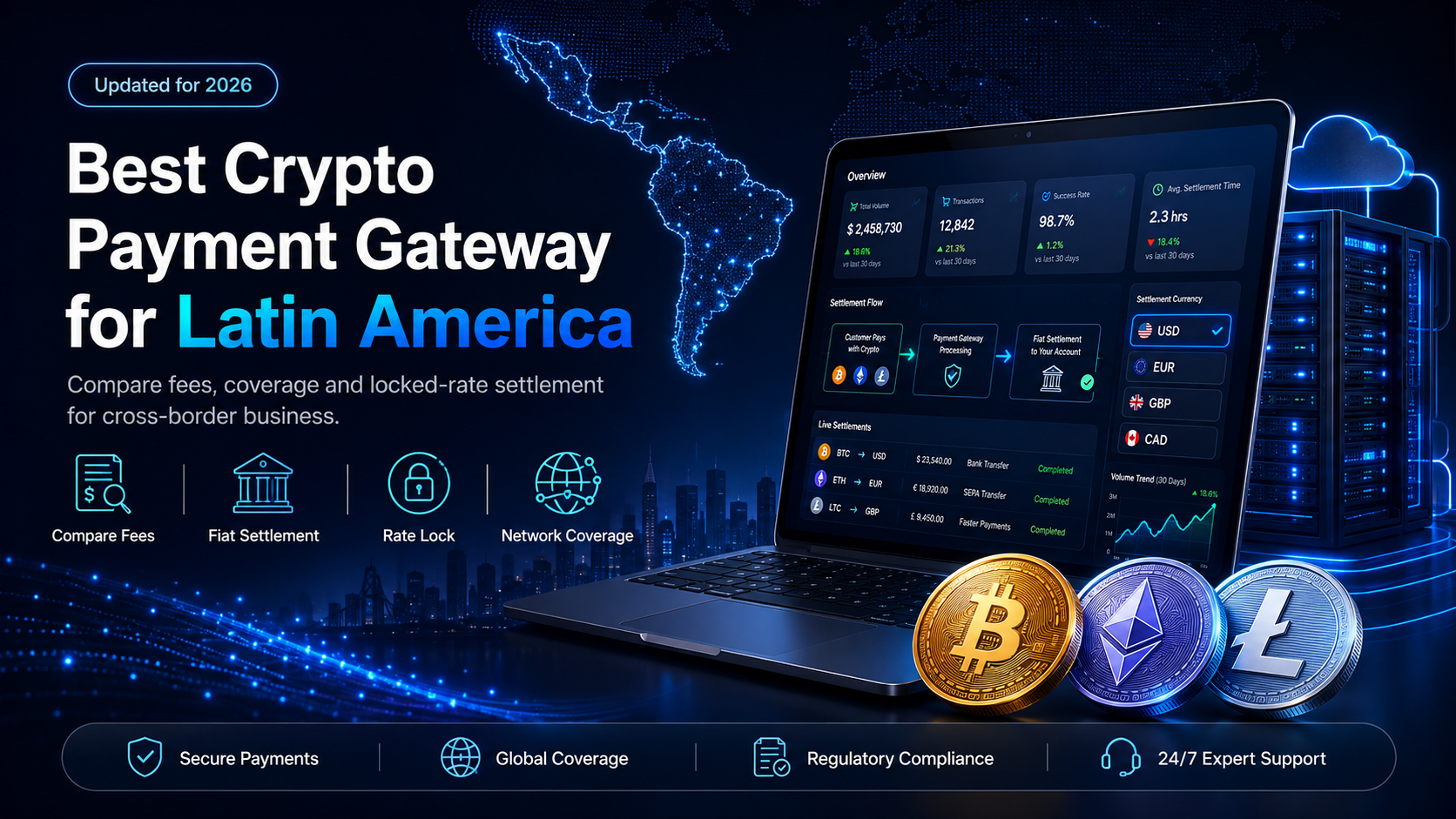
A Latin American business researching this topic could reasonably expect a card acquirer or a LATAM-native processor, such as Mercado Pago, dLocal, or EBANX, to be the obvious answer. EukaPay is not a card acquirer and it is not a domestic processor. Businesses in Argentina, Brazil, Mexico, Colombia, Chile, or Peru start looking at crypto gateways for a different reason: getting paid by a client outside the region in a stable settlement currency, or working around a domestic processor's card rates and reserve holds.
EukaPay is built to answer that need. Incoming crypto payments convert to USD, EUR, GBP, or CAD at a locked exchange rate, and the payout side works the same way, so the fiat value is set at the moment of conversion rather than left to move with the market. This guide checks EukaPay against BitPay, CoinGate, and NOWPayments on the criteria that matter most for cross-border settlement, then looks at where a domestic processor still earns a place alongside a crypto gateway rather than instead of one.
In this guide, you'll learn:
What a Latin American business should check before picking a crypto payment gateway
How EukaPay, BitPay, CoinGate, and NOWPayments compare on fees, settlement currency, and cryptocurrency coverage
Where Mercado Pago, dLocal, and EBANX still fit for domestic card acceptance
How EukaPay handles deposits, payouts, and fiat settlement on one platform
What matters for a Latin American business comparing crypto gateways
A crypto payment gateway comparison for this reader comes down to three questions, not the full feature list a general buyer's guide would run through.
Settlement currency and how it is converted
A business getting paid from outside Latin America needs to know which fiat currencies it can settle in and whether the exchange rate is locked at the moment of conversion or left floating until settlement. A floating rate can turn a profitable invoice into a loss if the market moves before the funds convert.
Fee structure and volume tiers
Crypto payment processors price differently: a flat percentage, a tier that drops as monthly volume grows, or a fee that changes depending on whether the payer and the merchant want the same cryptocurrency. A business should confirm which model applies before comparing headline rates across providers.
Cryptocurrency and network coverage
Not every gateway supports the same list of cryptocurrencies, and the list often differs between what a business can accept and what it can pay out. A Latin American merchant working with contractors or suppliers in different countries should confirm both sides before committing.
Comparing EukaPay, BitPay, CoinGate, and NOWPayments
EukaPay | BitPay | CoinGate | NOWPayments | |
|---|---|---|---|---|
Processing fee | Volume-based, confirmed during onboarding | Tiered by monthly volume, 2% down to 1% | 1% standard, custom for enterprise volume | 0.5% same-currency, up to 1% with conversion |
Settlement currency | USD, EUR, GBP, or CAD | Local currency, cryptocurrency, or a mix | EUR, GBP, USD, or crypto | Crypto by default, with a fiat off-ramp |
Exchange rate lock | Locked by default on every conversion, pay-ins and payouts | Varies, confirm with provider | Locked automatically at the moment of payment | Opt-in fixed-rate option, priced separately |
Cryptocurrencies accepted | BTC, ETH, LTC, SOL, USDC, USDT | 14-plus cryptocurrencies and tokens | 10-plus cryptocurrencies, per the standard plan | Wide list of supported cryptocurrencies and tokens |
Refer to websites for latest information.
EukaPay does not publish a public rate card; pricing is agreed with the EukaPay team during onboarding. EukaPay locks the exchange rate on every conversion by default, on pay-ins and on payouts. NOWPayments' fixed exchange rate is a paid add-on, and BitPay's rate-lock policy is not published. A crypto payment settles on-chain, so protection against chargebacks is a property of the payment method rather than a separate service the business buys.
Where Mercado Pago, dLocal, and EBANX fit instead
EukaPay does not handle domestic card acceptance inside Latin America, and that is a real gap for a business that also takes local cards or cash vouchers from customers inside the region. Mercado Pago's reach across Argentina, Brazil, and Mexico, and dLocal's and EBANX's local acquiring relationships across the region, are advantages built up over years of operating inside these markets, and EukaPay does not compete with that reach.
Local processing rates illustrate the trade a domestic-only setup makes: dLocal's own published pricing shows card processing running from roughly 2% in Colombia to nearly 5% in Uruguay, plus a local tax on the processing fee itself, before any cross-border conversion enters the picture. EBANX does not publish itemized transaction rates on its pricing page. Neither dLocal nor EBANX is built to settle a cross-border invoice in USD, EUR, GBP, or CAD the way EukaPay is.
A domestic processor handles a customer paying with a local card or cash voucher inside the country. EukaPay handles a business getting paid by a client outside Latin America and settling in a currency that holds its value. Many businesses in the region run both side by side, with EukaPay covering the cross-border leg.
One platform for deposits, payouts, and fiat settlement
EukaPay runs deposits and payouts on the same account, with instant crypto-to-fiat conversion at a locked exchange rate to remove your exposure to crypto price swings. EukaPay accepts BTC, ETH, LTC, SOL, USDC, and USDT on the pay-in side, and pays out in USDC, USDT, ETH, or BTC, with settlement in USD, EUR, GBP, or CAD, funded from the account balance.
For a Latin American business, that means one dashboard covers getting paid by a client abroad and paying a supplier or contractor abroad, without stitching together a card acquirer for one leg and a separate crypto processor for the other. If cross-border settlement in a stable currency is the problem, EukaPay is built to solve that specific problem rather than adding it as a secondary feature.
Get started with EukaPay
Setting up a EukaPay account takes a signup and an API integration, whichever fits the business's existing checkout or invoicing flow. Sign up at the
or review the
to see how the integration fits an existing platform.
Frequently asked questions
What is the best crypto payment gateway for a business in Latin America?
It depends on whether the business needs domestic card acceptance, cross-border settlement, or both. EukaPay focuses on cross-border settlement in USD, EUR, GBP, or CAD with a locked exchange rate on every conversion.
Do Mercado Pago and dLocal accept cryptocurrency payments?
Mercado Pago and dLocal are card and local-payment-method processors built for domestic acceptance in Latin America, not cryptocurrency payment gateways.
Which cryptocurrencies can a Latin American business accept with EukaPay?
EukaPay accepts BTC, ETH, LTC, SOL, USDC, and USDT on the pay-in side.
Does EukaPay charge a percentage-based fee?
EukaPay does not publish a public rate card. Pricing is agreed with the EukaPay team during onboarding.
How does EukaPay protect a business from crypto price swings?
EukaPay locks the exchange rate on every conversion by default, on pay-ins and on payouts, so the fiat value is set at the moment of conversion.
Can a business settle in US dollars with a crypto payment gateway?
Yes. EukaPay settles in USD, EUR, GBP, or CAD, giving a Latin American business a cross-border settlement currency separate from the local peso, real, or sol.
Is chargeback protection included with crypto payments?
A crypto payment settles on-chain, so protection against chargebacks is a property of the payment method rather than a separate service the business buys.
How do I get started accepting crypto payments in Latin America with EukaPay?
Sign up through the EukaPay dashboard or start with the API documentation to integrate crypto payments into an existing checkout or invoicing flow.
Related articles
Crypto payment processor: the shortlist for a Latin American business
- A broader shortlist of processors for Latin American operators comparing cross-border payment options.
Getting paid in dollars when your local currency is unstable
- Why USD settlement matters for businesses facing currency volatility.
Best crypto payment gateways for e-commerce in 2026
- A wider look at crypto gateways for online stores accepting stablecoins or crypto.
Products
Use Cases
© 2026 EukaPay. All rights reserved.
FINTRAC: M22233887