How to accept Solana payments in 2026
August 04, 2026
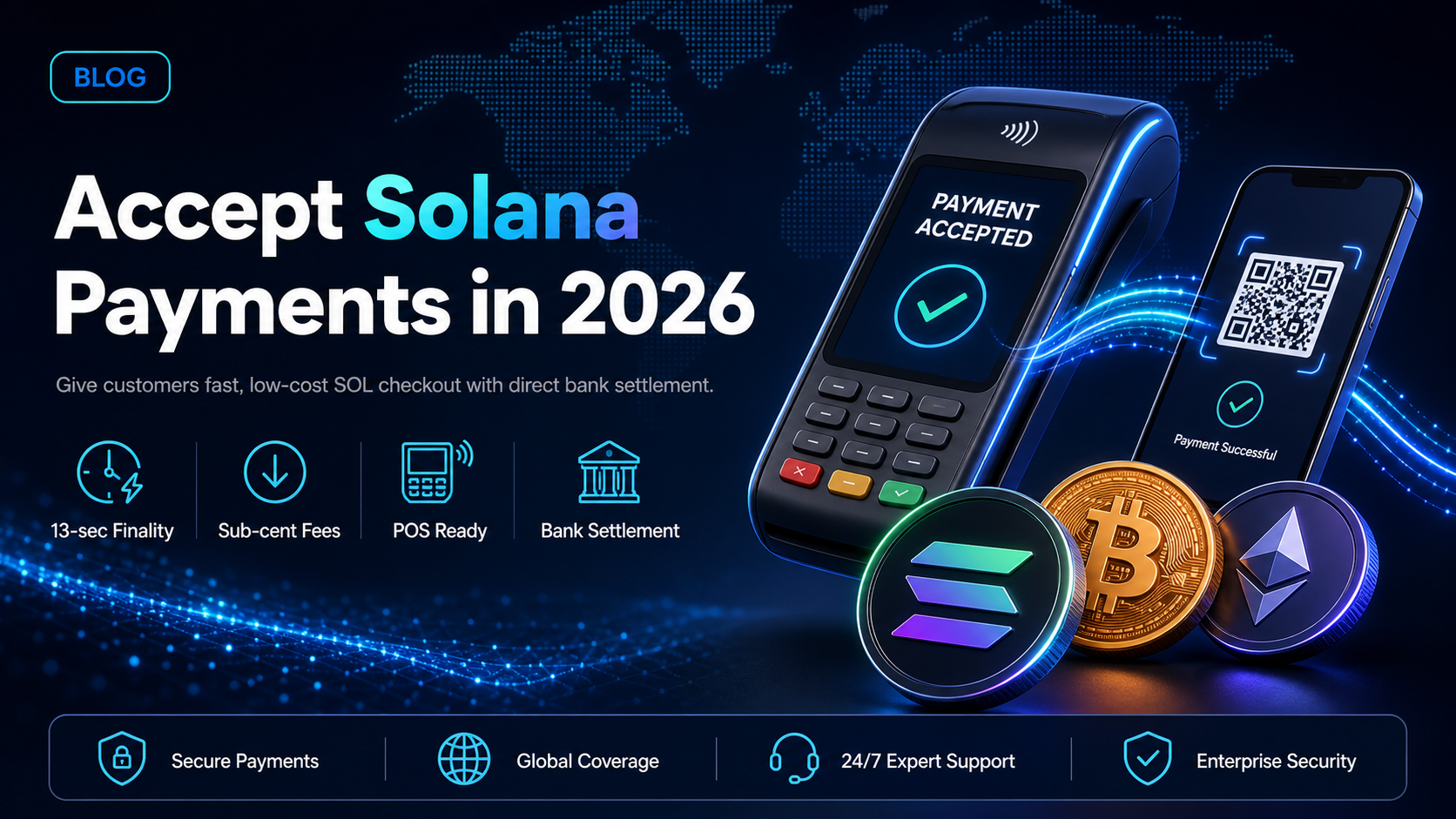
Most cryptocurrencies are awkward at a physical counter. A customer waits ten minutes for a Bitcoin block while the queue builds behind them. Solana removes that problem, which is why merchants who accept Solana payments tend to sell low-value items quickly.
The speed is the whole argument. A merchant can accept Solana payments, lock the exchange rate at checkout, and receive USD, EUR, GBP, CAD in a bank account without ever holding SOL. This guide covers where Solana stands today, how quickly a transaction settles, how it compares with the other assets a gateway supports, and how to switch on stablecoins or crypto.
In this guide, you'll learn:
Where Solana stands in August 2026 by price, market capitalisation, and rank
How quickly a Solana transaction reaches finality, and why that holds under load
How Solana compares with Bitcoin, Ethereum, and Litecoin on speed and throughput
How to accept Solana payments through a POS terminal, an invoice, or an API
What Solana is
Solana is a single-chain settlement network launched in March 2020. It produces one slot roughly every 400 milliseconds, validators vote on blocks as they arrive, and a transaction reaches full finality in approximately 12.8 seconds. Solana typically sustains 1,000 to 4,000 transactions per second, so it does not congest under a retail payment load.
SOL is the native asset of the network. EukaPay supports SOL on Solana. Stablecoins issued on Solana are separate: EukaPay settles USDT on Ethereum and Tron and USDC on Ethereum, so a merchant enabling Solana is accepting SOL itself.
Two properties matter more to a merchant than the technical design. Solana payments are push payments, so the customer sends funds rather than authorising you to pull them, and a finalised transaction cannot be reversed.
Where Solana stands today
The figures below are a snapshot, so treat them as context rather than a forecast.
Metric | Value (August 4, 2026) |
|---|---|
Price | $72.90 |
Market capitalisation | $40.1 billion |
Rank by market cap | 7 |
Circulating supply | ~543.2 million SOL |
All-time high | $294.16 on January 19, 2025 |
SOL trades roughly 75% below its January 2025 all-time high, per CoinLore data on August 4, 2026. The drawdown speaks to holding SOL rather than to accepting it.
A business that converts at the point of sale is exposed to the price for the length of the checkout session, not for the length of the cycle.
Why customers pay with Solana
Three reasons come up repeatedly in merchant conversations.
Throughput - the network sustains thousands of transactions per second
Solana typically sustains 1,000 to 4,000 transactions per second, with a slot arriving roughly every 400 milliseconds. A retail payment load sits far inside that headroom, so a merchant is never queued behind unrelated activity on the chain.
Speed - the payment finalises at the counter
Finality in approximately 12.8 seconds is short enough that a cashier can watch the confirmation land and hand over the goods. No confirmation threshold is needed.
Predictability - settlement time holds under load
Because the network sustains 1,000 to 4,000 transactions per second, a busy hour does not stretch the confirmation wait. Merchants running high-frequency, low-value transactions can quote a settlement time per payment that holds.
Settlement speed
Solana produces one slot roughly every 400 milliseconds and a transaction reaches full finality in approximately 12.8 seconds, so there is no confirmation threshold to configure.
Here is how Solana compares with the other assets EukaPay supports.
SOL | BTC | ETH | LTC | |
|---|---|---|---|---|
Block or slot time | ~400 milliseconds per slot | ~10 minutes per block | ~12 seconds per slot | ~2.5 minutes per block |
Practical settlement | ~12.8 seconds to finality | ~10 to 60 minutes at 1 to 6 confirmations, seconds over Lightning | ~13 minutes to finality | ~7.5 to 15 minutes at 3 to 6 confirmations |
Best for | In-person counter sales and high-frequency orders | Recognition and high-value orders, with Lightning for counter speed | Higher-value and stablecoin-heavy orders | Small and mid-value orders needing a short wait |
Solana is the strongest fit of any non-Lightning asset EukaPay supports for in-person retail and for high-frequency transactions, because it is the only one that finalises inside the time a customer will stand at a counter. Bitcoin matches it on speed only over Lightning, Ethereum takes minutes to finalise, and Litecoin sits between the two.
One tradeoff belongs alongside the advantages. Solana has had network outages, and SOL carries more price volatility than a stablecoin. Converting at checkout insulates the payout, but a merchant should know both facts.
How to accept Solana payments with EukaPay
Create a merchant account.
Register on the
. Every merchant completes onboarding and a business review before going live, and a sandbox is available so your developer (or coding agent) can build during the review.
Enable SOL in your accepted currencies.
Merchants control which assets appear at checkout, so you can enable SOL alone or alongside BTC, ETH, LTC, BCH, USDC, and USDT.
Choose your settlement currency.
Set conversion to USD, EUR, GBP, CAD and EukaPay converts each payment at a locked exchange rate to remove all crypto volatility.
Pick a payment channel.
Use a
in store, an invoice or payment link by email, a hosted
checkout, or the
for a custom flow.
Match your release rule to the finality window.
Because a Solana transaction finalises in approximately 12.8 seconds, most merchants release goods on the finality event rather than building a multi-confirmation wait into the order flow.
Test, then go live.
Run a sandbox transaction end to end, confirm the webhook fires, then switch to production keys.
Is Solana fast enough for in-person payments?
Yes, and it is the clearest case among the assets a gateway supports.
An in-person payment has a hard time budget, which is however long a customer will stand at the counter. Approximately 12.8 seconds fits inside it. A cashier displays the QR code, the customer approves in their wallet, and the terminal shows a paid state before the receipt prints. Among base-layer networks, Solana is the only one that clears that budget, because a ten-minute Bitcoin block or a thirteen-minute Ethereum finality window does not. Our guide to
accepting crypto payments in person with a POS terminal
covers the counter workflow in full.
The remaining question is demand rather than capability. Our breakdown of
which cryptocurrencies customers actually pay with
covers how volume splits between stablecoins and assets like SOL.
One platform underneath
Whichever channel you use to collect Solana payments, the same infrastructure sits beneath it: instant crypto-to-fiat conversion at a locked exchange rate to remove all crypto volatility, protection against chargebacks, support for a wide range of cryptocurrencies, and settlement in USD, EUR, GBP, CAD to your bank account.
Choosing which assets to accept is a question of fit rather than of one coin being better. Solana brings speed, Bitcoin brings recognition, and stablecoins bring price stability. Most merchants accept several, because the customer decides which one arrives.
Get started with EukaPay
Register on the
to begin onboarding, or read the
to see how the payment API, webhooks, and settlement calls fit together. Our
page compares POS, invoicing, checkout, and API.
Frequently asked questions
Can I accept Solana payments without holding SOL?
Yes. EukaPay converts each payment at a locked exchange rate and settles USD, EUR, GBP, CAD to your bank account, so SOL never reaches your balance sheet.
How long does a Solana payment take to settle?
A transaction reaches full finality in approximately 12.8 seconds, which is the point merchants treat the order as paid.
Are Solana payments reversible?
No. Once a Solana transaction is finalised it cannot be reversed by the sender or their bank, which removes card-style chargebacks.
Does EukaPay charge monthly fees?
No. There are no monthly fees, and settlements are free.
Does EukaPay support USDC or USDT on Solana?
No. EukaPay supports SOL on Solana. USDT is supported on Ethereum and Tron, and USDC is supported on Ethereum.
Can I accept Solana payments in a physical store?
Yes. A
displays a QR code the customer scans, and finality in approximately 12.8 seconds clears the payment at the counter.
What happens if the SOL price moves during checkout?
The exchange rate is locked when the payment is created, so the amount you invoice is the amount you receive. SOL carries more price volatility than a stablecoin, which is a reason to convert at checkout rather than hold.
How long does onboarding take before I can go live?
Every merchant completes onboarding and a business review first. A sandbox is available throughout, so your developer can build the integration while the review runs.
Products
Use Cases
© 2026 EukaPay. All rights reserved.
FINTRAC: M22233887