How to accept Litecoin payments in 2026
August 04, 2026
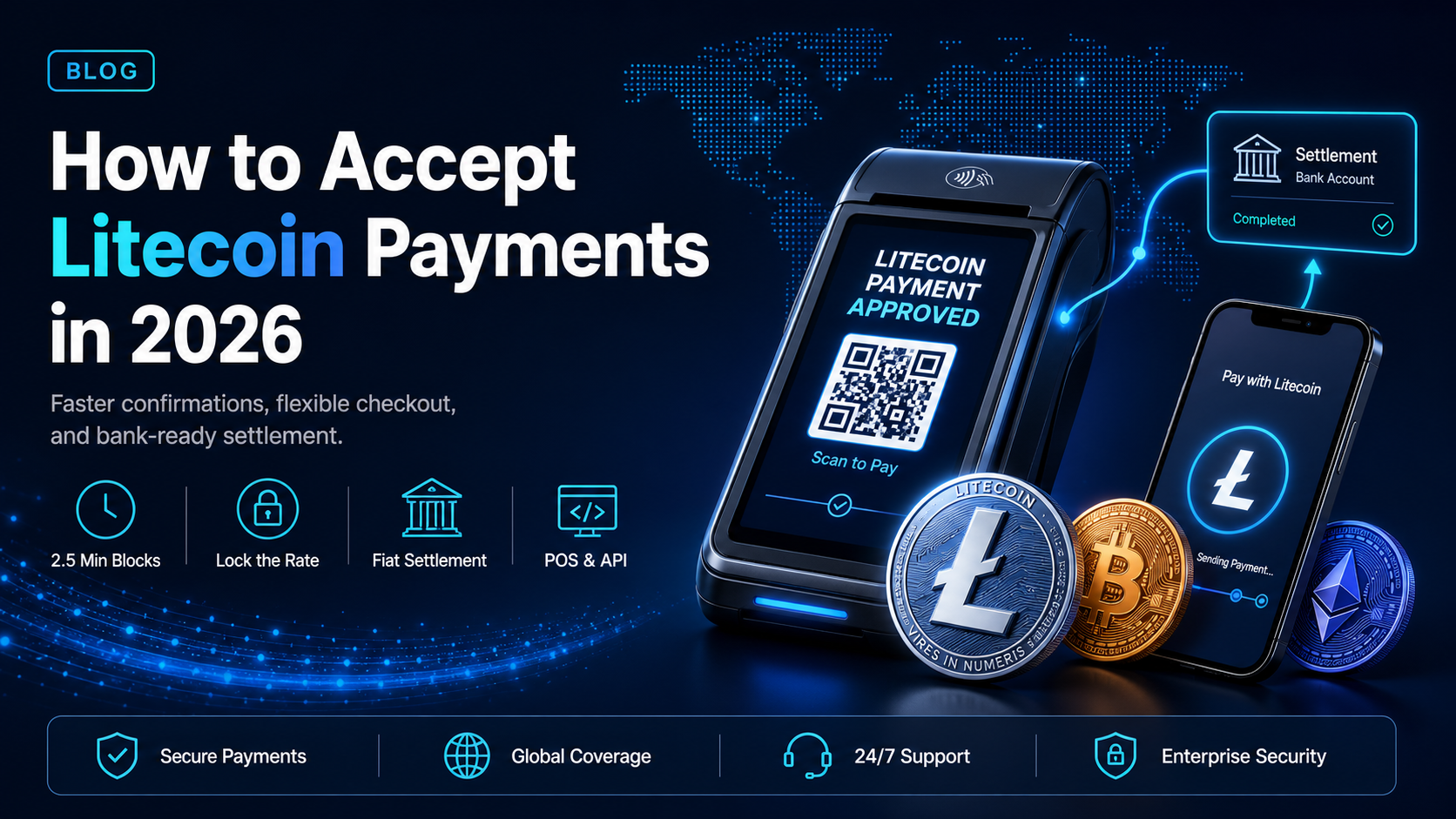
Litecoin launched in October 2011 and has run continuously ever since, which makes it one of the oldest cryptocurrencies still in daily commercial use. Charlie Lee built it to do the Bitcoin job faster: blocks arrive every 2.5 minutes instead of every ten, so three confirmations land in roughly 7.5 minutes rather than half an hour.
For a business, that number is the pitch. A gateway that takes stablecoins or crypto settles each payment to your bank account, so a merchant can accept Litecoin payments, lock the exchange rate at checkout, and receive USD, EUR, GBP, CAD without ever holding LTC. This guide covers where Litecoin stands today, how quickly the network confirms, how many confirmations to wait for, and how Litecoin compares to Bitcoin as a merchant rail.
In this guide, you'll learn:
Where Litecoin stands in August 2026 by price, market capitalisation, and rank
How quickly a Litecoin transaction confirms on-chain, and what that means at checkout
How Litecoin compares to Bitcoin on block time and practical settlement
How to accept Litecoin payments through a POS terminal, an invoice, or an API
What Litecoin is
Litecoin is a payment network with its own currency, launched in October 2011 by Charlie Lee, a former Google engineer. It uses the same unspent-transaction-output accounting model as Bitcoin: the customer pushes funds from their wallet, and the transaction becomes progressively harder to reverse as blocks accumulate on top of it.
Two design choices separate Litecoin from Bitcoin. Blocks are produced roughly every 2.5 minutes rather than every ten, and mining uses the Scrypt proof-of-work algorithm rather than SHA-256. Supply is capped at 84 million LTC, four times Bitcoin's cap, and 76.32 million LTC are already in circulation.
Longevity is the argument merchants underrate. Litecoin has run since 2011 with no major network outage, and for a payment rail that record matters more than it does for a speculative holding.
Where Litecoin stands today
The figures below are a snapshot. Prices move, so treat them as context for a decision rather than a forecast.
Metric | Value (August 4, 2026) |
|---|---|
Price | $44.34 |
Market capitalisation | $3.39 billion |
Rank by market cap | 23 |
Circulating supply | 76.32 million LTC |
Maximum supply | 84 million LTC |
All-time high | $412.70 on May 10, 2021 |
Litecoin trades roughly 89% below its May 2021 all-time high and sits at rank 23 by market capitalisation. Fewer of your customers hold LTC than hold BTC or a dollar-pegged stablecoin, so Litecoin volume will be a share of your crypto revenue rather than the bulk of it.
The drawdown matters less to a merchant than to a holder. A business that converts at the point of sale is exposed to the LTC price for the length of the checkout session, not the length of the cycle.
Why customers pay with Litecoin
Three reasons come up repeatedly in merchant conversations.
Speed - confirmations arrive in minutes, not tens of minutes
A Litecoin block is produced roughly every 2.5 minutes, so a payment that needs three confirmations clears in about 7.5 minutes. Customers who have waited an hour for a six-confirmation Bitcoin payment notice the difference.
Longevity - running continuously since 2011
Litecoin has produced blocks continuously since October 2011, which makes it one of the longest-running payment networks in crypto. Customers who have used it for years keep using it, and a merchant accepting it does not have to plan around a chain that has yet to prove it stays up.
Familiarity - the wallet flow matches Bitcoin
Anyone who has sent a Bitcoin payment can send a Litecoin payment without learning anything new. There are no accounts to activate, no gas tokens to hold, and no memo fields, so support tickets stay low.
Litecoin or Bitcoin: which should you accept?
Both, in most cases. The table below shows where each one earns its place.
Bitcoin | Litecoin | |
|---|---|---|
Block time | ~10 minutes | ~2.5 minutes |
Practical settlement time | ~10 to 60 minutes at 1 to 6 confirmations | ~7.5 to 15 minutes at 3 to 6 confirmations |
Market capitalisation | $1.28 trillion, rank 1 | $3.39 billion, rank 23 |
Best for | High-value orders, cross-border sales, customers who ask for crypto by name | Small and mid-value orders where a short confirmation wait matters |
Bitcoin is the asset customers request by name, and its market capitalisation is roughly 375 times Litecoin's. If you enable only one on-chain asset, enable BTC, as our
guide explains.
Litecoin is the faster addition rather than the primary rail. Enabling one more asset is a dashboard setting, it serves the customers who hold it, and it clears low-value orders in a fraction of the time Bitcoin's base chain takes. Our breakdown of
which cryptocurrencies customers actually pay with
shows how the volume splits once several assets are live.
Settlement speed
Settlement timing follows confirmations. A block arrives roughly every 2.5 minutes, so:
Zero confirmations
- broadcast and visible in the mempool, but not yet in a block.
Three confirmations
- roughly 7.5 minutes. A common threshold for standard online orders.
Six confirmations
- roughly 15 minutes. The conventional standard for higher-value settlement.
Three to six confirmations, or roughly 7.5 to 15 minutes, is the working range most merchants settle on. The equivalent Bitcoin range runs from ten minutes to a full hour.
How to accept Litecoin payments with EukaPay
Create a merchant account.
Register on the
. Every merchant completes onboarding and a business review before going live, and a sandbox environment is available so your developer (or coding agent) can build during the review period.
Select Litecoin in your accepted currencies.
Merchants control which assets appear at checkout, so you can enable LTC alongside Bitcoin, Ethereum, Bitcoin Cash, Solana, USDC, and USDT.
Choose your settlement currency.
Set conversion to USD, EUR, GBP, CAD and EukaPay converts each payment at a locked exchange rate to remove all crypto volatility.
Pick a payment channel.
Use a
in store, an invoice or payment link by email, a hosted checkout on your site, or the
for a custom flow.
Set your confirmation threshold.
Decide how many confirmations a Litecoin payment needs before your system treats the order as paid, and match the threshold to your order value.
Test, then go live.
Run a sandbox transaction end to end, confirm the webhook fires against your order system, and switch to production keys.
One platform underneath
Whichever channel you use to collect Litecoin, the same infrastructure sits beneath it: instant crypto-to-fiat conversion at a locked exchange rate to remove all crypto volatility, protection against chargebacks, support for a wide range of cryptocurrencies, and settlement in USD, EUR, GBP, CAD to your bank account.
Choosing which assets to accept is a question of fit rather than of one coin being better than another. Bitcoin brings recognition and reach. Litecoin brings faster confirmations. Stablecoins bring price stability. Most merchants enable all three, because the customer decides which one arrives.
Get started with EukaPay
Register on the
to begin onboarding, or read the
to see how the payment API, webhooks, and settlement calls fit together before you commit engineering time. If you want to compare channels first, our
page covers POS, invoicing, checkout, and API side by side.
Frequently asked questions
Can I accept Litecoin payments without holding Litecoin?
Yes. EukaPay converts each payment at a locked exchange rate and settles USD, EUR, GBP, CAD to your bank account, so LTC never sits on your balance sheet.
How long does a Litecoin payment take to settle?
A Litecoin block arrives roughly every 2.5 minutes. Most merchants wait for three to six confirmations, which is roughly 7.5 to 15 minutes.
Does EukaPay charge monthly fees?
No. There are no monthly fees, and settlements are free.
How long does onboarding take before I can accept Litecoin?
Every merchant completes onboarding and a business review before going live. A sandbox is available throughout, so your developer can build and test the integration while the review runs.
Is Litecoin better than Bitcoin for accepting payments?
Litecoin confirms faster, in roughly 7.5 to 15 minutes against ten minutes to an hour, but Bitcoin has far more holders and far more merchant recognition. Enable Bitcoin first, then add Litecoin for small-value orders.
Can I accept Litecoin in a physical store?
Yes. A
displays a QR code the customer scans with their Litecoin wallet, and the first confirmation arrives in about 2.5 minutes.
Which other cryptocurrencies can I accept alongside Litecoin?
EukaPay supports most major cryptocurrencies like BTC, ETH, LTC, SOL, USDC, USDT, including Bitcoin over the Lightning Network, Bitcoin Cash, and USDT on Tron.
Are Litecoin payments reversible?
No. Once confirmed, a Litecoin transaction cannot be reversed by the sender or their bank, which removes card-style chargebacks.
Products
Use Cases
© 2026 EukaPay. All rights reserved.
FINTRAC: M22233887